

Permitting and interconnection are only part of how to avoid BESS project delays. Screen site suitability and grid connection early, then align equipment interfaces, construction readiness, and commissioning requirements before installation. A battery system may be ready to ship while unresolved approvals, control-system integration, or site conditions still hold the project back.
It’s understandable to focus on permits and utility approvals: both can shape the project schedule. But late decisions about the battery supplier, container layout, inverter controls, or testing plan can also lead to avoidable rework. This article explains how coordinated planning can reduce those risks, from early permitting and interconnection work to pre-installation checks, foundations, logistics, equipment choices, and staged commissioning. It outlines what to address at each stage so teams can resolve interfaces sooner and move toward energization with a clear, integrated plan.
Key Takeaways
- Screen site suitability, permitting constraints, and interconnection conditions early to surface obstacles before they drive redesign.
- Plan commissioning from project initiation through acceptance, with staged tests, clear responsibilities, and documented system configurations.
- Bring risk and insurance considerations into design discussions early, when project changes are easier to coordinate.
- Confirm layouts, foundations, drainage, delivery routes, and site access before equipment arrives.
- Align battery, inverter, and control-system interfaces before installation to reduce integration issues during startup.
1. How can poor commissioning procedures ruin a BESS project?
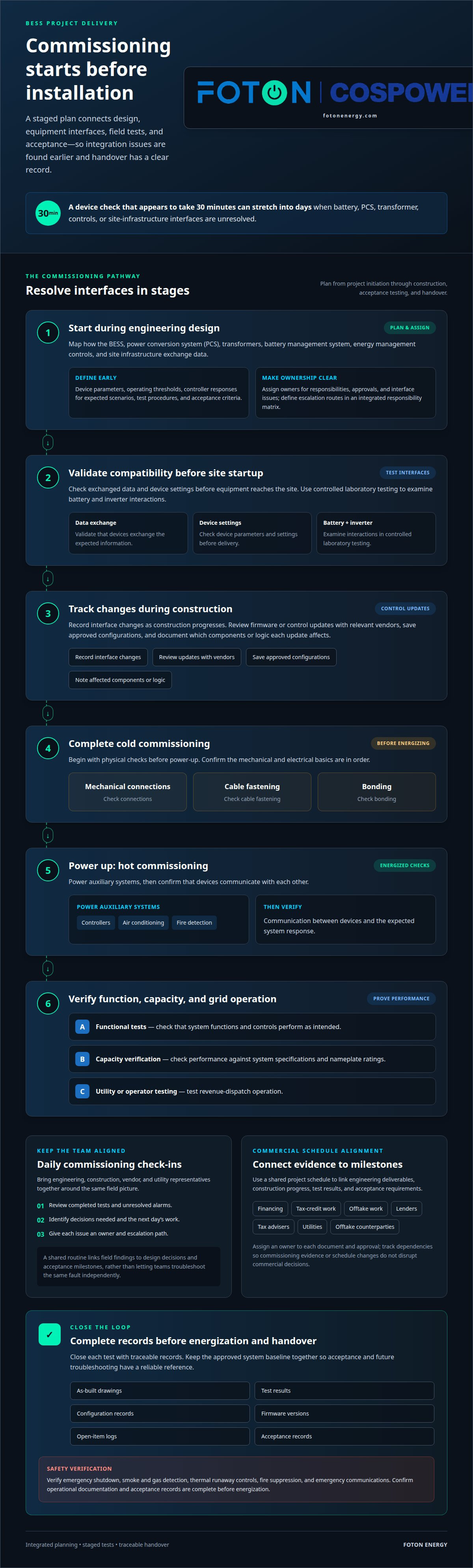
Commissioning delays arise when teams leave system checks until construction ends. Plan commissioning from project initiation through construction, acceptance testing, and handover. A BESS must work across its battery, power conversion system (PCS), transformers, controls, and site infrastructure. If those interfaces remain unresolved, a device verification that appears to take 30 minutes can stretch into days of troubleshooting.
Financing, tax-credit, and offtake work also need defined milestones and clear supporting records. Build a shared project schedule that links engineering deliverables, construction progress, test results, and acceptance requirements. Assign an owner to each document and approval, then track dependencies with lenders, tax advisers, utilities, and offtake counterparties. This coordination helps prevent commissioning evidence or schedule changes from disrupting commercial decisions.
Start during engineering design, not after equipment installation. Map how the BESS, PCS, transformers, battery management system, and energy management controls exchange data. Define device parameters, operating thresholds, and controller responses for expected scenarios. Agree on test procedures, acceptance criteria, responsibilities, and escalation routes before construction begins. An integrated responsibility matrix clarifies who resolves each interface issue.
Test compatibility in stages. Validate exchanged data and device settings before equipment reaches the site, then use controlled laboratory testing to examine battery and inverter interactions. During construction, record interface changes and review firmware or control updates with relevant vendors. Save approved configurations and note which components or logic an update affects. This sequence can reveal integration problems before field startup.
Follow a structured progression from cold commissioning to hot commissioning, functional tests, capacity verification, and utility or operator revenue-dispatch testing. Cold checks cover mechanical connections, cable fastening, and bonding. Hot commissioning powers auxiliary systems, including controllers, air conditioning, and fire detection, then tests communication between devices. Capacity verification checks performance against system specifications and nameplate ratings.
Daily commissioning check-ins give engineering, construction, vendor, and utility representatives a shared view of blockers. Review completed tests, unresolved alarms, decisions needed, and the next day’s work. Assign each issue an owner and escalation path instead of having separate teams troubleshoot the same fault independently. This routine connects field findings to design decisions and acceptance milestones.
Close each test with traceable records. Keep as-built drawings, test results, configuration records, firmware versions, and open-item logs together. Verify emergency shutdown, smoke and gas detection, thermal runaway controls, fire suppression, and emergency communications. Before energization, confirm that operational documentation and acceptance records are complete. These steps support safe handover and give maintenance teams a reliable baseline for future troubleshooting.
2. What are the most common BESS installation mistakes?
Common causes of BESS project delays include misaligned permits, unresolved grid connection design, unsuitable sites, and late technical decisions. These gaps can trigger redesign, repeat testing, or construction changes after teams have committed resources.
For a broad US planning benchmark, solar and storage projects usually take 1-2 years from development to interconnection. A utility-scale project’s overall schedule also includes construction, so site conditions, permitting steps, utility requirements, and delivery sequencing shape the time to completion.
Screen each candidate site before committing engineering or permitting resources. Overlay zoning codes, access routes, environmental exclusions, and required setbacks on the parcel plan. Check for protected habitats and floodplains, then assess whether the battery containers and medium-voltage equipment fit the available land. A site selected using solar-only criteria may not suit energy storage infrastructure.
Engage local authorities early with a clear project description and preliminary site layout. Identify applicable planning, fire-safety, and electrical reviews, then map required submissions and decision dependencies. Authorities assess public safety and regulatory compliance, so late changes to equipment placement or access can require revised drawings and further review. Link the permitting schedule to design milestones.
Start utility discussions during site screening, not after the design is fixed. Ask about the interconnection queue, substation capacity, applicable technical studies, and required grid-performance evidence. Early engagement can reveal whether the proposed connection needs design changes. Use realistic grid simulations to identify performance gaps before commissioning, and track utility decisions alongside engineering and construction milestones.
Include insurance input in early design reviews. Discuss the project layout, equipment interfaces, fire-safety approach, construction sequencing, and transport exposure while changes remain practical. This gives the project team a chance to address risk concerns before they become redesign tasks or delay approvals. Include insurance expertise in stakeholder meetings with engineering, construction, finance, and permitting leads.
Coordination needs named owners. Create a shared approvals and dependencies register, assign an accountable lead to each submission, and record decisions from utility and authority meetings. If a site layout changes, for example, the register should identify affected drawings, permit applications, and electrical studies. This keeps stakeholders working from consistent information and helps resolve blockers before they affect construction.
For a utility-scale project, connect early site, technical, and grid decisions with utility-scale storage planning. A coordinated project scope helps teams identify permitting and interconnection dependencies before those decisions become installation obstacles.
3. Pre-installation risk assessments and inspections
A field-based assessment turns site assumptions into engineering inputs before battery storage equipment arrives. Walk the parcel with civil, electrical, environmental, and construction leads. Compare survey information with drainage paths, ground conditions, access constraints, existing utilities, and proposed equipment locations. Record each hazard, its potential schedule effect, and the person responsible for resolving it.
Assess environmental exclusions during the initial site review. Screen for protected habitats and floodplains before committing to detailed design or permitting. A flood-prone area can affect equipment placement, drainage design, access, and construction sequencing. If a constraint emerges, document its boundary and design implications, then assess an alternative layout or parcel before procurement decisions make changes harder.
Connect inspection findings directly to the project schedule. A field review might identify a narrow delivery route, unstable ground, or a drainage crossing near planned foundations. Assign each finding an owner and due date, then show its effect on civil design, equipment access, or commissioning readiness. This gives stakeholders a shared record rather than separate assumptions.
In the United States, BESS project delays can mean lost revenue and continuing debt-service, contractual, and operating costs when damage delays commissioning or grid connection. The exposure depends on the project’s commercial arrangements, delay duration, and the work needed to restore affected equipment. Schedule contingency should reflect identified risks, including weather-related installation windows, site access, and unresolved field conditions.
Turn the risk register into practical contingencies. Identify which activities can proceed if another task is blocked, which equipment or approvals sit on the critical path, and what decisions would trigger a schedule reset. For example, document an alternate access plan if a route becomes unusable, and agree on a recovery sequence if field conditions require revised foundation work. Review these scenarios with construction and commissioning leads before mobilization.
EPC contract terms can reduce ambiguity by defining schedule milestones, reporting duties, responsibility for specific interfaces, and procedures for managing changes. Set out how schedule contingencies are handled and how liquidated damages relate to defined delay events. Align contract language with the risk register, project schedule, and acceptance milestones so teams understand their obligations when a critical activity slips.
Use each inspection as a decision gate. Before construction release, close critical findings or document the design response, accountable owner, and schedule impact. Before commissioning, confirm that site access, foundations, drainage, and electrical interfaces match current drawings. This evidence provides a traceable basis for managing risk and keeps field conditions connected to regulatory, construction, and acceptance planning.
4. Site preparation, foundations, drainage, and access
Treat site readiness as a construction milestone, not a final delivery-day check. Confirm battery-container, medium-voltage station, and access-road layouts before detailed engineering locks them in. Then coordinate grading, foundation work, drainage, and utility corridors with the equipment plan. A layout that ignores crane positions or turning space can force crews to revise access arrangements after deliveries are scheduled.
Foundations must be level and stable, support equipment loads, and preserve required ventilation clearances. Tie foundation design to geotechnical findings and container placement, then inspect completed pads before shipment release. Plan drainage to direct water away from equipment areas and access routes. For example, a low point beside a laydown area can obstruct unloading after heavy rain. These checks provide a dependable basis for the next construction activities.
Order batteries, inverters, transformers, and other long-lead equipment once the design basis is stable and procurement approvals are in place. Work backward from the construction sequence when setting order dates, allowing for manufacturing, transport, site readiness, and technical reviews. This is a practical part of how to avoid BESS project delays: coordinate equipment arrival with the work needed to receive and install it.
Plan transport as part of the construction schedule. Battery, inverter, and transformer shipments can travel thousands of kilometers before installation, so evaluate routes before dispatch. Confirm bridge restrictions, road geometry, site entry, and any oversize route requirements. Coordinate specialized trailers, loading and offloading equipment, rigging crews, and delivery windows with the teams responsible for site access.
Before pickup, align load plans, rigging strategies, and contingency routes with the shipment schedule. Check that the laydown area is cleared and graded, and that cranes or rigging crews are available when the truck arrives. If equipment arrives before these conditions are met, trucks may wait or teams may need temporary storage. Limited shipment visibility can also disrupt installation crews and related infrastructure work.
Remote-site logistics need clear communication when conditions change. Set a process for shipment updates, route disruptions, and revised arrival times, then share changes with construction leads and site personnel. A route closure, for example, should trigger a review of the contingency route, unloading plan, and crew schedule. To avoid BESS project delays, link each delivery milestone to site readiness and grid-connection activities instead of treating logistics as a separate workstream.
Connect procurement, transport, and site preparation through one integrated timeline. Track each critical delivery against foundation acceptance, access completion, drainage readiness, and installation crew availability. Stage hard-to-replace spare parts onsite where appropriate, since waiting for critical replacements can create extended delays. This coordinated plan helps renewable energy infrastructure teams manage interdependent timelines and move equipment toward installation and grid connection.
5. Battery supplier, container, and control-system choices
Battery selection alone rarely determines a project schedule. Delays can arise when the battery, inverter, container, and controls are chosen without resolving how they integrate. Before procurement, create an interface schedule showing equipment responsibilities, data exchanges, installation requirements, and required documentation. This gives engineering and construction teams a shared basis for coordinating supplier deliverables.
Assess suppliers against the project’s technical scope and delivery sequence. Compare proposed battery and inverter controls, equipment interfaces, documentation, and compatibility evidence. IEC 62619 is an established international standard relevant to energy storage system safety and performance. Consider applicable standards during design, and make required documentation part of the procurement package rather than a late-stage request.
Container decisions affect more than equipment placement. Confirm that the selected layout works with site access, foundations, electrical connections, ventilation clearances, and maintenance access. Thermal management should account for peak-load conditions and ambient temperature variations, not only normal operation. If container configuration and site design develop separately, teams may need to revise layouts or supporting infrastructure before installation.
Align control systems early. Foton provides an AI-driven Energy Management System for real-time monitoring and optimisation. Define how system components exchange data, which parameters and thresholds they use, and how the controller responds to different operating scenarios. Test those interfaces before shipment where practical, so field teams are less likely to discover communication gaps during startup.
Build a compatibility matrix for the battery, power conversion system, energy management system, and transformers. Record each interface, its responsible party, the required configuration, and the evidence needed for acceptance. For example, a mismatch between expected data fields and controller inputs can prevent a device from responding correctly. Assign an owner to resolve each mismatch so troubleshooting does not become an untracked handoff.
Make firmware and configuration control part of the equipment plan. Review proposed updates with vendors before commissioning, save approved settings, and identify affected components or control logic. Keep the revision history alongside wiring diagrams and system documentation. This helps teams distinguish a configuration change from an equipment fault and provides a consistent reference during testing and operational handover.
Close supplier and control-system decisions with staged integration tests. Validate components first, then subsystems, then the complete battery energy storage system against agreed acceptance criteria. Include thermal-management performance under varied load conditions and communication checks across devices. Include fire safety in the design process and consider applicable safety requirements. Discuss battery and control-system alignment as part of your project planning.
Foton Energy (Foton Pty Ltd): C&I BESS
Foton Energy (Foton Pty Ltd) offers C&I BESS for commercial and industrial energy storage projects. Consider this offering when assessing how a battery system fits your site, operating requirements, and project plan. Foton Energy also offers Residential Storage Systems, Utility-Scale Storage, and Data Centre & Telco Backup for different storage applications.
Bring the project’s intended use, site constraints, equipment interfaces, and operational objectives into early planning. These inputs help frame system selection and connect technical decisions to construction and commissioning requirements. If your team is assessing a commercial or industrial BESS, contact Foton Energy to discuss the project.
Build the Next Project Decision Into the Plan
A BESS schedule is shaped by decisions connecting commercial objectives with technical design and delivery. Turn those priorities into a coordinated project basis: define the intended application, identify key interfaces, and align decision-makers around the milestones that govern progress.
A practical framework for how to avoid BESS project delays is to make dependencies visible early, assign clear ownership, and connect design, procurement, construction, and commissioning in one plan. Revisit assumptions as the project develops and scope or site conditions change, so teams can respond before changes affect later work.
Foton Energy (Foton Pty Ltd) offers C&I BESS, Residential Storage Systems, and Utility-Scale Storage for different project applications. If you’re considering storage for a commercial, residential, or utility-scale project, contact Foton Energy to discuss your project. A clear starting point can help your team move forward with greater alignment and purpose.
Frequently Asked Questions
How can developers minimize delays linked to permitting and interconnection processes?
Developers can reduce process friction by submitting coordinated, complete project information and tracking review dependencies. Prepare one version-controlled package covering the site layout, electrical design basis, equipment details, and expected operating modes. Assign a lead to manage questions from authorities and the utility, then record decisions and revisions centrally. If a design change affects permit documents and interconnection studies, update both workstreams together to avoid conflicting submissions.
How can poor commissioning procedures ruin a BESS project?
Poor commissioning can leave faults undiscovered until the system is expected to operate, leading to retesting and delayed acceptance. For example, a controller may receive incorrect battery status data and fail to respond as intended during a test. Set clear pass criteria for each test, record exceptions, and require closure evidence before moving to the next stage. This makes failures easier to isolate and gives the owner a usable operational baseline.
How can storage providers, developers/owners, and their engineers work collaboratively for the best outcome?
Give each party a defined decision-making role and access to current project information. The owner can set operating priorities, the developer can coordinate scope and schedule, engineers can manage design interfaces, and the storage provider can supply equipment and technical documentation. Use a decision log to capture assumptions, approvals, and open issues. For example, agree who approves a control-setting change before it affects equipment configuration or acceptance testing.
What are the best practices to keep construction timelines on schedule?
Tie the construction schedule to prerequisites, not just target dates. For each work package, identify required drawings, access, materials, permits, and predecessor tasks, then review constraints with field leads in regular look-ahead meetings. If electrical crews need an approved cable route before installation, track that design decision as a prerequisite. Escalate blocked work promptly and resequence independent tasks without compromising safety or inspection requirements.
What are the most common BESS installation mistakes?
Common mistakes include treating battery containers as standalone equipment, overlooking balance-of-plant interfaces, and finalising layouts before checking access and electrical routing. A container position may appear workable on a drawing but obstruct installation or future servicing. Review the complete site arrangement with civil, electrical, and equipment teams. Resolve how the battery, inverter, transformer, controls, and supporting infrastructure connect before field installation begins.
What permits and environmental reviews are required for BESS projects, and how long do they take?
Permit and environmental review requirements depend on the jurisdiction, site, design, and project scope. Planning or zoning, building, electrical, fire-safety, and environmental reviews may apply, alongside utility interconnection reviews. Timelines depend on application completeness, review capacity, site-specific studies, and whether authorities request revisions. Build a project-specific approvals register early, identify dependencies between reviews, and track each submission, response, and design change.
How can developers speed up utility interconnection studies and grid upgrades for BESS projects?
Developers can make study reviews more efficient by submitting consistent technical data and responding promptly to utility questions. Keep the proposed point of connection, equipment parameters, operating modes, and project drawings aligned across submissions. Name one coordinator to manage utility requests and route technical questions to the responsible engineer. Grid upgrades still depend on study findings, system constraints, and utility processes, so distinguish faster information exchange from the time required for physical work.
How can BESS developers reduce supply-chain, shipping, and equipment commissioning delays?
Connect procurement milestones to design decisions, transport planning, and site readiness. Track each critical shipment from dispatch to arrival, and coordinate delivery windows with unloading resources and installation crews. For equipment interfaces, agree on data formats and control responsibilities before components arrive. Missing parts or incompatible settings can interrupt commissioning, so maintain a clear record of required components, configuration versions, outstanding technical questions, and the owners responsible for resolving them.


