

Sodium-ion is moving toward commercialization, but it is not a universal replacement for lithium-ion. The practical question is whether sodium-ion is ready for utility-scale projects, where performance, operating conditions and project requirements all need to align.
Lithium-ion already has an established role in energy storage, so it is reasonable to ask what a newer chemistry can offer and where it still involves trade-offs. This comparison explains how sodium-ion and lithium-ion differ, and what those differences mean for large-scale renewable energy and stationary storage.
We’ll examine the technologies’ core characteristics, their potential fit for grid applications and the factors that shape readiness beyond battery chemistry. This gives a clearer basis for understanding where sodium-ion may complement lithium-ion, and where lithium-ion remains the more established choice.
Key Takeaways
- Assess sodium-ion readiness against project requirements, not chemistry headlines alone; manufacturing scale and supply-chain maturity matter alongside battery performance.
- Compare energy density, operating conditions, charging and discharge needs to identify where each chemistry may fit.
- Consider sodium-ion’s potential for grid storage applications where compact energy density is less critical.
- Production forecasts point to possible market growth, but projected capacity is not the same as established deployment at scale.
- Connect battery selection to the renewable energy application and storage duty the system needs to serve.
Are sodium-ion batteries finally ready to compete with lithium?
Sodium-ion is nearing commercialization, but manufacturing scale and supply-chain maturity still shape its competitiveness. Sodium-ion batteries using flammable organic electrolytes carry fire risks similar to lithium-ion batteries. During thermal runaway, their electrolyte can emit flammable gases.
Manufacturing Costs and Supply-Chain Maturity
Manufacturing costs and supply-chain maturity show how efficiently factories can produce cells and source materials at scale. They matter because a promising chemistry must also support dependable procurement and repeatable production for utility projects.
Three Gorges Corporation started a GWh-scale sodium-ion production line in Fuyang, Anhui province, in late 2022. That step shows industrial production activity, but a production line alone doesn’t establish broad supplier depth or consistent project delivery. For buyers, supply-chain readiness depends on whether cell production, components, quality control and system integration can align at the required scale.
Raw-Material Abundance and Battery Costs
Sodium-ion cells use sodium as their charge carrier, drawing on a widely available raw material. Sodium is over 1,000 times more abundant than lithium, while identified global soda-ash resources are estimated at approximately 47 billion tons. This abundance may ease pressure on raw-material supply, but it doesn’t by itself determine a battery system’s final cost.
Cost depends on more than the price or availability of a single material. Cell manufacturing, processing, production volume, system components and integration all affect the delivered cost. Lithium-ion has a mature industrial base, while sodium-ion’s potential materials advantage must translate into reliable, scaled production before its cost position becomes consistent. For utility-scale projects, compare complete systems against operating needs, not isolated raw-material costs.
Recycling is another part of the cost picture. End-of-life value depends on the chemistry, recoverable materials, collection and processing requirements. Sodium-ion’s different material mix may change what recycling processes recover, but available data is insufficient to definitively compare the environmental sustainability of sodium-ion and lithium-ion batteries. This uncertainty makes lifecycle assessment important when weighing material abundance against long-term resource recovery.
So, is sodium-ion ready for utility-scale deployment? Commercialization is progressing and industrial production is underway, but competitiveness depends on supply-chain depth, manufacturing scale and project-specific economics. Sodium’s abundance is a strategic advantage, but it does not by itself prove that sodium-ion batteries will cost less or outperform established lithium-ion systems.
Sodium-ion and lithium-ion battery performance comparisons
Battery performance depends on chemistry, temperature and the electricity a project needs to store and deliver. Comparing energy density, discharge and operating range shows where sodium-ion and lithium-ion differ.
Chemistry and Battery Components
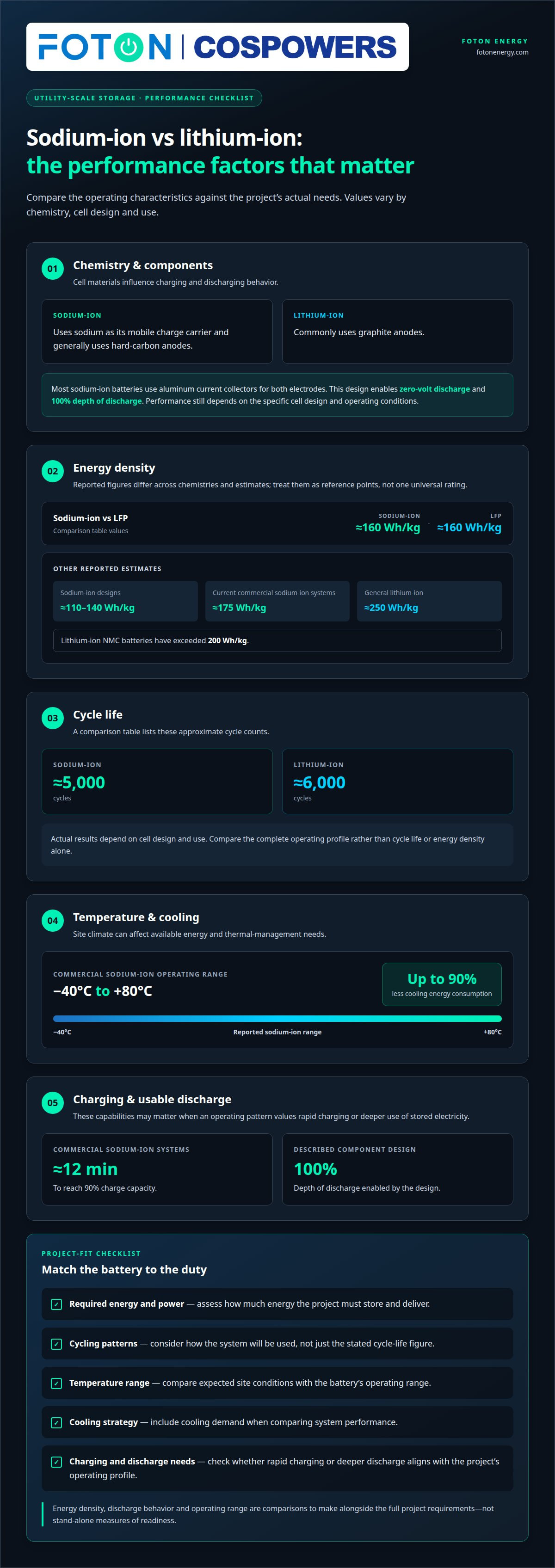
Chemistry describes the materials that move and store charge, so it is central to cell performance. Sodium-ion batteries use sodium as the mobile charge carrier and generally use hard-carbon anodes. Lithium-ion batteries commonly use graphite anodes.
Most sodium-ion batteries use aluminum current collectors for both electrodes. This design enables zero-volt discharge and 100% depth of discharge. Those component choices affect how a battery handles charging and discharging, but performance still depends on the specific cell design and operating conditions.
Performance Compared with Lithium Iron Phosphate
Energy density indicates how much energy a battery stores relative to its weight, which matters when space or mass is constrained. A comparison table puts sodium-ion at approximately 160 watt-hours per kilogram and lithium iron phosphate (LFP) at around 160 Wh/kg.
Other estimates vary across sodium-ion designs: reported figures include roughly 110-140 Wh/kg and approximately 175 Wh/kg for current commercial systems. General lithium-ion energy density is listed at approximately 250 watt-hours per kilogram, while lithium-ion NMC batteries have exceeded 200 Wh/kg. These figures describe different chemistries and estimates, not a single universal rating.
Cycle life is another useful comparison. One table lists sodium-ion at approximately 5,000 cycles and lithium-ion at approximately 6,000 cycles. Actual results depend on cell design and use, so project comparisons should consider the complete operating profile rather than energy density alone.
Performance in Hot and Cold Climates
Temperature performance describes how a battery operates in hot and cold conditions. It matters because climate can affect the energy available to a system and its thermal-management needs.
Commercial sodium-ion systems are described as operating from -40°C to +80°C. Sodium-ion batteries can also reduce cooling energy consumption by up to 90%, according to the cited comparison. These figures make temperature range and cooling demand relevant when assessing sites exposed to challenging climates.
Charging speed and usable discharge also shape performance. Current commercial sodium-ion systems can reach 90% charge capacity in approximately 12 minutes, while the described component design permits 100% depth of discharge. These capabilities may suit operating patterns that value rapid charging or deeper use of stored electricity.
For a utility project, compare required energy and power, cycling patterns, temperature range and cooling strategy. A high-density lithium-ion option may better suit a space-constrained installation, while sodium-ion’s operating range or discharge characteristics may matter more in other settings. Base the comparison on the project’s actual duty cycle, not the chemistry label alone.
What Makes Sodium-Ion Batteries Attractive for Grid Storage?
Sodium-ion can support long-duration storage and grid ancillary services when system design matches the required discharge duration, response and energy. In the United States, available manufacturing capacity depends on cell production, cathode materials, components and system assembly.
Production Capacity and Market Growth
Production capacity measures how much sodium-ion battery manufacturing can supply, while market growth signals potential demand. Both matter because forecasts point to an evolving industry, not guaranteed availability for a project.
Benchmark Mineral Intelligence projects global sodium-ion production rising from 70 GWh to approximately 400 GWh by 2030. The International Energy Agency forecasts production capacity of 590 gigawatt-hours by 2030. These projections differ, so they should be read as separate estimates, not combined into one expected output figure.
For utility procurement, forecast capacity matters when it translates into available cells, components and delivery schedules. A larger production base could support more supplier options and production learning. Project economics also depend on factory utilization, cathode supply and the ability to scale system integration alongside cell output.
Market Share and Competitiveness
Market-share forecasts estimate sodium-ion’s portion of deployed storage, helping readers distinguish emerging adoption from a full replacement for lithium-ion. Morgan Stanley Research estimated sodium-ion would reach 2% of deployed energy storage in 2027, 20% in 2030 and 37% in 2035.
These projections suggest adoption could expand, but they remain forecasts. Sodium-ion is more likely to compete first in applications where its characteristics align with project needs. Lithium-ion’s established deployment base remains a major competitive factor, and sodium-ion’s future share will depend on production scale, performance and the cost of complete systems.
The global sodium-ion battery market was valued at USD 1,732.40 million in 2025 and is projected to reach USD 7,530.44 million by 2033, with a projected CAGR of 20.43% over the forecast period. Market expansion indicates rising commercial interest, but market value does not directly measure installed utility capacity or prove that sodium-ion will replace lithium-ion across applications.
Grid Services and Long-Duration Storage
Grid services are functions batteries provide to support reliable electricity supply, while long-duration storage shifts energy across extended periods of demand. This distinction matters because project value depends on both how much energy is stored and how quickly the system can respond.
Sodium-ion batteries may suit large-scale storage where high energy density is less critical. A system can also provide ancillary services when its controls, power-conversion equipment and operating strategy meet grid response requirements. Chemistry alone does not establish suitability. Duration, dispatch pattern and site integration all shape the application.
For United States projects, distinguish domestic cell manufacturing from cathode production, component sourcing and final system assembly. These are separate supply-chain stages, and strength in one does not establish capacity across the others. Buyers can assess sodium-ion’s practical competitiveness by matching forecast production to the system’s required duration, services and delivery plan.
Renewable energy and stationary storage applications
Sodium-ion’s utility-scale fit depends on how its energy density, cycle life and project design serve the grid. Renewable integration and energy arbitrage offer practical ways to assess that fit.
Energy Density and Cycle Life
Energy density measures stored energy relative to battery size or weight, while cycle life reflects repeated charging and discharging. Both matter because they influence site layout and how a system serves renewable generation over time.
For a solar project, storage can hold surplus daytime electricity for later dispatch. Lower energy density may require more space for a given storage capacity, making land and layout important design considerations. Cycle performance matters when the system is regularly charged and discharged to manage generation variability. Assess these trade-offs against the project’s duty profile rather than treating them as chemistry-wide guarantees.
Grid-Scale Projects
Grid-scale projects show how sodium-ion is moving from development toward large installations, giving project teams practical examples to examine.
A sodium-ion battery energy storage project in Tongliao Naimanqi, China, is described as having 500 MW / 2 GWh capacity and coming online in November 2025. The Anhui Conch Cement Tongliao Naimanqi Energy Storage Project is also described as a 2 GWh sodium-ion project. A separate Chinese hybrid sodium-ion and lithium-ion facility has 200 MW / 400 MWh capacity. These examples show deployment at substantial scale, while differing project designs illustrate that installations aren’t interchangeable.
Commercial and Technical Deployment Risks
Deployment risks are the commercial and engineering factors that can affect reliable project delivery and operation. They matter because a large installation must perform as an integrated system, not simply as a set of battery cells.
Commercial exposure includes whether manufacturing and supply can meet a project’s procurement schedule as the market expands. Technical assessment must account for energy density, cycling demands, thermal management and system controls. Safety is also part of project design: sodium-ion batteries using flammable organic electrolytes can carry fire risks similar to lithium-ion batteries. Each factor affects site planning, system integration and operating strategy.
Renewable energy integration links storage to the timing and variability of generation. Renewable sources accounted for 92.5% of global new power capacity added in 2024, increasing the relevance of systems that can shift electricity to when it is needed. Sodium-ion may suit applications where footprint constraints are manageable and the operating profile aligns with its characteristics.
Wholesale energy arbitrage offers another use: a storage system charges when electricity prices are lower and discharges when prices are higher. This strategy depends on market conditions, system efficiency and dispatch flexibility, not battery chemistry alone. BloombergNEF expects global stationary storage capacity to grow 12-fold over the next 10 years, underscoring why project developers assess both grid services and market-based applications. For each project, match charging windows, discharge timing and renewable output to the intended operating strategy.
Sodium-ion and lithium-ion technology comparison
Sodium-ion, lithium-ion, flow batteries and pumped hydro store electricity through different system designs. Their suitability for utility-scale projects depends on deployment needs, site conditions and the required balance of power and stored energy.
Lithium-ion is the established benchmark for many grid projects. It accounts for 95% of energy storage systems with discharge durations of two to eight hours, according to an energy storage industry executive. Sodium-ion uses a different charge carrier and may suit stationary applications where energy density is less decisive. Its role is therefore more likely to complement lithium-ion than replace it across every use case.
Compared with lithium-ion, sodium-ion’s potential advantages include its abundant raw materials and broad operating-temperature range. Commercial sodium-ion systems are described as operating from -40°C to +80°C. That range may be relevant for sites facing extreme temperatures, although the full system’s thermal controls and operating design remain important. Lithium-ion, meanwhile, benefits from a more established deployment base and wider market experience.
Flow batteries store energy in liquid electrolytes held in external tanks, separating energy capacity from the power-producing cell stack. This architecture can suit stationary installations where a project values flexible energy capacity and has room for tanks and supporting equipment. Sodium-ion and lithium-ion cells store energy within electrochemical cells, offering a different balance of footprint, power and system integration. Site layout and discharge needs help distinguish these options.
Pumped hydro stores energy by moving water between reservoirs at different elevations, then releasing it through turbines. Unlike sodium-ion or lithium-ion batteries, it depends on suitable terrain, water infrastructure and a grid connection. Pumped hydro is a long-established storage approach, but it is not a universal alternative for locations without appropriate geography.
Technology choice also depends on how the asset earns value. A project focused on rapid dispatch, renewable shifting or multiple daily operating periods may prioritize different system characteristics. Sodium-ion’s 100% depth-of-discharge design, described for cells using aluminum current collectors, can be relevant to usable stored energy. Battery management, conversion equipment and operating strategy still shape the complete system’s performance.
For global projects, compare technologies against site constraints, discharge profile, required response and deployment timeline. The strongest fit may combine technologies rather than rely on a single chemistry. Sodium-ion is a developing option; lithium-ion has a larger established role, while flow batteries and pumped hydro offer distinct system architectures. Over the coming decade, manufacturing scale and project experience will influence how these options compete.
Discuss utility-scale storage options in relation to your project’s operating requirements and site conditions.
Foton Energy (Foton Pty Ltd): Utility-Scale Storage
Foton Energy (Foton Pty Ltd) offers Utility-Scale Storage for projects evaluating battery-based grid storage. Its direct-sale options include Tier-1 manufactured lithium iron phosphate and sodium-ion battery modules and containers, giving project teams two chemistries to consider against their operating requirements.
Use this offering when assessing how battery technology, storage needs and project objectives fit together. The comparison in this guide can help frame the decision: consider required discharge patterns, site conditions, system integration and the maturity of the selected chemistry’s supply chain. These factors help clarify whether sodium-ion, lithium-ion or a combination best aligns with the project.
For a discussion of utility-scale storage requirements, contact Foton Energy (Foton Pty Ltd).
Shape the Next Storage Decision
Whether sodium-ion is ready for utility scale depends on how a project’s operating needs align with its technology and procurement strategy. Treat chemistry selection as part of a broader infrastructure plan that can adapt as manufacturing capacity and deployment experience develop.
Foton Energy (Foton Pty Ltd) offers Utility-Scale Storage, C&I BESS and Residential Storage Systems. This range supports storage planning for grid-scale, commercial and industrial, and residential applications. The next step is to connect your project objectives with the system requirements that matter most, including how storage will fit into operations and future energy needs.
Start a focused conversation about your storage priorities and the role different battery chemistries may play. Contact Foton Energy (Foton Pty Ltd) to discuss your project and explore a practical path forward.
Frequently Asked Questions
Will sodium-ion batteries replace lithium-ion chemistries as the dominating technology?
No. Sodium-ion is more likely to expand storage options than to displace lithium-ion across every application. A utility planning storage for a constrained site, for example, may weigh energy density differently from a project prioritizing material availability or particular operating conditions. Whether sodium-ion is ready for utility-scale deployment depends on project requirements and system design, while lithium-ion’s established deployment base remains a competitive factor.
What is the energy density and round-trip efficiency of utility-scale sodium-ion batteries?
Reported sodium-ion energy-density estimates vary by cell design, and round-trip efficiency depends on the complete system, not chemistry alone. For a project comparison, distinguish cell-level energy density from the energy available after conversion equipment, controls and thermal systems operate. Then assess charging and discharging under the intended duty cycle. This gives a more useful view of deliverable energy than treating a single cell figure as system performance.
What is the installed cost per kWh of sodium-ion versus lithium-ion grid storage?
Installed cost per kilowatt-hour depends on the full project configuration, not just the battery cells. A comparison should account for storage capacity, power-conversion equipment, enclosures, controls, site integration and operating profile. A short-duration system and one designed for longer discharge may allocate costs differently across these components. For a fair comparison, assess both chemistries at the same project boundary and against the same operating requirements.
How long do utility-scale sodium-ion batteries last in cycles and years?
A comparison table places sodium-ion batteries at approximately 5,000 cycles, but cycle count alone doesn’t establish service life in years. Calendar life depends on how often the asset cycles and how it is operated. For instance, a system dispatched once per day accumulates cycles differently from one used for occasional grid support. Depth of discharge, temperature and charging strategy also shape degradation over its operating life.
How do sodium-ion batteries perform in cold and hot temperatures?
Commercial sodium-ion systems are designed to operate across a broad temperature range, but site performance also depends on container conditions, thermal management and charging strategy. A cold-climate project should consider how the system is controlled during low-temperature operation; a hot-climate site must account for heat management and operating conditions. Evaluate the battery alongside its enclosure and power-conversion equipment, since the installation must function as an integrated system.
What sodium-ion grid-scale battery projects are operating or under construction in 2026?
The Tongliao Naimanqi sodium-ion BESS, also identified as the Anhui Conch Cement project, was described as a 500 MW/2 GWh project coming online in November 2025. Other projects listed include a 100 MW/200 MWh installation under development and a 200 MW/400 MWh hybrid sodium-ion and lithium-ion facility.


