

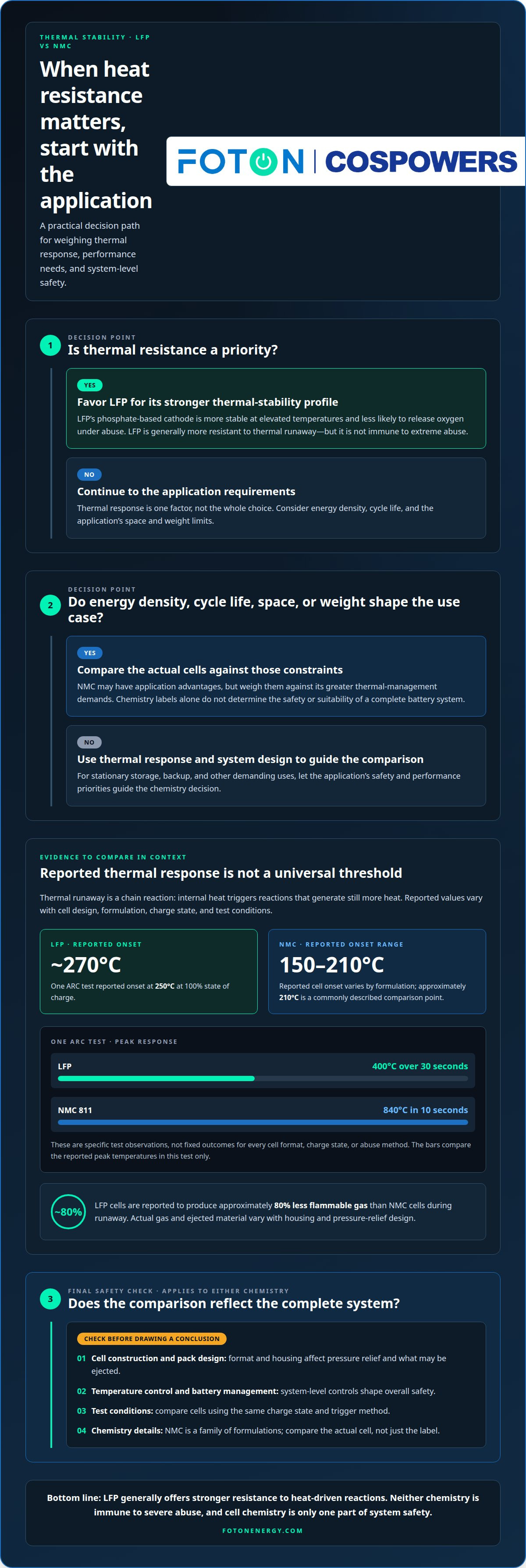
NMC isn't inherently unsafe, but its chemistry is generally more vulnerable to heat than LFP. The thermal stability of LFP vs NMC batteries reflects a key difference in their cathodes: LFP’s phosphate structure is more stable at elevated temperatures and less likely to release oxygen under abuse. Thermal runaway onset is often described as around 270°C for LFP and approximately 210°C for NMC, though values vary with cell design and test conditions.
It’s reasonable to ask whether NMC is unsafe when heat-related failure is a concern. NMC cells are not inherently unsafe: they can be engineered for safe operation, while LFP cells can still enter thermal runaway under extreme abuse. Overall safety also depends on cell construction, pack design, temperature control and battery management.
This comparison explains why phosphate chemistry gives LFP a stronger thermal-stability profile, what the figures do and don’t tell you, and where each chemistry may fit. Energy density, cycle life and application requirements all shape the choice for stationary storage, backup systems and other demanding uses.
Key Takeaways
- LFP’s phosphate-based cathode is more resistant to heat-driven reactions, but no lithium-ion chemistry is immune to severe abuse.
- Thermal runaway temperatures vary with cell design and test conditions, so compare results in context rather than treating them as universal thresholds.
- Choose between LFP and NMC by balancing thermal response, energy density, cycle life and the space and weight limits of the application.
- Cell chemistry is only one part of safety: pack design, thermal management and battery management controls also shape system-level risk.
- Use the application’s safety and performance priorities to guide the chemistry decision for stationary storage, backup or other demanding uses.
Thermal Stability of LFP vs NMC: Which Chemistry Is Safer?
LFP is generally more resistant to thermal runaway than NMC, but neither chemistry is immune. Thermal runaway is a chain reaction: internal heat triggers reactions that generate still more heat.
LFP and NMC Runaway Onset Temperatures
LFP is often described as reaching thermal runaway onset around 270°C, compared with approximately 210°C for NMC. Reported NMC cell onset temperatures span 150°C to 210°C, depending on formulation. One ARC test reported LFP onset at 250°C at 100% state of charge, illustrating why these figures describe tested cells rather than universal thresholds.
These values indicate that LFP generally needs harsher thermal abuse to trigger hazardous reactions. The difference reflects material-level stability, not a guarantee that every LFP cell will outperform every NMC design.
Peak Runaway Temperatures and Time to Peak
Onset temperature marks the beginning of runaway; peak temperature shows how severe the event can become. In one ARC test, an LFP battery reached 400°C over 30 seconds, while an NMC 811 battery reached 840°C in 10 seconds.
Those results show a faster, higher peak for the tested NMC 811 cell. They are specific test observations, not fixed outcomes for all cell formats, charge states, or abuse methods.
Heat and Energy Released During Runaway
There is no single heat or energy value that applies to all LFP and NMC cells. Heat released depends on cell capacity, state of charge, design and trigger method. During runaway, either chemistry can vent flammable gases, electrolyte droplets, hot particles or flames.
LFP cells are reported to produce approximately 80% less flammable gas than NMC cells during runaway. Gas quantity and ejected material still vary with housing and pressure-relief design, so this comparison does not describe every event’s total released energy.
| Option | Reported onset | Tested peak response | Relative thermal profile |
|---|---|---|---|
| LFP | Around 270°C; 250°C in one ARC test at 100% charge | 400°C over 30 seconds in one ARC test | Generally more resistant to runaway |
| NMC | 150°C to 210°C, depending on formulation | NMC 811 reached 840°C in 10 seconds in one ARC test | More reactive at elevated temperatures |
Choose LFP when thermal resistance is a priority. Weigh NMC’s application advantages against its greater thermal-management demands.
Design, Charge State, and Temperature Effects
Cell chemistry is only one factor in runaway risk. Cell format and housing affect pressure relief and the materials ejected, while state of charge and abuse-test method influence measured onset. A 100%-charged LFP cell, for example, had a reported ARC onset of 250°C.
Elevated temperatures can initiate internal reactions, and high-energy NMC designs need careful heat control. Compare cells under the same test conditions, including charge state and trigger method, before applying a temperature result to a battery system.
Iron-phosphate and layered cathode structures
The cathode’s crystal structure helps explain why LFP and NMC respond differently to heat. Comparing lithium iron phosphate with nickel-manganese-cobalt oxides shows how structure and composition shape thermal stability.
Cathode Crystal Structure and Oxygen Release
LFP uses a phosphate-based cathode, while NMC uses a layered oxide cathode. At elevated temperatures and high delithiation, NMC’s layered structure can release reactive lattice oxygen. This can intensify reactions inside a lithium-ion cell, contributing to a more demanding thermal-safety profile.
LFP’s phosphate structure is more stable at elevated temperatures and less likely to release oxygen under abuse conditions. This helps explain why the two chemistries can respond differently to similar thermal stress. It does not mean an LFP cell cannot fail under extreme conditions.
For energy storage systems, cathode chemistry is only part of the safety picture. Oxygen-release behavior helps explain differences between cells, while cell construction and system design also affect how a battery responds to an incident.
LFP Phosphate Cathode Stability
In lithium iron phosphate, the cathode combines lithium, iron, and phosphate. Its phosphate-based structure remains comparatively stable as temperature rises, limiting the tendency to release oxygen during abuse. This material-level characteristic contributes to LFP’s stronger resistance to heat-driven reactions.
NMC combines nickel, manganese and cobalt in a layered oxide cathode. The proportions can vary, so “NMC” describes a family of chemistries rather than one identical material. Its layered structure supports lithium-ion movement, but at high delithiation and elevated temperatures, the oxide can release reactive oxygen-containing species.
This distinction helps when assessing battery chemistry for a specific duty. LFP’s phosphate cathode favors thermal stability; NMC’s layered cathode behaves differently under heat. Neither cathode structure alone determines the safety of a complete battery system.
In practice, compare the actual cell chemistry and design rather than relying on the chemistry label alone. An NMC formulation’s nickel, manganese and cobalt proportions describe its composition, while its cell and pack designs shape how that chemistry is managed. LFP’s phosphate-based cathode offers a more stable foundation at elevated temperatures, but the system still needs suitable safeguards. For residential or utility-scale storage, consider both the cathode and the demands of the application.
Battery chemistry choice by application
Choose a battery chemistry according to the application’s priorities, not a single safety or performance label. Understanding the thermal stability of LFP vs NMC batteries helps frame the decision alongside energy density, cycle life and pack constraints.
For electric vehicles, NMC is selected for premium long-range models where battery-pack space and weight are constrained. Its reported gravimetric energy density is 150 to 220 Wh/kg, compared with 90 to 160 Wh/kg for LFP. That difference can make NMC an advantage when substantial stored energy must fit within a limited pack volume.
LFP offers a different balance for vehicles and stationary storage. It is presented as a preferred option where safety is paramount, including public transportation, and it usually provides a longer cycle life under similar conditions. Reported cycle ranges are 4,000 to 10,000 full charge and discharge cycles for LFP, compared with 1,500 to 3,000 for NMC, before capacity falls below 80% of its original rated value.
For home energy storage, weigh LFP’s thermal profile and cycle-life characteristics against NMC’s higher energy density. The thermal stability of LFP vs NMC batteries is one consideration, alongside available space, expected use and system design. LFP can suit stationary applications where safety priorities matter more than minimizing pack size. NMC may fit where space or weight is a stronger constraint, with appropriate thermal management.
Use these application priorities as a starting point:
- Public transportation: LFP is a preferred option where safety is paramount and longer cycle life supports repeated use.
- Premium long-range electric vehicles: NMC’s higher energy density suits designs with strict pack-space and weight constraints.
- Home and other stationary storage: LFP’s thermal profile and cycle-life characteristics can align with sustained energy storage needs.
- Space-constrained systems: NMC’s higher energy density may offer an advantage where compactness matters.
These are selection considerations, not guarantees of system-level safety or service life. Cell manufacturing quality, pack design, battery management and operating conditions also shape performance. A chemistry label alone cannot describe how a complete system will behave in a particular installation.
To make a practical choice, identify the limiting requirement first: available space, weight, safety priorities, or expected cycling. Then compare cell-level energy density and cycle-life characteristics against that requirement. A compact premium vehicle may prioritize NMC’s energy density, while a stationary system may favor LFP’s thermal resilience and longer cycle life.
LFP vs NMC Battery Safety: Why Is LFP More Thermally Stable?
Thermal stability is one safety factor, alongside energy density, capacity, cycle life and pack design. LFP’s lower energy density can come with a milder thermal response, while NMC’s higher energy density makes system-level heat control especially important.
Energy Density and Failure Severity
Energy density describes how much energy a cell stores relative to its weight or volume. NMC’s higher energy density can support compact electric vehicle packs, but high-energy designs require careful thermal-safety engineering. LFP’s lower energy density can mean a larger or heavier pack for comparable energy capacity.
Energy density alone does not determine the severity of a failure. Cell format, state of charge, housing, pressure relief and the abuse trigger all influence heat release and ejected materials. During severe thermal runaway, either chemistry can vent flammable gases, hot particles, electrolyte droplets or flames.
Fire Risk During Charging, Operation, and Storage
During charging, operation or storage, neither LFP nor NMC is immune to overheating or severe abuse. NMC’s greater reactivity at elevated temperatures makes thermal management especially important. LFP is more resistant to runaway, but events such as overcharge, nail penetration or external heating can still trigger it.
Battery management systems monitor and control cell temperatures to help prevent overheating. Thermal management systems control and dissipate heat, particularly in NMC deployments. For either chemistry, pack design and operating conditions shape system-level fire risk, so chemistry alone is not a complete safety measure.
Thermal Stability Tests and Standards
IEC 62619 and UL 9540 are named safety standards applicable to both LFP and NMC systems. They provide relevant reference points when comparing battery safety, but a standard name alone does not describe a cell’s thermal-runaway onset or peak temperature.
For home battery safety, National Fire Protection Association lithium-ion battery guidance covers broader safety practices. Thermal-stability comparisons also rely on abuse testing, where results depend on cell format, state of charge and test method. Compare results under matching conditions rather than treating one test temperature as universal.
Other factors matter alongside chemistry: manufacturing quality, cell design, pack layout, pressure-relief design, state of charge and battery management controls all influence thermal behavior. A battery management system can monitor cell temperatures, while thermal management removes heat before it accumulates. In NMC systems, robust thermal management is central to safe deployment. LFP’s material stability adds resilience but does not replace system controls.
LFP chemistry and phosphate's role in thermal stability
LFP’s thermal advantage begins with its phosphate-based cathode, not with a system-level safety guarantee. Compared with NMC’s layered oxide chemistry, lithium iron phosphate is more stable at elevated temperatures and less likely to release oxygen under abuse conditions.
How phosphate shapes LFP’s thermal response
In an LFP cell, the cathode combines lithium, iron and phosphate. Its phosphate-based structure is central to its thermal behavior: it remains more stable as temperatures rise than the layered oxide cathodes used in NMC. This helps explain why LFP generally requires harsher thermal abuse to initiate hazardous reactions.
This distinction matters because oxygen-containing species released from a cathode can contribute to reactions inside a cell. NMC cathodes can release reactive lattice oxygen at high delithiation and elevated temperatures. LFP is less likely to release oxygen under abuse, a material-level advantage that informs cell and pack design.
What the chemistry means for applications
For stationary energy storage, LFP can suit applications where thermal stability and long cycle life are priorities. Residential storage and utility-scale systems have different layouts and operating demands, but both rely on cell chemistry working alongside pack design, temperature monitoring and thermal management.
Electric vehicles involve a different balance. NMC’s higher energy density can support designs with strict space and weight constraints, while LFP’s lower energy density may require a larger or heavier pack for comparable stored energy. The decision depends on whether the application prioritizes compactness or thermal resilience.
Composition also distinguishes the two options. LFP avoids cobalt, while NMC cathodes use nickel and cobalt. These material differences contribute to distinct cathode behavior, but chemistry alone does not determine a finished battery’s safety or suitability. Cell construction and system controls remain part of the engineering decision.
A practical selection process starts with the duty profile. Identify space and weight limits, expected cycling and safety priorities. Then assess whether LFP’s phosphate-based thermal stability or NMC’s higher energy density better matches those requirements. A stationary installation, for example, may prioritize thermal resilience, while a weight-constrained electric vehicle may value NMC’s energy density.
The key takeaway is specific: phosphate gives LFP a more thermally stable cathode foundation, not immunity from failure. Use that material advantage as one input alongside cell design and system-level controls. Plan a storage system around your application and its chemistry priorities.
Foton Energy (Foton Pty Ltd)
Foton Energy (Foton Pty Ltd) helps organisations translate battery chemistry considerations into energy storage decisions. When thermal stability, capacity, system design and operating needs must be weighed together, its solutions support project planning across residential, utility-scale, commercial and industrial, and data centre and telecommunications backup applications.
For a stationary storage project, choosing between LFP and NMC is part of a wider system decision. Foton Energy’s Residential Storage Systems and Utility-Scale Storage address those deployment contexts. Data Centre & Telco Backup and C&I BESS serve other operational needs.
Contact Foton Energy (Foton Pty Ltd) to discuss your energy storage requirements.
Turn Chemistry Insight Into a Confident Project Decision
A sound decision about the thermal stability of LFP vs NMC batteries starts by translating chemistry differences into project requirements. Define the system’s operating profile, space constraints, energy needs, and safety priorities. Then consider how cell choice fits with pack design, monitoring, and thermal management. This gives project teams a clear basis for aligning technical decisions with long-term operational goals.
For an energy storage project, connect those requirements with the system’s intended role, whether supporting a facility, a home or utility-scale operations. Foton Energy’s C&I BESS, Residential Storage Systems and Utility-Scale Storage address distinct deployment contexts. A focused discussion can help clarify project priorities without treating chemistry as the only design decision.
Contact Foton Energy (Foton Pty Ltd) to discuss your energy storage project. With a clear view of your requirements, you can move forward with a solution aligned to your application and its performance priorities.
Frequently Asked Questions
Is NMC battery chemistry unsafe?
No. NMC chemistry is not inherently unsafe, but its cells are more reactive at elevated temperatures and require careful thermal-safety engineering. Risk depends on more than cathode chemistry: cell manufacturing quality, pack design, charge state and temperature controls also matter. Under demanding conditions, an NMC system needs effective heat management and battery monitoring as part of its safety architecture.
Application Selection: LFP or NCM/NCA?
Choose LFP when thermal resilience and long cycle life are priorities; consider NMC/NCA when pack weight or space is constrained. NMC/NCA is used in premium long-range electric vehicles, while LFP suits safety-focused applications such as stationary storage and public transportation. Compare the system’s required energy capacity, available space, expected duty cycle and thermal-management design rather than relying on chemistry alone.
What Is Thermal Stability & Thermal-Abuse Tolerance for Lithium Batteries?
Thermal stability describes how well a battery’s materials resist heat-driven reactions. Thermal-abuse tolerance describes how much heating or other severe stress a cell can withstand before hazardous reactions begin. In lithium-ion cells, thermal runaway is a chain reaction in which heat triggers internal reactions that generate more heat. Test results depend on cell format, state of charge and abuse-test method.
Why is LFP considered safer than NMC?
LFP is considered more thermally stable because its phosphate-based cathode is less likely to release oxygen under abuse conditions. NMC’s layered oxide cathode can release reactive oxygen-containing species at high delithiation and elevated temperatures. This gives LFP a material-level safety advantage, not immunity from failure. Severe overcharge, nail penetration or external heating can still trigger runaway in LFP cells.
How does the thermal stability of LFP compare with NMC lithium-ion batteries?
LFP generally resists thermal runaway more effectively than NMC, and its thermal response is usually milder under comparable abuse conditions. The chemistry also tends to release less flammable gas during runaway. These properties can inform system selection, but they do not establish the safety of a complete battery. Cell quality, enclosure design, ventilation, temperature control and safeguards influence outcomes in a real installation.
At what temperatures do LFP and NMC batteries enter thermal runaway?
Reported onset temperatures are around 270°C for LFP and approximately 210°C for NMC. NMC cell reports span 150°C to 210°C depending on formulation. These are not universal operating thresholds: state of charge, cell format, and test protocol affect measured results. A temperature from one cell test should not be treated as a guaranteed trigger point for every pack or battery system.
What are the thermal runaway onset temperatures for LFP and NMC cathode materials?
Reported cell-level onset is around 270°C for LFP, while NMC onset ranges from 150°C to 210°C depending on formulation. These figures describe tested battery cells, not an invariant temperature for cathode material alone. Cathode composition, cell construction, state of charge, and abuse-test method all affect results. For meaningful comparisons, interpret onset data alongside the test conditions and the specific cell design.


