

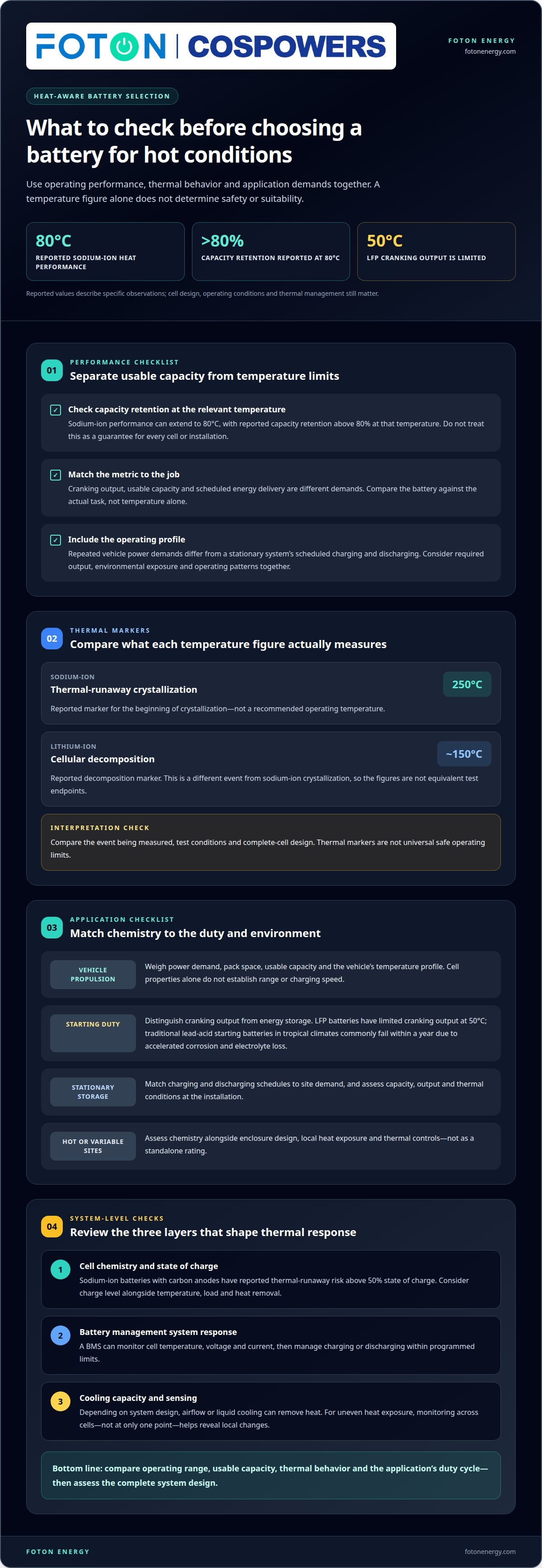
The high temperature performance of sodium-ion batteries can extend to 80°C, with reported capacity retention above 80% at that temperature. That advantage doesn’t mean every sodium-ion battery suits every hot-climate application: operating range, cell design and thermal management all matter. In comparison, LFP batteries have limited cranking output at 50°C, while lead-acid batteries face accelerated corrosion and electrolyte loss in tropical conditions.
When choosing storage for an EV or energy system, look beyond a single temperature rating. Capacity retention, thermal stability and application demands all shape performance in real conditions. This article explains how sodium-ion cells respond to heat and cold, what capacity figures indicate, and how sodium-ion compares with LFP and lead-acid. A high-temperature rating is not a guarantee of safety or suitability: state of charge, cell chemistry and system design also influence performance. Use these factors to compare technologies and identify trade-offs for your operating environment, from vehicle use to stationary storage.
Key Takeaways
- Distinguish a battery’s operating-temperature range from its thermal stability and usable capacity.
- Match sodium-ion, LFP, and lead-acid chemistry to the demands of the application, not temperature alone.
- Assess how cell design, state of charge, and thermal management influence performance in hot conditions.
- Use the comparison and decision guide to identify which battery trade-offs matter most for EVs and energy storage.
Thermal stability of sodium-ion cathode materials
Thermal stability depends on cell chemistry, electrode materials, operating conditions, and system controls. Sodium-ion and lithium-ion cells show different reported thermal events, but neither chemistry removes the need for careful monitoring.
Sodium-Ion and Lithium-Ion Stability
Reported thermal markers distinguish sodium-ion cells from lithium-ion cells, but they describe different events. Sodium-ion thermal-runaway crystallization begins at 250°C, while lithium-ion cellular decomposition triggers around 150°C. These figures indicate material behavior, not a universal safe operating temperature. Cell construction, state of charge, and heat exposure shape how a specific battery responds.
Cathode chemistry matters because heat can change electrode structure and contribute to cell failure. For sodium-ion batteries, the reported 250°C marker concerns thermal-runaway crystallization; it should not be read as a recommended operating limit. The lithium-ion figure describes cellular decomposition, so the two numbers are not identical test endpoints. Compare the event being measured, test conditions, and complete-cell design before drawing conclusions.
| Option | Reported thermal marker | Comparison point |
|---|---|---|
| Sodium-ion | Thermal-runaway crystallization begins at 250°C | Marker relates to crystallization |
| Lithium-ion | Cellular decomposition triggers around 150°C | Marker relates to decomposition |
Compare equivalent test conditions and the cell’s operating profile instead of ranking temperature figures on their own.
Cooling and Thermal Runaway Risks
Cooling and control systems manage heat; they don’t change the chemistry’s underlying thermal markers. Sodium-ion batteries with carbon anodes have reported thermal-runaway risk above 50% state of charge. That condition makes charge level relevant to thermal risk assessment, alongside cell temperature, load, and heat removal. Fire risk therefore depends on system design and operating conditions, not chemistry name alone.
A battery management system (BMS) can monitor cell temperature, voltage and current, then manage charging or discharging within programmed limits. Depending on system design, thermal controls may use airflow or liquid cooling to remove heat. For example, a storage installation exposed to uneven heat needs monitoring across its cells, not just at one point in the enclosure. Consistent temperature measurements help the BMS respond to local changes.
For a practical review, assess three linked layers: cell chemistry, BMS response, and cooling capacity. Confirm that temperature sensing and control strategies suit the site’s heat exposure and operating cycle. Battery safety certifications can be a useful reference when assessing an installation. These standards add a useful safety reference, while system-level thermal management remains essential for sodium-ion and lithium-ion installations.
Applications in electric vehicles and energy storage
Battery choice depends on the application: vehicle propulsion, backup power or stationary storage. Electric vehicles need cells that support repeated power demands while fitting the vehicle’s mass, space and thermal-control design. Stationary systems may prioritize dependable energy delivery and integration with site loads. Sodium-ion chemistry can serve different roles, but suitability depends on cell-level performance and the operating profile.
For EVs, sodium-ion cells may be relevant when power delivery and temperature range matter. Sodium ions have a smaller Stokes radius and lower solvation energy than lithium ions, properties described as favorable for high-power output and low-temperature operation. These properties alone do not establish range, charging speed or suitability for a particular vehicle. Pack design, cell capacity, power demand and thermal controls remain key decision factors.
In energy storage, stationary installations can be designed around predictable charging and discharging schedules. A facility managing daytime demand, for example, can assess how the battery’s capacity and output align with its load profile. Sodium is approximately 1,000 times more abundant than lithium in Earth’s crust, a resource distinction relevant to long-term supply considerations. Abundance alone doesn’t determine system performance or project suitability.
Heat exposure also changes the comparison. LFP batteries have limited cranking output at 50°C, a consideration for applications requiring engine-starting power in hot conditions. Traditional lead-acid starting batteries in tropical climates commonly fail within a year because of accelerated corrosion and electrolyte loss. These observations concern specific functions and conditions; they don’t establish that one chemistry is best for every EV or storage system.
Use the application’s operating requirements to narrow the options:
- Vehicle propulsion: weigh power demand, pack space, usable capacity, and the temperature profile.
- Starting duty: consider the difference between cranking output and energy storage, especially in hot climates.
- Stationary storage: match charging and discharge schedules to site demand and thermal conditions.
- Hot or variable environments: assess chemistry alongside enclosure design and thermal controls.
A fleet vehicle and a stationary backup system, for example, may face the same hot weather but operate on different duty cycles. Repeated acceleration in a vehicle differs from scheduled energy delivery by a storage unit. Compare required output, environmental exposure and operating patterns before choosing a chemistry. This application-first approach helps distinguish cell properties from the performance of a complete battery system.
Capacity retention across a wide temperature range
Temperature affects how much stored energy a battery can deliver. Sodium-ion capacity figures span a broad reported range, but test conditions and cell design matter. One account discusses performance from -40°C to 80°C, while another lists an operating range of −20°C to 60°C. These ranges aren’t interchangeable: a temperature included in a performance discussion doesn’t automatically define a recommended operating limit.
At the cold end, sodium-ion batteries are reported to retain over 70% capacity at -40°C. Optimized sodium-ion cells are also reported to retain more than 85% capacity from -30°C to 60°C. These figures describe different temperature spans and shouldn’t be combined as one universal performance guarantee. They do indicate why the specific cell’s test conditions matter when evaluating a project with winter exposure.
A 2025 review reports better capacity retention and cycling stability for sodium-ion batteries than LFP below -20°C. That comparison is useful for cold-weather screening, but it doesn’t establish that every sodium-ion cell will outperform every LFP cell. Cell design, discharge rate, and thermal conditioning affect the usable energy available at a given temperature. Compare like-for-like test results before applying a chemistry-level conclusion to an actual system.
| Reported condition | Sodium-ion capacity detail | How to interpret it |
|---|---|---|
| -40°C | Over 70% capacity retained | Cold-end performance result |
| -30°C to 60°C | More than 85% capacity retained in optimized cells | Applies to optimized cells across the stated span |
| −20°C to 60°C | Listed operating range | Operating range, distinct from wider performance discussion |
For a practical comparison, ask three questions: what temperatures will the system experience, how much capacity remains at those temperatures, and does the result apply to the selected cell? For a site exposed to winter lows, focus on cold-temperature capacity results and their test conditions. A system facing both cold starts and warm operation needs evidence across the full expected temperature profile, not just a single peak figure.
Capacity retention needs context. It describes the capacity remaining under stated conditions, not necessarily the energy a complete installation can deliver after conversion losses, controls and operating limits. A battery management system may restrict charging or discharging as temperatures change, affecting available output even when the cell retains capacity. Include the operating window, test temperature and system-level limits when comparing sodium-ion and LFP.
Use the reported figures as screening points, then align them with the actual duty cycle. For cold-climate storage, prioritize verified low-temperature capacity and cycling results. For installations spanning -30°C to 60°C, check that the cell’s reported performance covers that range. This keeps laboratory capacity figures connected to the operating conditions the battery must serve.
High-temperature performance
Reported results indicate that sodium-ion cells can operate under high-temperature test conditions, but temperature ratings need careful interpretation. The high temperature performance of sodium-ion batteries depends on cell chemistry, electrolyte, state of charge and system controls.
Chemistries and Electrolytes
No single sodium-ion cathode chemistry or electrolyte is established as best for heat. NFM111 layered oxide and hard carbon appear in reported electrode tests, but those tests don’t rank complete cells at high temperatures. The cathode, anode, and electrolyte function together, so compare full-cell results under matching test conditions. Material names alone don’t establish a preferred chemistry for every application.
Reported sodium-ion batteries can maintain stable performance up to 80°C and retain over 80% of their capacity at 80°C. These are reported results, not universal limits for all sodium-ion designs. A listed operating range is −20°C to 60°C, which differs from the broader high-temperature performance result. Keep operating limits distinct from test outcomes when evaluating a cell for a specific duty.
Test Standards and Operating Limits
For United States projects, UL 1973 and IEC 62619 are battery safety certifications to look for. These certifications are safety references, not universal operating-temperature limits. The applicable temperature window comes from the specific battery system’s operating conditions. Review temperature performance and safety certification as separate parts of a technical assessment.
How should a reported high-temperature result guide operation? Treat 80°C as a performance test condition, not a default system setpoint. The listed range of −20°C to 60°C provides a distinct operating reference. Carbon-anode sodium-ion batteries also have reported thermal-runaway risk above 50% state of charge. Assessing the high temperature performance of sodium-ion batteries therefore means considering temperature and charge level together.
Capacity, Efficiency, and Cycle Life
Capacity, efficiency, and cycle life describe different outcomes. Retaining over 80% capacity at 80°C doesn’t establish charging efficiency or durability over repeated cycles. Elevated temperature can affect electrochemical reactions, while heat removal consumes system energy. Charging and discharging rates depend on cell limits and thermal management, so heat alone doesn’t establish a safe rate or improved output.
For a project review, compare test conditions with the intended duty cycle. Distinguish capacity measured at temperature from efficiency across a full charge-discharge cycle and from capacity change after repeated cycling. Include the system’s thermal controls and operating window in the assessment. This makes the high temperature performance of sodium-ion batteries more useful when evaluating applications, without treating one test result as a complete measure of long-term performance.
How does high temperature affect sodium-ion battery capacity, efficiency, and cycle life?
Heat affects three distinct outcomes in a sodium-ion cell: available capacity, energy efficiency and ageing. A strong result in one category does not establish equally strong results in the others. For example, capacity measured under hot test conditions says little about how much energy the cell retains after repeated hot operating cycles. Evaluate each outcome using the same cell design and operating profile.
At elevated temperatures, electrochemical reactions can proceed faster, but unwanted side reactions may also accelerate. These reactions can consume electrolyte or active material, reducing the cell’s ability to store and deliver energy over time. The result depends on the cathode, anode, electrolyte, charge level and exposure duration. A single temperature reading therefore cannot describe the full ageing effect.
Capacity is the energy a cell can deliver under specified conditions. A reported sodium-ion result above 80% capacity retention at 80°C is one performance measure, not a cycle-life figure. Efficiency instead compares energy delivered with energy supplied during charging. Heat generated inside the cell or removed through cooling affects system-level efficiency, so cell capacity and installation performance should be assessed separately.
Cycle life describes how performance changes over repeated charge and discharge cycles. Sustained high temperatures can increase chemical degradation, while repeated temperature swings add thermal stress to cell materials. For example, a battery cycling daily in a warm enclosure will age differently from one used occasionally in a temperature-controlled space. Operating time, depth of discharge, state of charge and cooling strategy all contribute to that difference.
- Capacity: compare usable energy at the operating temperature, not just a room-temperature rating.
- Efficiency: include charging losses, discharge losses, and energy used for thermal control.
- Cycle life: assess ageing under the expected charge pattern and thermal exposure.
- Controls: review how the battery management system responds to temperature and charge level.
For a practical assessment, first map the expected temperature profile. Then compare cell test data at matching temperatures and operating conditions. Distinguish short-term capacity retention from long-term cycling results, and account for cooling energy when assessing system efficiency. If the system could remain hot while highly charged, include that scenario in the thermal-risk review. This prevents a high-temperature capacity result from standing in for a complete durability assessment.
For storage planning, align cell performance evidence with the site’s duty cycle, thermal conditions, and control strategy. Plan a temperature-aware storage system around those operating requirements.
Foton Energy (Foton Pty Ltd)
Foton Energy (Foton Pty Ltd) connects battery-chemistry considerations with energy storage needs across residential, utility-scale and backup applications. Its offerings include Residential Storage Systems, Utility-Scale Storage, and Data Centre & Telco Backup. For projects where temperature exposure, capacity requirements and operating patterns must be considered together, these options provide a starting point for assessing system fit.
Foton Energy also offers C&I BESS for commercial and industrial energy storage. Share your application, expected operating conditions and storage requirements with Foton Energy to discuss the right direction for your project.
Turn battery data into a project decision
The next step is to relate laboratory performance to the conditions your energy system will actually face. The high temperature performance of sodium-ion batteries matters alongside duty cycle, thermal controls, capacity needs and the consequences of interrupted power. Define those priorities first, then use them to shape the chemistry and system requirements for your project.
Foton Energy (Foton Pty Ltd) can help you consider storage requirements for C&I BESS, Residential Storage Systems and Utility-Scale Storage. A clear project brief can identify the application, expected operating environment and role of storage. This creates a focused basis for discussing system fit and next steps.
Contact Foton Energy to discuss your energy storage project and move from battery comparisons toward a solution aligned with your operating priorities.
Frequently Asked Questions
What temperatures can sodium-ion batteries safely operate at?
The safe operating range depends on the specific cell and system limits. A listed sodium-ion operating range is −20°C to 60°C, while reported performance results extend to 80°C. A performance result at a temperature doesn’t establish that continuous operation there is safe. For a project, use the battery’s specified operating limits and ensure controls can manage the site’s expected ambient and internal temperatures.
What are the thermal runaway and fire risks of sodium-ion batteries at high temperatures?
Sodium-ion batteries can face thermal-runaway risk under certain conditions, including elevated temperature and high state of charge. Carbon-anode sodium-ion cells have a reported risk above 50% state of charge. This is a risk condition, not a prediction that a battery will catch fire. Cell design, charge management, temperature monitoring, and system protections all matter when assessing fire risk for an installation.
How do sodium-ion batteries perform at high temperatures compared with lithium-ion batteries?
Reported thermal markers differ, but they describe different events, so they don’t provide a direct safety ranking. Sodium-ion thermal-runaway crystallization begins at 250°C; lithium-ion cellular decomposition triggers around 150°C. These figures aren’t operating limits or a substitute for comparing complete systems. For a practical comparison, consider each battery’s documented temperature range, thermal controls, and test conditions alongside the application’s power and capacity requirements.
What cooling or thermal management is needed for sodium-ion battery systems in hot climates?
Thermal management should keep cell temperatures within the battery system’s operating limits during local heat and expected charging or discharging. A battery management system can monitor cell conditions and control operation; cooling design may use airflow or liquid cooling. For a hot-climate site, assess enclosure ventilation, heat distribution, sensor placement and cooling response together. The right design depends on the system configuration and operating pattern.
What real-world applications use sodium-ion batteries in hot environments, and what field data is available?
Sodium-ion batteries can be considered for stationary energy storage and backup applications, where system design can account for site conditions and operating schedules. The temperature and capacity figures discussed here are reported performance results, not a complete field dataset. To assess real-world operation, useful records include ambient and cell temperatures, state of charge, charging and discharging activity, delivered energy and maintenance events throughout the deployment.


