

The payback from commercial battery storage for demand response depends on the value the system can deliver, not storage capacity alone. A battery can reduce grid imports during demand response events, but financial returns vary with demand charges, available utility programmes and how the system is operated. There is no single payback period for every facility.
It is reasonable to want a clear timeline before committing to an energy investment. A battery may support demand response, manage peak demand and store on-site solar generation for later use. Its value depends on how these benefits fit the facility’s load and operating requirements. This article explains how battery storage works with demand response, the controls and metering involved, and the factors that influence payback. It also distinguishes demand response from peak shaving to help you assess each role in a practical storage strategy.
Key Takeaways
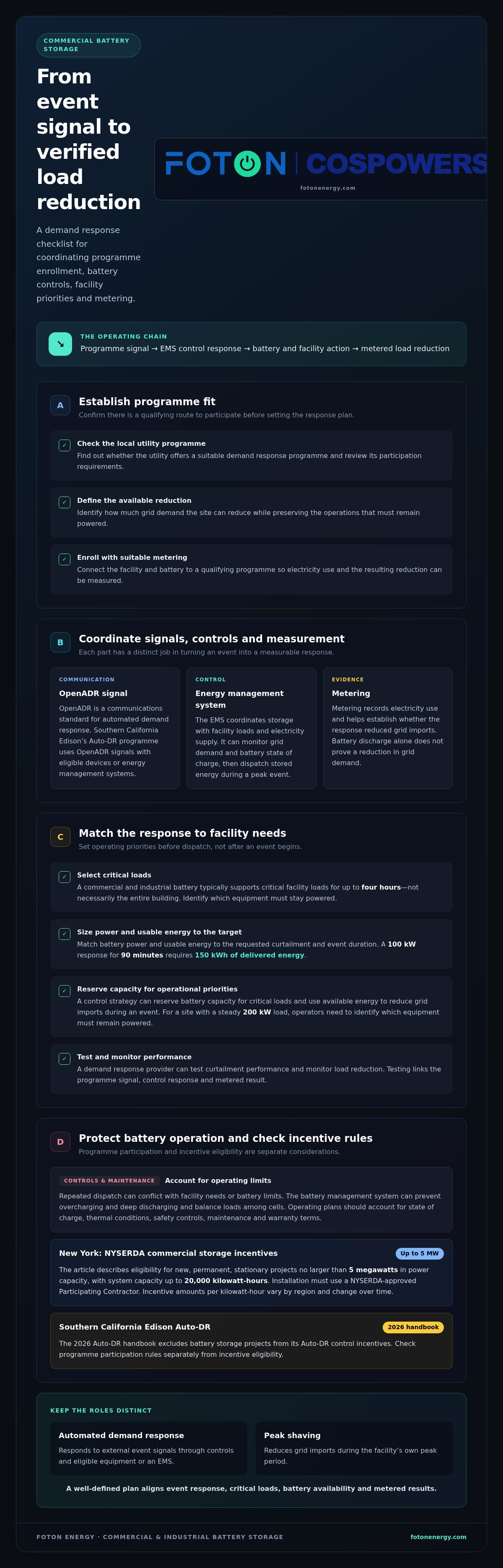
- Match battery power and usable energy to the curtailment target and event duration; a 100 kW response for 90 minutes requires 150 kWh of delivered energy.
- Separate automated demand response, which follows external event signals, from peak shaving, which reduces grid imports during a facility’s own peak period.
- Coordinate the battery, energy management system, communications, and metering so event signals can translate into measurable load reduction.
- Evaluate payback across demand charge savings, energy use, programme participation, installation requirements, and the facility’s operating profile.
- Check how local programme rules and incentives affect eligibility, since requirements and opportunities differ by region.
How do battery storage systems enable demand response participation?
A commercial battery can reduce grid imports during a demand response event while supplying selected facility loads. Its backup role also matters: commercial and industrial systems typically support critical loads for up to four hours.
Batteries, Generators, and Load Curtailment
Battery storage supplies stored electricity, generators produce electricity on-site, and load curtailment reduces or shifts facility demand. The distinction matters: a battery can lower grid imports while keeping selected operations running, whereas curtailment requires changing electricity use. Pairing on-site generation with a battery can also provide backup during an active curtailment event, giving facilities another way to manage operational requirements.
Duration and load selection determine how backup energy is allocated. A commercial and industrial battery system typically supports critical facility loads for up to four hours, not necessarily the entire building. For a site with a steady electrical load of 200 kW, operators need to identify which equipment must remain powered during an event. Prioritizing critical loads helps align the battery’s available energy with operational needs.
Backup activation can also be automatic. Commercial and industrial battery backup systems activate when the primary power source fails, while an automatic transfer switch detects the disruption and initiates backup power flow. This response helps maintain power to connected loads during an outage. During demand response, the battery can instead supply on-site loads, reducing grid imports without requiring electricity exports.
In a microgrid, battery backup can coordinate with on-site generation and facility loads to support operations during grid interruptions and active demand response curtailment. Microgrid batteries may also earn revenue through demand response, capacity markets and other utility programmes that reward flexible energy deployment or load reduction. These services can complement peak-period reductions in grid use and help manage energy costs.
Enrolling a Commercial Battery
Enrolling connects a facility’s battery to a local demand response programme and establishes how load reduction will be measured. First, find out whether the local utility offers a suitable programme. Then determine the facility’s available reduction and enrol the battery and site in a qualifying programme with suitable metering. A demand response provider can test curtailment performance and monitor the resulting load reduction.
Testing helps establish whether the battery can meet the programme’s requested response while preserving critical loads. For example, a facility can define which equipment stays powered and how much grid demand the battery is intended to reduce. Programme signals, metering, battery availability and operating priorities all affect participation. Aligning these elements clarifies the battery’s role in demand response alongside its backup function.
Energy management systems, OpenADR communications and metering
An energy management system (EMS) coordinates storage with facility loads, electricity supply and demand response signals. It can monitor grid demand and battery state of charge, then dispatch stored energy during a peak event. Metering records the facility’s electricity use, helping establish whether the response reduced grid imports.
OpenADR is a communications standard for automated demand response. Southern California Edison’s Auto-DR programme uses OpenADR signals to communicate with eligible devices or energy management systems. Participation requires suitable metering and enrolment in a qualifying programme. The EMS translates an event signal into a facility response, while metering captures the resulting load reduction.
Controls need to reflect operating priorities. A control strategy can reserve battery capacity for critical loads, then use available energy to reduce grid imports during an event. A demand response provider can test curtailment and monitor the reduction. Testing connects the event signal, control response and metered result, rather than treating battery discharge alone as proof of reduced grid demand.
Operational and degradation risks can arise when repeated dispatch conflicts with facility needs or battery limits. A battery management system can prevent overcharging and deep discharging and balance loads among cells. Operating plans also need to account for battery state of charge and thermal conditions. Safety controls, maintenance requirements and warranty terms should align with the system’s duty cycle and operating environment.
Costs and incentives depend on project design and program rules. In New York, NYSERDA commercial storage incentives apply to new, permanent, stationary projects no larger than 5 megawatts in power capacity, with system capacity up to 20,000 kilowatt-hours. Installation must use a NYSERDA-approved Participating Contractor, and incentive amounts per kilowatt-hour vary by region and change over time. The 2026 Southern California Edison Auto-DR handbook excludes battery storage projects from its Auto-DR control incentives, so program participation and incentive eligibility are distinct considerations.
Renewable generation and electric vehicle fleets can add flexibility, but they also shape the load profile. A facility with solar can store excess generation for use after sunset, while battery controls coordinate charging and discharge with changing electricity consumption. This matters when vehicle charging overlaps with peak demand.
Suitability depends partly on whether the local utility offers demand response programs and whether the facility’s load can respond without disrupting operations. In a microgrid, an EMS can coordinate storage, on-site generation, and selected loads as operating conditions change. For integrated storage system planning, align controls, metering, and facility priorities from the design stage.
Commercial battery storage for demand response and grid services
A battery system can respond to utility signals while supplying facility loads. Its value depends on dispatch timing, available capacity and the grid services accessible in the facility’s region.
Charging and Discharging on Grid Signals
Grid-signal dispatch means adjusting battery charging or output in response to utility needs. This flexibility allows a storage system to support grid conditions while managing electricity use on-site.
A system can charge during low-demand periods and discharge stored energy during a peak event. Commercial batteries can adjust output within milliseconds in response to utility signals. The energy management system coordinates this response with facility requirements as grid conditions change.
Frequency regulation can require a faster response than longer demand response events. This differs from a longer demand response event, which focuses on reducing electricity use during high demand. A facility’s available capacity and operating priorities determine which response it can offer.
Grid-Service and Stacked Revenue
Stacked revenue means drawing value from more than one battery service or operating benefit. For a facility, this can combine demand response participation with capacity markets, peak-period grid support and reduced grid imports.
These value streams rely on the same finite battery capacity, so dispatch must account for competing needs. A battery committed to one event may have less stored energy available for another. The operating strategy should therefore align programme signals, energy requirements and the facility’s load profile.
Revenue opportunities also depend on local utility programmes and market rules. Demand response programmes reward flexible energy deployment or load reduction, while capacity markets value available support. Assess these as distinct potential services, then determine how the battery can meet each programme’s operating requirements.
Utility Incentives and Grid Support
Utility incentives and grid support programs can improve a project’s overall value, but eligibility and terms vary by region. In New York, NYSERDA offers incentives for commercial energy storage systems with capacities up to 20,000 kilowatt-hours.
NYSERDA’s incentive amount per kilowatt-hour varies by region and changes over time. Higher incentive rates are available for on-site, behind-the-meter storage at critical facilities in a Disadvantaged Community and at affordable housing properties. Location and facility type therefore matter to project economics.
Incentives are separate from service revenue. A battery may participate in a utility load relief programme while also supporting grid operations, but each opportunity has its own criteria. Assessing both can show how programme participation may contribute to the project’s financial case.
Dispatch to Reduce Grid Imports
Battery dispatch reduces grid imports by supplying electricity directly to a facility’s on-site loads. Exporting power is not necessary for this reduction.
For example, a site targeting a 100 kW reduction in grid imports for 90 minutes needs 150 kWh of delivered energy at constant power. The battery can meet part of the facility’s demand during that interval, reducing the electricity drawn from the grid. The target connects dispatch power with required energy.
Controls can monitor grid demand and battery state of charge, then discharge when a peak-demand signal arrives. This can combine peak shaving with demand response, provided the system has capacity available for the event. Dispatch planning must balance grid imports, facility loads and the battery’s remaining stored energy.
What is the typical payback period for a commercial battery storage system?
There is no single payback period for every commercial battery project. Reported examples range from a Chick-fil-A location in California achieving 2.5 years through demand charge reduction and solar self-consumption, to an estimated period under 6 years for a California bus charging depot. An agricultural facility in Malibu reached a period under 5 years. These cases show how load patterns and multiple value streams shape results.
For New York projects, NYSERDA incentive eligibility has defined size and installation conditions. The project must be new, permanent, and stationary, with power capacity no larger than 5 megawatts. NYSERDA incentives cover commercial storage systems with capacities up to 20,000 kilowatt-hours, and installation must use a NYSERDA-approved Participating Contractor. Incentive amounts per kilowatt-hour vary by region and change over time.
Those limits describe program eligibility, not the ideal size for every facility. Sizing starts with the power needed to reduce grid imports or support loads, then matches energy capacity to the required discharge duration. For example, a 100 kW response lasting 90 minutes requires 150 kWh of delivered energy at constant power. A longer event needs a different energy budget, so power and energy ratings must be assessed together.
Modular system design can align installed capacity with current operations and planned expansion. Before choosing capacity, a facility can compare demand charges, consumption patterns, outages and critical loads. Future electric vehicle charging or additional industrial equipment may change peak demand and electricity costs. Accounting for these changes in the design can avoid sizing the system solely around today’s load profile.
Chemistry also affects how a battery fits operating requirements. Lithium iron phosphate batteries are described as having thermal stability and long cycle life, with energy density and voltage ceiling listed as weaknesses. Lead-acid batteries are cost-effective and reliable, but have shorter lifespans and higher maintenance than other options. The right choice depends on facility needs, budget and environmental conditions.
System components influence operation over time. A battery management system can prevent overcharging and deep discharging while balancing loads among cells. This monitoring supports controlled cycling during demand response and helps manage battery condition. Maintenance planning should account for the selected chemistry, operating environment and expected use during peak periods and backup duty.
Payback analysis should combine demand charge reduction, solar self-consumption, program value, and installation requirements. The California Chick-fil-A example achieved a 2.5-year payback through two benefits, while the bus depot and Malibu examples show different timelines. A project model should therefore connect facility load data, system sizing, incentive eligibility, and intended services rather than relying on one example as a universal benchmark.
Battery storage for demand response
Battery storage can make demand response more manageable by supplying electricity while a facility reduces grid imports. The battery stores electricity produced elsewhere and releases it when needed; it is not an energy source by itself. Charging strategy, available capacity and connected equipment determine what the facility can deliver during an event.
The financial case often starts with demand charges. According to the National Renewable Energy Laboratory, these charges typically account for 30%-70% of commercial and industrial customers’ electricity bills. They are commonly based on a facility’s highest average electricity use during a 15-minute interval in a billing cycle. A short-lived demand spike can therefore influence charges beyond the event itself.
Battery dispatch can address a peak by supplying on-site loads instead of drawing the same power from the grid. Commercial demand charges are generally calculated per kilowatt, while consumption charges use kilowatt-hours. The distinction matters: reducing a brief peak can affect demand charges, while shifting energy use changes when electricity is consumed. A storage strategy can target one or both, depending on the tariff and operating pattern.
Demand response and peak shaving are related but solve different problems. Demand response shifts electricity use during periods of high demand, often in response to an external programme signal. Peak shaving uses battery storage or facility-owned generation during the site’s own peak period. A facility can combine them, but dispatch priorities must account for event commitments, critical equipment and remaining battery energy.
Loads suited to peak shaving include HVAC operations, high-voltage appliances, electric vehicle fleets and energy-intensive industrial processes. At an electric vehicle fleet depot, for example, charging may create a concentrated load, while battery discharge can reduce grid imports during that period. On-site solar can charge storage for later use, matching renewable supply with evening consumption when the facility still needs electricity.
Integration is central to performance. An energy audit, electrical-system evaluation and financial modelling help connect load patterns with storage capacity and programme opportunities. Controls must coordinate the battery with existing equipment and the facility’s operating schedule. A system sized only for a short peak may not have enough stored energy for a longer response or backup requirement.
A practical assessment should compare the facility’s load profile, demand-charge structure, program availability, and intended operating services. Local utility rules matter because demand response opportunities vary by region. For a facility weighing storage integration, discuss a battery storage strategy aligned with its electrical system and operating priorities.
Foton Energy (Foton Pty Ltd): C&I BESS
Foton Energy (Foton Pty Ltd) offers C&I BESS for businesses considering battery storage for demand response, peak management or backup. The next step is to align the system’s role with the facility’s load profile, critical equipment, grid connection and intended programme participation. This helps clarify how storage may fit operational requirements and which design considerations shape the project.
For other applications, Foton Energy also offers Residential Storage Systems, Utility-Scale Storage and Data Centre & Telco Backup. These offerings address different energy storage needs, from residential use to large infrastructure and backup applications.
To discuss how C&I BESS could fit your facility’s energy strategy, contact Foton Energy.
Turn a storage strategy into a practical next step
The next decision is how storage should serve your site over its operating life. First, define the facility’s priorities: demand response participation, peak management, backup or a combination. Then assess how they align with the electrical load, control strategy and local programme opportunities. This gives your team a clear basis for evaluating commercial battery storage for demand response as part of a broader energy plan.
Foton Energy (Foton Pty Ltd) offers C&I BESS for commercial and industrial applications, alongside Residential Storage Systems and Utility-Scale Storage. These offerings suit different project contexts, from business facilities to residential and grid-scale storage needs. A focused discussion can connect the application to the right storage category and project considerations.
Contact Foton Energy to discuss storage and take the next step toward a strategy built around your facility’s priorities. A well-aligned plan can help your organization move forward with clarity and confidence.
Frequently Asked Questions
How Does Automated Demand Response Work?
Automated demand response uses an external event signal to trigger preconfigured changes in a facility’s electricity use. An energy management system can receive the signal and adjust connected equipment according to operating priorities. Southern California Edison’s Auto-DR programme uses OpenADR signals with eligible devices or energy management systems. Suitable metering records performance, helping compare the facility’s electricity use during an event with its response.
Can a Business Opt Out of an Event?
Whether a business can opt out depends on its demand response programme terms. Before enrolment, review the agreement for participation commitments, notification procedures, exceptions and any consequences for a missed event. Operational changes, equipment maintenance or production needs can affect a facility’s response. Establishing who monitors event notices and who can authorise a response helps the business act consistently with its programme obligations.
How do you determine if your facility is suitable for battery-enabled demand response?
Assess suitability by comparing the facility’s load profile, electrical system, operating priorities and local programme options. An energy audit can identify when demand rises and which equipment drives those peaks. An electrical-system evaluation can show how storage connects to existing loads and controls. Financial modelling can then compare potential programme value with demand charge reduction and other operating benefits, helping determine whether battery participation fits the facility.
What Happens if an Event Lasts Longer Than Planned?
If an event lasts longer than planned, the battery’s remaining usable energy limits how long it can supply loads or reduce grid imports. Operators need an energy budget that reflects the required output and event length while preserving capacity for priority equipment. A facility can also plan how to respond if stored energy runs low, such as reducing noncritical loads or using available on-site generation.
What Should You Check Before Choosing a BESS?
Check the facility’s target use, load profile, electrical connection, required output duration, control strategy and local programme conditions. Compare battery chemistry with operating needs and environmental conditions, then review how the battery management system handles charging, discharging and cell balancing. Also examine metering and communications requirements. These details help determine whether the system can support demand response without conflicting with critical operations or planned backup use.
What are demand charges?
Demand charges are electricity bill charges based on a customer’s peak power demand, measured in kilowatts. Consumption charges, by contrast, reflect total electricity used in kilowatt-hours. Commercial demand charges are commonly based on the highest average use during a 15-minute interval in a billing cycle. That means a short, high-load period can affect the bill differently from steady consumption across the month.
How does commercial battery storage participate in demand response programs?
Commercial battery storage participates by supplying facility loads or reducing grid imports during a programme event. Controls coordinate the battery’s available energy with the event signal and operating priorities, while metering records the response. Depending on its local programme, a facility may enrol through a utility or demand response provider. Programme requirements determine how performance is measured and which operating commitments apply.
What types of demand response programs pay commercial battery storage operators?
Potential revenue programmes include utility demand response initiatives, capacity markets and other utility programmes that reward flexible energy deployment or load reduction. Some compensate participation differently, for example by valuing availability or measured response. Frequency regulation is another grid service batteries can provide when they meet its response requirements. Accessible services depend on regional market rules, utility offerings and system capabilities.


