

A grid bottleneck doesn’t always require more wires. Non-wire alternatives for grid congestion use local resources, including battery storage, demand response, and energy efficiency, to address specific network constraints. By shifting or reducing demand when the grid is under pressure, these solutions can help manage peak loads and defer or avoid some transmission or distribution upgrades.
That doesn’t mean conventional infrastructure is no longer needed. The right approach depends on the constraint’s location, timing, and scale. Battery storage is particularly relevant because it can charge when demand is lower and discharge during peak periods, easing pressure on constrained parts of the network. This article explains what non-wires alternatives are, how they work alongside existing grid assets, and when storage may offer a practical alternative to network expansion.
Key Takeaways
- Match distributed resources to the location and timing of a grid constraint; combining technologies can address needs a single solution may not cover.
- Assess whether local flexibility can defer an upgrade by comparing its performance with the specific network requirement and conventional investment.
- Use demand response and other flexible resources to reduce pressure during peak periods, while considering how a broader portfolio balances cost and performance.
- Plan non-wires solutions alongside existing infrastructure, since targeted upgrades may still be needed to meet grid requirements.
- Battery storage can support network planning by shifting energy across time; its role depends on the constraint it needs to address.
What are non-wires alternatives?
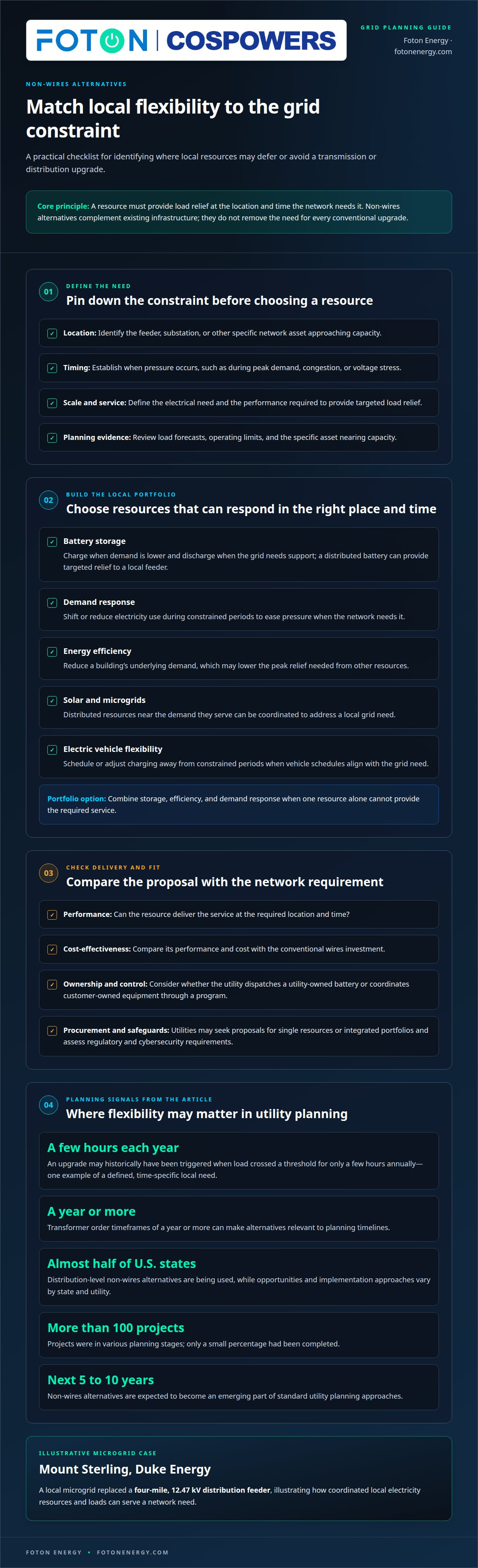
Non-wires alternatives are grid investments that defer or eliminate the need to build or upgrade transmission or distribution assets. They use local resources to meet a specific system need, such as relieving a constrained feeder during peak demand.
Distributed Resources and Microgrids
Distributed energy resources are assets connected to a customer’s premises or the utility network, located near the electricity demand they serve. They include batteries, demand response, solar, and microgrids. Coordinated together, these resources can provide targeted load relief and help address a local grid constraint without relying solely on a network upgrade.
A microgrid combines local electricity resources and loads so it can operate as a coordinated system. Duke Energy’s Mount Sterling microgrid replaced a four-mile, 12.47 kV distribution feeder, illustrating how a local system can serve a network need. A portfolio can also combine energy storage, efficiency, and demand response when one resource alone cannot provide the required service.
Ownership shapes how resources participate. A utility may own and dispatch a battery, while a business or multifamily building may control its own equipment or adjust demand through a utility program. In either case, the resource must provide load relief at the location and time the network needs it. Non-wire alternatives for grid congestion therefore depend on coordinating available resources with the specific constraint, not simply adding generation elsewhere.
In the United States, businesses and multifamily buildings may find support through utility incentives for energy efficiency or demand response, alongside eligible public funding programs. Available support depends on location, customer type, technology, and the grid service proposed. Efficiency measures can reduce a building’s underlying demand, while demand-response participation can shift or reduce use during constrained periods. Together, these measures may reduce the peak relief needed from other resources.
Battery and Vehicle Flexibility
Battery energy storage shifts electricity across time, charging when demand is lower and discharging when the grid needs support. Electric vehicle flexibility can also contribute when charging is scheduled away from constrained periods or adjusted in response to grid needs. These resources give utilities and customers more ways to manage peaks, though their value depends on where and when they can respond.
For example, a utility-owned battery can be dispatched to relieve a local feeder, while customer-owned batteries can contribute through a coordinated program. Vehicle charging can add flexibility when schedules align with the constraint. Combining these resources with efficiency and demand response gives utilities more options for matching local supply and demand.
Avoiding or delaying transmission and distribution infrastructure
Non-wires alternatives can address a specific network constraint before utilities commit to new transmission or distribution infrastructure. Their purpose is to defer or avoid an upgrade when local resources can meet the grid’s need.
Distribution Constraints and Battery Storage
Distribution constraints arise when local equipment cannot reliably meet demand, including during periods of voltage stress or congestion. A distributed battery can charge and discharge in response to these conditions, providing targeted support where the network needs it.
Timing and location matter. Historically, an upgrade could be triggered when load crossed a threshold for only a few hours each year. This example shows how a defined local need can shape a non-wires proposal.
Adoption Across Utilities and States
Distribution-level non-wires alternatives are being used in almost half of U.S. states, but opportunities and implementation approaches vary by state and utility. Local planning processes, regulatory considerations, the specific electrical need, and available resources all shape what a utility can procure.
For businesses and communities, that variation means an opportunity depends on the service territory and the grid constraint being addressed. More than 100 projects were in various planning stages, while only a small percentage had been completed. Non-wires alternatives are expected to become an emerging part of standard utility planning approaches over the next five to 10 years.
Utilities evaluate proposals against a defined electrical need, including location, timing, performance, and cost-effectiveness compared with a wires investment. They may issue a request for proposals, consider bids for single resources or integrated portfolios, and assess regulatory and cybersecurity requirements before implementation.
Utilities can identify viable locations by studying load forecasts, operating limits, and the specific asset approaching capacity. A constraint concentrated on a feeder or substation, particularly one triggered by a short annual peak, may be a candidate for local flexibility. Transformer order timeframes of a year or more can also make alternatives relevant to planning timelines.
Differences between states and utilities affect procurement routes, eligible resources, and project requirements. Some utilities may accept partial proposals or combine multiple solutions; others may structure opportunities around a particular network need. Utilities and regulators can build portfolios based on practical local experience instead of assuming one approach fits every service territory.
Other examples show how utilities can frame a local need around capacity and operating conditions. New York State Electric & Gas was seeking almost 6 MW of distributed energy resources by 2024 for the area of its Java Substation. In a case study, infeasible hours represented approximately 4.05% of the observed distribution network's annual operation, and the acceptable voltage range for network operation was 0.95-1.05 p.u. Such conditions help define where flexibility may support reliable service.
The scale of traditional investment also provides context: US regulated utilities invested about $55 billion a year in poles and wires starting in 2006. The Alabama Municipal Electric Authority has 30 megawatts of conservation voltage reduction available and estimated that an additional 20 megawatts of conservation voltage reduction could be available within the next two years. These resources can be considered alongside other local options when utilities assess how to address network needs.
Non-wire alternatives for reducing grid congestion and peak demand
Brooklyn-Queens shows how utilities can pair customer-side flexibility with targeted infrastructure. The approach focuses on relieving local constraints during the periods that matter most.
Batteries, demand response, and other distributed energy resources work in different ways. Batteries shift electricity across time; demand response changes or moves customer use; solar and microgrids add local supply or coordinated capability. Their suitability depends on the grid location, operating need, and availability during peak demand.
The project combines 17 MW of infrastructure investment with 52 MW of demand-side solutions across utility and customer resources. This mix illustrates how a portfolio can balance grid needs and customer participation.
Demand Flexibility and Load Shifting
Demand flexibility is the ability to adjust electricity use in response to grid conditions, while load shifting moves consumption to another time. Both can lower demand during a constrained peak without requiring every customer to reduce total energy use.
For example, a building can shift flexible equipment operation away from a utility-defined peak period. Demand-response programs coordinate changes across participating customers, helping utilities match available flexibility to a specific feeder or substation need. Results depend on participation, timing, and how much load can be shifted.
Comparing Congestion Solutions
Batteries provide dispatchable energy storage; demand response relies on changing customer consumption; distributed energy resources include both approaches, as well as local generation and microgrids. Comparing them helps utilities select resources that match the constraint’s timing and operating requirements.
A portfolio can combine resources when one option cannot meet the entire need. Brooklyn-Queens is an example: customer-side measures complement infrastructure investment rather than replacing every network asset. This approach can make procurement more adaptable while keeping performance requirements central.
Demand response can also use different coordination models. The pilot illustrates one way to coordinate flexible load; it doesn’t establish that blockchain is necessary for every project.
Reliability and operational risks include resources failing to respond when called, inaccurate forecasts, and controls that don’t coordinate with utility operations. Cybersecurity risks can arise when connected devices, communications, and control systems exchange data. Utilities address these concerns through project requirements, operational planning, and cybersecurity assessment, while checking that the portfolio can meet the electrical need.
Non-wires alternatives and existing grid infrastructure
Non-wires alternatives are investments that defer or eliminate the need to build or upgrade grid components. Their value depends on meeting a defined electrical need while working with existing infrastructure.
Deferring Grid Upgrades
Deferral means using local resources to manage a constraint before a planned network expansion is required. This can give utilities time to plan infrastructure investment while addressing immediate operating needs.
In a distribution-network case study, a battery with 13.7 MWh of energy capacity and 5 MW of rated power addressed voltage violations. The network had 355 infeasible operating hours across approximately 115 critical days before storage was added. The battery eliminated the identified violations and infeasible conditions in that case, showing how performance against a specific constraint can be measured.
Economic Benefits
Economic value comes from comparing a portfolio’s cost and performance with the wires investment it could defer. A broader mix of technologies can balance cost-effectiveness and service delivery more effectively than relying on a single resource.
Energy storage, demand response, and efficiency can also support renewable resources and reduce exposure to peak-period constraints. Microgrids can generate revenue, reduce costs, optimize renewable resources, and help avoid the consequences of downtime. These benefits depend on how the resources serve local needs and operate alongside the grid.
Comparing Alternatives and Upgrades
Traditional upgrades add or replace physical grid assets; non-wires alternatives use local resources to meet the same defined electrical need. Alternatives can defer investment when they provide sufficient relief at the right location and time. Wires remain appropriate when the constraint requires additional network capacity.
Neither approach is automatically faster or more reliable. Utilities compare expected performance, timing, operational requirements, and cost-effectiveness against the specific upgrade. A battery’s dispatch capability, for example, must match the duration and timing of the constraint; other technologies may have different operating profiles.
Costs and Performance Metrics
There is no single typical cost or performance figure for non-wires alternatives in the United States. Project economics depend on the resource mix, delivery requirements, operating period, and conventional investment being assessed.
Useful metrics include peak load relief, available capacity, duration, response timing, voltage performance, and operating hours. The case study’s 13.7 MWh battery and 5 MW rated power were evaluated against voltage limits and infeasible operating conditions. Those measures connect technical performance to the grid need and support an economic comparison.
Battery storage as a non-wire alternative to network expansion
A battery can support a constrained network by absorbing electricity when demand is lower and discharging during peak periods. This shifts when electricity reaches the grid, helping address congestion or voltage challenges at a particular location. Unlike new generation, storage doesn’t create energy. Its grid value depends on when it charges and discharges, and whether it serves the constrained part of the network.
Matching Storage to the Grid Need
Planning starts by defining the constraint: its location, timing, duration, and required response. A battery’s power capability determines how much it can deliver at once; its energy capacity affects how long it can sustain that output. Both must match the network need. A system sized for a brief peak, for example, may not cover a longer period of congestion.
Charging also matters. If a battery charges while the same feeder is already constrained, it could add to the problem. A useful operating plan coordinates charging and discharging with grid conditions, customer demand, and available generation. Utilities can assess these conditions alongside voltage performance and network operating limits.
Assessing Value Alongside Network Investment
Battery storage is not a universal replacement for wires. It may suit a defined, localized constraint when storage can provide the required service at the relevant time. A conventional upgrade may still be necessary when the need is continuous, covers a wider area, or requires capacity the battery cannot reliably provide.
Economic evaluation compares the battery’s performance and project costs with the proposed network investment. It also considers how frequently the resource must operate and whether it can continue serving its intended grid function over the planning period. A Rocky Mountain Institute report found that deploying distributed energy resources for non-wires alternatives can increase battery storage’s value by more than 100% in many cases.
Pairing storage with demand flexibility, efficiency, or renewable generation can broaden its role. These resources may reduce the battery discharge needed during a peak, while storage can respond when other measures do not fully meet the local requirement. Assess the combination as an integrated portfolio, not as separate investments with unrelated operating plans.
For project teams, the practical takeaway is to define the grid service first, then assess storage capacity, operating schedule, location, and alternatives together. Explore utility-scale storage as part of evaluating battery-based options for network planning.
Potential non-wires alternative technologies include demand response, solar, energy storage, combined heat and power, microgrids, energy efficiency, and other distributed energy resources or generation. Comparing these options can help planners identify a portfolio that addresses a localized need and fits network operating requirements. The City of Field microgrid uses energy storage to support a remote community during outages. This example shows how storage may serve a resilience function alongside grid support, though each project’s role depends on the need being addressed.
The Brooklyn-Queens Demand Management microgrid includes a 300 kW energy storage system. Projects like these make it important to assess storage within its wider system: the question is not simply whether a battery is present, but whether its operation aligns with the constraint and complements other measures. Non-wires alternatives can combine technologies, with performance judged against the specific service required.
Foton Energy (Foton Pty Ltd)
Foton Energy (Foton Pty Ltd) helps organizations consider how energy storage can support local power needs and broader grid objectives. Its offerings include Residential Storage Systems, Utility-Scale Storage, and Data Centre & Telco Backup. These solutions may be relevant when evaluating storage as part of a broader approach to peak demand, resilience, or network planning.
The right role for storage depends on the project’s electrical requirements, operating needs, and relationship to the constrained network. Foton Energy’s storage offerings include utility-scale systems, residential applications, and backup for critical infrastructure, helping organizations consider storage in different project contexts.
To discuss energy storage options for your project, contact Foton Energy (Foton Pty Ltd).
Turn a grid constraint into a clear planning decision
The next step is to frame the constraint as an operational requirement, not just a call for more capacity. Identify where pressure occurs, when it peaks, and what response the network needs. That provides a clearer basis for assessing whether flexibility, storage, or a conventional upgrade best fits the project. For non-wire alternatives for grid congestion, the central question is whether a resource can reliably serve the constrained location at the required time.
Project teams can then align technical requirements with an investment pathway, considering how a solution will operate alongside existing assets and future demand. Foton Energy’s C&I BESS offering can support commercial and industrial storage planning, while its broader storage capabilities serve different project contexts.
Bring your project requirements into the next conversation and explore a storage approach suited to your objectives. Contact Foton Energy (Foton Pty Ltd) to discuss your next step. A well-defined need is a strong foundation for a resilient grid.
Frequently Asked Questions
What are non-wire alternatives (NWAs) for grid congestion?
Non-wire alternatives are local resources used to address a grid constraint without relying solely on new network construction. For example, a utility facing a busy distribution feeder could coordinate a battery with building demand response to reduce net load at the constrained point. The key is matching the resource’s location and operating schedule to the constraint, rather than treating energy produced elsewhere as equivalent support.
Which technologies can relieve grid congestion without building new transmission lines?
Battery storage, demand response, energy efficiency, solar, combined heat and power, and microgrids can help relieve congestion. A battery can discharge during a local peak; a demand-response program can shift participating customers’ electricity use. Solar or combined heat and power can supply energy closer to demand, while a microgrid coordinates local resources and loads. Utilities can combine technologies when a single resource cannot meet the required service.


