

Storage can do more than shift energy. In the United States, energy storage as a transmission asset is classified to meet a transmission need, with reliability as its primary purpose. The Energy Policy Act of 2005 laid the legal groundwork, and these assets must be available at an appropriate state of charge during designated reliability windows.
That distinction matters because a battery’s classification shapes how it is planned and operated. A project designed to relieve a grid constraint may also support market services, but combining these roles depends on how reliability requirements and market participation are managed.
This article explains how storage can defer or replace transmission upgrades, what FERC classification means in practice, and how dual-use projects balance grid reliability with market opportunities. It also covers examples of storage serving transmission needs and the practical questions that shape a project’s role, from its grid location to its operating requirements.
Key Takeaways
- See how battery projects can address local transmission constraints, with examples from California and Wisconsin.
- Understand why a project’s primary reliability role shapes its classification and operating requirements.
- Learn how storage may combine grid support with ancillary market services, and why tariff design matters.
- Explore the planning factors that determine whether a battery can defer or replace a transmission upgrade.
- Identify how utility-scale storage and engineering support can fit into transmission-focused project development.
Case studies of storage projects
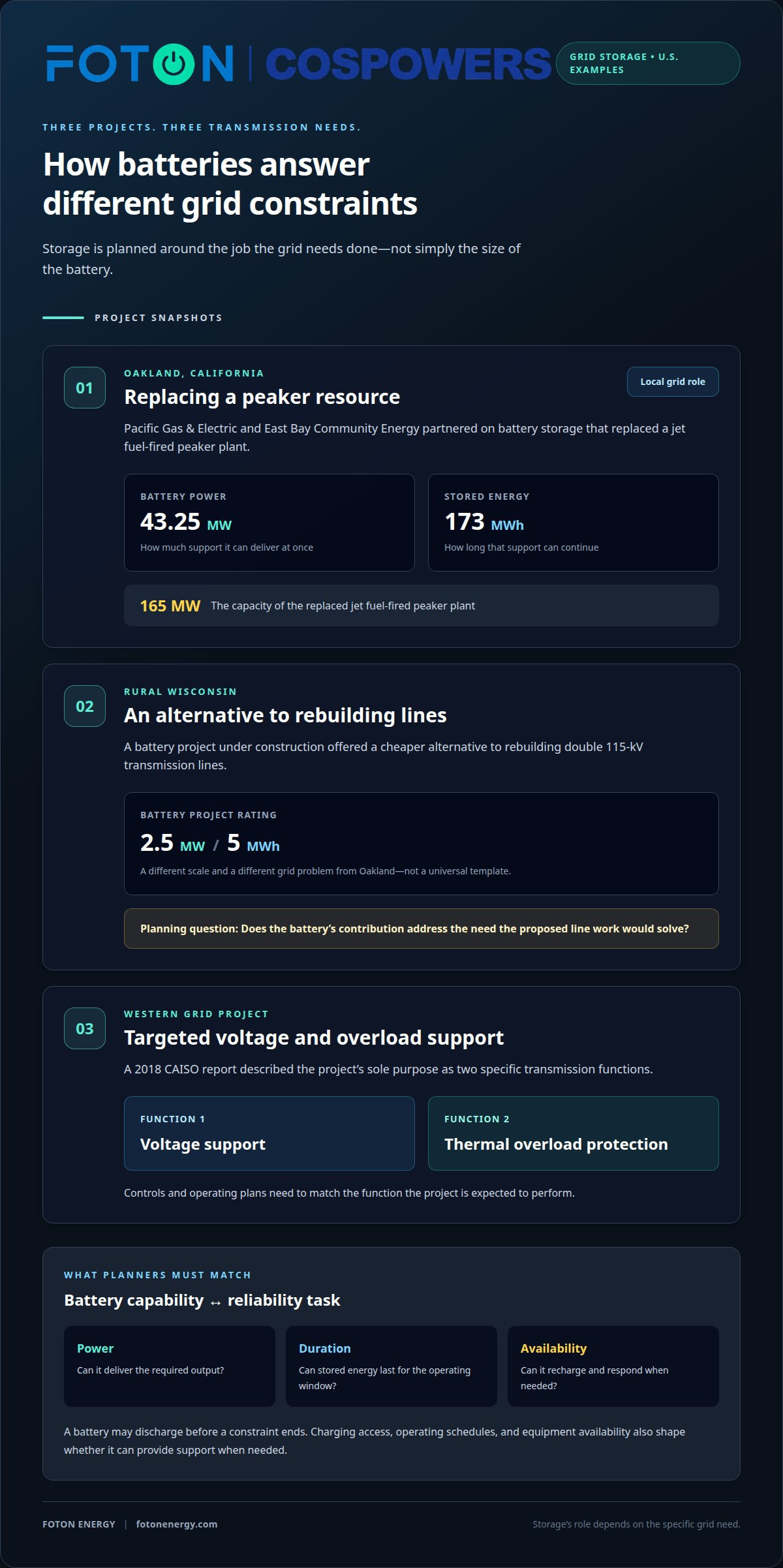
Three U.S. examples show how batteries can address different transmission constraints. The Oakland project replaced a generation resource, while a Wisconsin project offered an alternative to rebuilding lines. A Western Grid project focused on voltage support and thermal overload protection. Together, they show that storage’s role depends on the specific grid need, not simply battery size.
In Oakland, Pacific Gas & Electric and East Bay Community Energy partnered on battery storage that replaced a 165-MW jet fuel-fired peaker plant. The battery project was rated at 43.25 MW/173 MWh. The comparison highlights two distinct measures: megawatts describe power output, while megawatt-hours describe stored energy. For transmission planning, both matter. Output indicates how much support the system can deliver at once; stored energy indicates how long that support can continue. The Oakland example therefore shows a battery serving a local grid role while replacing a conventional generation resource.
That distinction also helps explain why a battery cannot be assessed by its MW rating alone. A transmission constraint may require a defined level of support during a particular operating window. Planners must consider whether the project can deliver that output for the required duration, and whether it can recharge before another need arises. Oakland’s 43.25-MW/173-MWh configuration provides a concrete example of why power and energy ratings belong together in project descriptions.
In rural Wisconsin, a 2.5-MW/5-MWh battery project was under construction as a cheaper alternative to rebuilding double 115-kV transmission lines. The project illustrates a different use case: addressing a line constraint without reconstructing the existing route. Its smaller rating, compared with Oakland’s, reflects a separate grid problem and should not be read as a universal template. The relevant comparison is between the battery’s contribution and the need the proposed line work would address.
A 2018 CAISO report described the Western Grid project’s sole purpose as voltage support and thermal overload protection. That example matters because it shows storage can be planned around specific transmission functions, rather than primarily around energy trading. Voltage support and overload protection are distinct needs; a project’s controls and operating plan must align with the function it is expected to perform.
State utility commissions and regional transmission organizations review proposals based on the identified grid need, alternatives, and proposed operating arrangements. The responsible body and approval sequence depend on the project’s structure and jurisdiction.
The main limitation is duration: a battery may discharge before a grid constraint ends. Charging access, operating schedules, and equipment availability also determine whether it can provide support when needed. As the Oakland and Wisconsin examples illustrate, planners must match the battery’s power and energy capabilities to the specific reliability task.
Dual-use storage and market services
A battery can serve a transmission need and support electricity markets, but these roles must be coordinated. In dual-use operation, the grid function remains central, while the system may also provide eligible market services. The practical design challenge is ensuring that a market dispatch does not leave the battery unable to meet its transmission purpose when needed.
Yes. FERC issued a 2017 policy statement allowing storage systems classified as transmission assets to provide ancillary market services. Revenue treatment depends on applicable market tariffs and project arrangements. CAISO and MISO had begun proceedings to develop tariffs for dual-use storage, but neither had finalized rules for those systems.
Ancillary services support reliable grid operation, while transmission service addresses a network constraint. A dual-use battery therefore needs clear operating priorities. Its controls and dispatch arrangements must preserve its ability to perform the designated grid function while identifying when market participation is compatible. The project’s operating plan connects these requirements.
Location can create value for both roles. Batteries sited near load centers can alleviate pressure on the grid and absorb excess renewable generation that might otherwise be curtailed. For example, a battery near a constrained area could charge when renewable output exceeds the network’s capacity to carry it, then provide support under the project’s grid operating plan.
This example also shows why market activity cannot be treated as an automatic extra revenue stream. Charging and discharging affect the battery’s available energy and its ability to respond later. The schedule must account for grid needs, market opportunities, and the time required to restore stored energy. Tariff rules determine which services are eligible and how associated revenues are treated.
CAISO and MISO illustrate the importance of regional market design. Their proceedings to develop dual-use storage tariffs had started, but rules for these systems were not finalized. Until a tariff establishes how participation works, project economics and dispatch arrangements cannot be assessed as if every market follows the same framework. Transmission planning and market operations must remain aligned.
For project teams, the key design steps are to define the reliability function, identify compatible market services, and coordinate dispatch priorities. Then assess how market participation affects charging availability and transmission performance. This sequence helps distinguish a genuinely dual-use design from a battery whose market schedule could conflict with its grid role.
Project planners must carefully balance market opportunities against the battery’s grid role. A location near load centers can alleviate pressure on the grid, while the system can absorb excess renewable generation that might otherwise be curtailed. These benefits make the site’s operating priorities central to any dual-use assessment: charging or discharging should be considered in relation to the network need the battery is intended to address. The same location may support both purposes, but the evaluation should keep the grid function explicit and distinguish it from compatible market activity.
Definitions of storage as a transmission asset (SATA)
Storage as a transmission asset, or SATA, describes a battery assigned to meet a transmission need. Its defining role is not simply to store electricity for later sale. Instead, its location and operation address a grid requirement, such as supporting voltage or easing a network constraint. The Oakland and Wisconsin examples show how different grid needs can shape a storage project’s purpose.
Classification depends on function. A battery used primarily for transmission must be planned around the grid service it is expected to provide. That service may involve delivering power during a reliability need, absorbing energy, or maintaining a required operating condition. The project’s purpose guides its operating limits and distinguishes its transmission role from market-led storage.
Three questions clarify whether a project fits this description:
- What grid need does it address? Identify the specific transmission constraint or reliability function.
- Where must it operate? The battery’s location affects whether it can serve that network need.
- What operating conditions apply? Define when the system must be available and how its stored energy supports the assigned function.
These questions separate the asset’s core purpose from its technology. A battery may provide transmission support while also being technically capable of charging or discharging for other purposes. Those capabilities do not, by themselves, make it a transmission asset. Classification follows the project’s designated grid role and operating arrangements.
Compared with new transmission lines, storage costs depend on project scope, location, duration, interconnection, and the line work being considered. Potential economic benefits include deferring or avoiding a line upgrade and, where allowed, earning revenue from compatible market services. The comparison depends on project-specific costs and benefits.
The term SATA also helps planners describe an asset’s role without confusing it with a standalone generation resource. For example, a battery selected to address a transmission constraint should be assessed against that constraint, not only by its ability to participate in energy markets. Its required availability, charging access, and discharge capability all connect the equipment to its grid function.
In practical planning, a clear definition sets the boundaries for design and evaluation. First, specify the transmission need. Then connect the battery’s location and operating plan to that need. Finally, distinguish the primary grid service from any additional uses. This makes the project’s intended role clear to planners, operators, and stakeholders.
FERC classification of storage as a transmission asset
In the United States, the Energy Policy Act of 2005 laid the legal groundwork for classifying energy storage as a transmission asset. That foundation connects storage to transmission planning when its primary purpose is meeting a reliability need. The classification is therefore about the asset’s role, not simply its battery technology or ability to trade electricity.
The technical requirement is operational availability. A storage asset classified as transmission must be at an appropriate state of charge during designated reliability windows because reliability is its primary purpose. Its operating plan must preserve enough stored energy to serve the assigned grid need during those periods.
For project teams, this requirement links planning assumptions to battery operation. The designated window defines when the system must be ready, while the required state of charge establishes the energy condition needed for the task. Together, these elements inform charging schedules, dispatch priorities, and coordination with grid operators. They also shape how the project’s transmission function is described.
FERC classification is not a blanket label for every battery connected to the grid. A battery designed mainly for market participation has a different stated purpose from one assigned to transmission reliability. The decisive question is what function the project is planned to perform. A battery that supports a transmission constraint may also have market capabilities, but those capabilities do not replace its reliability obligation.
The distinction affects how project performance is evaluated. Consider a battery assigned to provide support during a designated reliability window. Its market schedule cannot leave it without the appropriate state of charge when that window begins. The operating plan must coordinate charging and dispatch with the transmission function. This is the practical connection between classification and control strategy.
FERC’s framework also makes reliability the primary purpose, not an occasional benefit. Project documentation and operating arrangements should describe the grid need, when the asset must be available, and how its state of charge supports that need. These details connect the planned transmission role to actual battery operation.
A useful review sequence is to define the reliability function, identify its designated operating windows, and set the required state-of-charge condition. Then align charging and dispatch arrangements with those commitments. The Energy Policy Act of 2005 provides the legal groundwork, while the project’s reliability purpose determines how the storage asset must operate.
How can battery storage defer or replace transmission upgrades?
A battery can defer a transmission upgrade by supplying power where and when the network faces a constraint. Instead of rebuilding a line immediately, planners can assess whether storage at a suitable grid location can meet the need. The key is alignment: the battery’s location, discharge capability, and operating schedule must address the specific constraint.
The planning case starts with the problem the proposed upgrade would solve. If a corridor faces limited capacity during predictable periods, storage may inject power near the constrained area. That local supply can reduce the electricity the corridor must carry during those periods. The project must then be assessed against the reliability requirement, including the constraint’s duration and timing.
Storage can also support the grid while a longer-term network solution is developed. In this role, it may defer construction rather than eliminate the need for new lines. The distinction matters: a battery is useful only while it can meet the constraint, and its available energy falls as it discharges. Charging access and recharge timing therefore affect how reliably it can provide repeated support.
Location is central to the comparison. A battery connected beyond the constrained point may not relieve the constraint, even if its capacity appears adequate. Planners need to consider where power enters the network and how it changes flows through the affected equipment. They also assess whether the battery can operate during relevant conditions without conflicting with other grid needs.
U.S. transmission planning processes rarely consider storage alternatives, and only a handful of storage projects have been selected. This makes the planning approach important. A robust comparison evaluates proposed line work and a storage alternative against the same grid need, operating conditions, and reliability expectations. It should also account for how each option performs as network conditions change.
A battery may be a poor substitute when the constraint lasts longer than its stored energy can support, or when it cannot recharge in time. A transmission line can provide network capacity without relying on a charging schedule. Storage, by contrast, offers dispatchable support at its connection point but depends on available charge and operating controls. These differences determine whether storage can defer an upgrade, complement it, or meet the need at all.
For a project assessment, define the constraint, identify the effective connection point, and match the battery’s operating capability to the grid requirement. Then compare storage and line options using equivalent reliability terms. This keeps the decision grounded in system performance rather than assuming either technology is always preferable.
To develop a utility-scale storage concept around a transmission need, explore utility-scale storage solutions.
Foton Energy (Foton Pty Ltd)
Foton Energy (Foton Pty Ltd) offers storage options for projects assessing how batteries may support grid needs. For transmission-scale requirements, utility-scale storage may be relevant when the project’s location, operating role, and reliability objectives align. Residential Storage Systems and Data Centre & Telco Backup address different needs and are also part of Foton Energy’s wider storage offering.
Consider Foton Energy when evaluating a storage project’s role, scale, and intended application. A clear understanding of the grid requirement helps frame which storage category may be suitable, without assuming a battery can replace every planned network upgrade.
To discuss your storage requirements, contact Foton Energy (Foton Pty Ltd).
Turn the Grid Need Into a Project Brief
The next step is to translate a transmission challenge into a clearly defined storage requirement. Specify the grid need, the location where support is required, and the operating conditions the system must meet. This foundation helps determine whether energy storage as a transmission asset belongs in the project’s planning pathway or whether another solution better fits the need.
Foton Energy (Foton Pty Ltd) offers C&I BESS, Residential Storage Systems, and Utility-Scale Storage. These offerings address different project contexts, while the right direction depends on the system’s intended role and scale. A focused discussion can connect the technical requirement with an appropriate storage approach.
Bring your project goals and grid requirements into the next conversation. Contact Foton Energy (Foton Pty Ltd) to discuss your storage needs, and take the next step with clarity and confidence.
Frequently Asked Questions
What does energy storage as a transmission asset mean?
It means a storage system is assigned a transmission function, rather than operating primarily as a market resource. Its purpose is to address a grid need, such as supporting reliability at a particular location. For example, planners may assess whether a battery can provide the required network support during specific operating conditions. Its classification follows that assigned role and the operating arrangements needed to deliver it.
What are examples of energy storage projects classified as transmission assets in the United States?
Examples include projects in Oakland, rural Wisconsin, and the Western Grid. The Oakland partnership involved Pacific Gas & Electric and East Bay Community Energy, while the Wisconsin project was considered instead of rebuilding transmission lines. A 2018 CAISO report described the Western Grid project as serving voltage support and thermal overload protection. These cases illustrate distinct applications, from replacing a peaker plant to addressing a line or reliability need.
How do FERC rules treat energy storage used as a transmission asset?
FERC’s treatment centers on the project’s transmission purpose and its reliability obligations. The Energy Policy Act of 2005 laid legal groundwork for classifying storage as a transmission asset. FERC’s 2017 policy statement allowed these systems to provide ancillary market services as well. In operation, the asset must retain an appropriate state of charge during designated reliability windows, so market dispatch cannot displace its primary grid function.
How do transmission planning and cost-allocation rules apply to storage projects?
Planning evaluates whether a storage proposal can address an identified grid need alongside other potential solutions. In the United States, planning processes rarely consider storage alternatives, and only a handful of projects have been selected. Cost treatment depends on the project’s applicable planning and tariff arrangements, including how its transmission function and compatible market services are handled. The project’s location and intended grid service inform the evaluation.
How do state utility commissions and regional transmission organizations approve these projects?
They review proposals against the identified grid need, alternatives, and proposed operating arrangements. The responsible body and approval sequence depend on the project’s structure and jurisdiction.


