

The absence of cobalt doesn’t decide whether a battery will work for your project. Choosing among cobalt-free battery chemistries for industry means matching the chemistry to the duty cycle, operating conditions and performance the system needs to deliver. A chemistry that suits one site may not fit another.
Comparing material claims alone can leave project teams with more questions than answers. LFP is a commercially mature option, while sodium-ion is advancing as a candidate for stationary storage. Each brings different considerations, and uneven public data can make direct comparisons difficult. Neither chemistry is automatically safer, greener, cheaper or more bankable simply because it avoids cobalt.
This article compares industrial cobalt-free battery options by performance, maturity and project fit, then outlines evidence that can support a bankable system decision. It explains how chemistry relates to duty cycle and site conditions, and why an assessment should also cover system integration, thermal management, safety architecture and energy management. The aim is a clearer way to match technical choices to project requirements.
Key Takeaways
- Understand what makes a battery chemistry cobalt-free, and why cell materials are only one part of an industrial BESS.
- Compare cobalt-free battery chemistries by maturity and project fit, separating established evidence from claims that depend on the application.
- Assess safety and bankability across the complete system rather than assuming they follow from a cobalt-free label.
- Use a structured project assessment to connect duty cycle, site conditions and integration needs to chemistry selection.
- Account for thermal management, safety architecture and EMS when designing a system around project requirements.
What Makes an Industrial Battery Chemistry Cobalt-Free?
Cobalt-free describes the cell’s chemistry, not the quality of the complete energy storage system. The term refers to materials used in the electrochemical cell, especially its cathode, and should be supported by a disclosed composition. It isn’t a standalone performance rating or proof that a battery is safer, more sustainable or better suited to an industrial site.
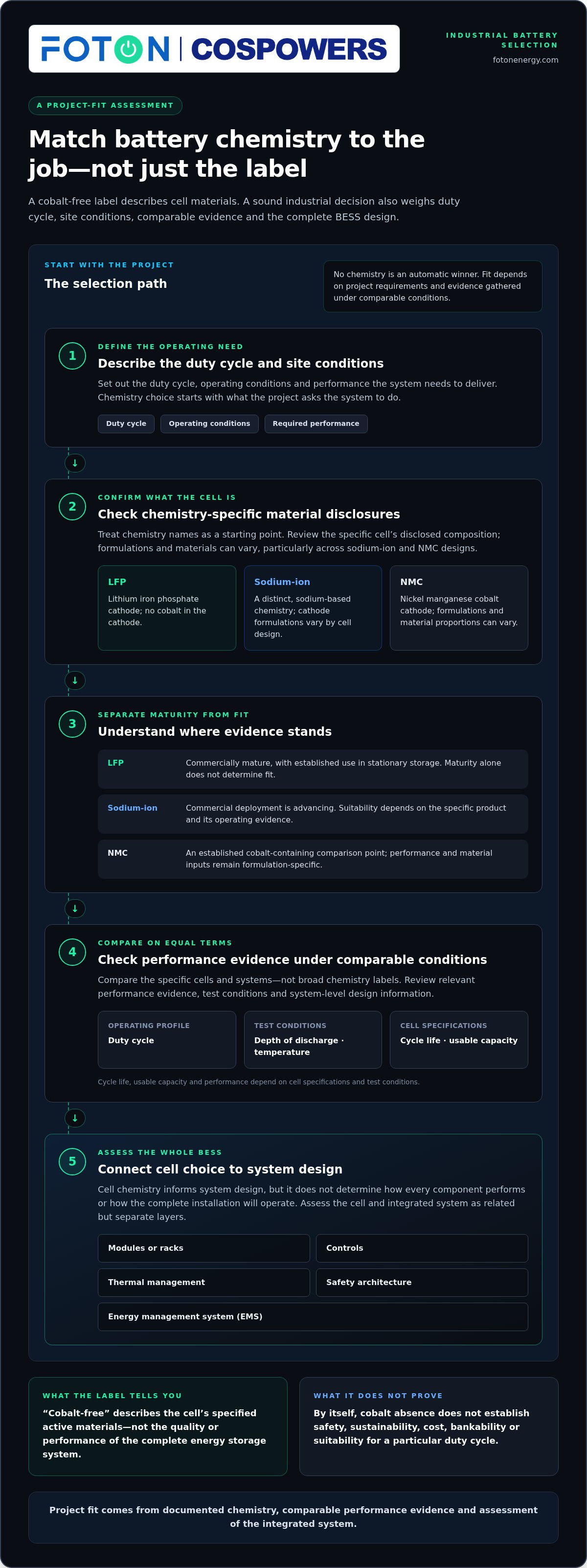
This distinction matters because a battery energy storage system (BESS) includes much more than cells. Its design may bring together modules or racks, controls, thermal management, safety architecture and energy management. Cell chemistry informs system design, but it doesn’t determine how every component performs or how the complete installation will operate. Assess the cell and integrated system as related but separate layers.
Which battery chemistries are commonly described as cobalt-free?
Lithium iron phosphate (LFP) is a lithium-ion chemistry whose cathode uses lithium, iron and phosphate rather than cobalt. It can be compared with other lithium-ion options, including nickel manganese cobalt (NMC), which contains cobalt. The relative proportions in NMC formulations can vary. This lithium-ion battery chemistry overview can help clarify how these cell designs differ.
Sodium-ion is a distinct battery chemistry, not a type of lithium-ion battery. Its cells use sodium-based chemistry, and cathode formulations vary between designs. For a meaningful comparison, use the specific cell’s material documentation rather than assuming all sodium-ion cells share the same composition or performance profile. Chemistry names are a starting point, not a substitute for project-specific evidence.
Why does cobalt absence matter to industrial buyers?
For procurement teams, cobalt content can be one factor in evaluating material exposure and supply-chain priorities. A cobalt-free option may align with a project’s sourcing objectives, but that alone doesn’t establish the origin or processing impacts of its materials, or its end-of-life outcomes. Nor does it demonstrate the system’s operating life, safety performance or suitability for a particular duty cycle.
At cell level, “cobalt-free” means the cell’s specified active materials contain no cobalt; it does not certify the performance or sustainability of the complete battery system.
Make comparisons on a like-for-like basis. Review chemistry-specific material disclosures alongside relevant performance evidence, test conditions and system-level design information. A claim about one cell isn’t proof about a complete BESS, and results from different operating conditions may not be directly comparable. For industrial buyers evaluating cobalt-free battery chemistries for industry, the practical question is whether the documented chemistry and integrated system meet procurement priorities and operating requirements, not just whether cobalt is absent.
How LFP, Sodium-Ion and Cobalt-Containing Batteries Differ
Comparisons are most useful when they separate established evidence from factors that depend on a particular cell, system and operating profile. LFP has a well-established role in stationary storage, while sodium-ion is advancing commercially and NMC remains a widely used cobalt-containing reference chemistry. None is a universal winner. Trade-offs depend on project requirements and evidence gathered under comparable conditions.
| Chemistry | Material distinction | Maturity and industrial fit |
|---|---|---|
| LFP | Lithium iron phosphate cathode; no cobalt in the cathode. | Commercially mature, with established use in stationary storage. Assess performance against the project’s operating profile. |
| Sodium-ion | Sodium-based chemistry; cathode formulations vary by cell design. | Commercial deployment is advancing. Suitability depends on the specific product and its operating evidence. |
| NMC | Nickel manganese cobalt cathode; formulations and material proportions can vary. | An established comparison point, but performance and material inputs remain formulation-specific. |
LFP: a cobalt-free lithium-ion option
LFP uses lithium iron phosphate as its cathode material, distinguishing it from cobalt-containing lithium-ion chemistries. Its commercial maturity makes it a relevant option for stationary storage, but maturity alone doesn’t determine fit. Cycle life, usable capacity and performance depend on cell specifications and test conditions. Compare evidence under equivalent operating assumptions, including depth of discharge, temperature and duty cycle, rather than relying on a chemistry label or headline figure.
Sodium-ion and NMC: different material and deployment trade-offs
Sodium-ion is distinct from lithium-ion, and cathode materials can differ across cell designs. Treat deployment announcements as evidence of market progress, not proof that every sodium-ion system has the same maturity or performance. NMC contains cobalt, but its formulation also varies, so material proportions and test results matter. The University of Texas’s cobalt-free battery research illustrates ongoing chemistry development, not a blanket performance guarantee for commercial systems.
In brief: LFP is a mature lithium-ion chemistry with a phosphate-based cathode; sodium-ion uses a different, variable chemistry and is progressing through commercial deployment. For either option, verify the specific cell composition and compare lifecycle and performance claims using equivalent conditions. A result from one design cannot automatically be applied to another.
For industrial buyers, the decision should connect chemistry evidence to the intended application, system design and operating conditions. Foton Energy’s energy storage solutions bring LFP and sodium-ion into a broader project-fit assessment.
Does Cobalt-Free Mean Safer, Greener or More Bankable?
No. Cobalt-free describes a material attribute, not a complete risk assessment. It doesn’t establish how a cell behaves under stress, how a system manages heat, what impacts occurred during material production, or whether a project will meet its performance and financing requirements. Industrial buyers need evidence tied to the specific battery and its intended operating conditions.
Assess the system at multiple levels. Cell test results don’t automatically demonstrate pack or container performance, and neither alone establishes how the installation will be managed at the site. Duty cycle, environment, controls and integration all shape the evidence relevant to a project. Evaluate cobalt-free battery chemistries for industry in that system context, not through a single label.
How should industrial teams assess safety and lifecycle claims?
Start by checking what was tested, under which conditions and when. A useful comparison identifies the cell or system tested, the test boundaries, operating assumptions and evidence date. Results from different configurations or methods may not support a direct ranking. Then trace each lifecycle claim across its stated boundary rather than treating the cell as the whole story.
- Safety: Review relevant test reports and certification evidence for the cell and integrated system. Consider how thermal management, monitoring and site-level safety architecture work together.
- Materials and manufacturing: Distinguish the origin and processing of minerals from the chemistry name. Cobalt absence alone doesn’t establish lower manufacturing impacts.
- Operating life and end of life: Check the assumptions behind lifecycle estimates, including the operating profile and system boundary. Consider end-of-life handling separately from in-service performance.
Apply the same discipline to sodium-ion systems. Chemistry-specific evidence matters, and a general claim about a battery type can’t replace assessment of the actual system and site.
What does bankability require beyond chemistry?
Bankability rests on a project’s complete evidence package, not a material claim. Review technical documentation against project requirements, including operating assumptions, integration approach, system-level performance evidence and applicable certification documentation. Financing requirements vary by project, so align the evidence package with the relevant diligence process and commercial structure.
Supplier experience provides useful context, but it isn’t a substitute for evidence about the system being assessed. Industry heritage and manufacturing track records are relevant background factors, but they do not prove a particular system’s performance or suitability. A stronger case connects supplier credentials to project-specific documentation, supply arrangements, system integration and clear operating assumptions.
Build confidence from evidence at every level: specified materials, documented tests, integrated safety design, supply arrangements and financing requirements. Engineering consulting can help align technical choices with project needs, while thermal management, safety architecture and energy management remain part of the system assessment.
Matching Cobalt-Free Chemistries to Industrial Duty Cycles
Define the service first. Compare chemistries second. LFP or sodium-ion may each merit consideration, but neither can be selected responsibly from a material claim alone. Start with what the asset must do, how it will operate and what the site can support. This framework connects chemistry evidence to real operating requirements.
Start with the service the battery must deliver
Peak management, renewable energy shifting, backup and grid support place different demands on a storage system. A facility managing recurring demand peaks, for example, may value predictable dispatch, while backup service prioritises readiness for events that may be less frequent. Define the required response, expected operating pattern and consequences of unavailable capacity before comparing options.
Work through these five steps in order:
- Define the use case. State the primary service and any secondary objectives, such as combining backup with energy shifting.
- Map the duty cycle. Document when charging and discharging occur, how often dispatch is expected, and the required response. Use actual load and operating data where available.
- Characterise the site. Record ambient conditions, available footprint, connection constraints and other physical requirements that could affect system design.
- Plan integration. Identify how controls, the energy management system (EMS), thermal management and safety architecture must interact with site equipment and operations.
- Set the evidence standard. Specify which test results, system documentation and performance assumptions are needed to compare options consistently.
Keep the use case specific. Commercial and industrial (C&I) projects may be shaped by facility loads and peak-management objectives; utility-scale projects by grid-service requirements; and data-centre or telecom deployments by backup expectations and the criticality of supported loads. These categories aren’t interchangeable. Use actual project data to guide the evaluation rather than relying on a generic application label.
Assess site, integration and lifecycle requirements
Site conditions can change how a technically suitable cell performs as part of a complete system. Consider the available footprint, local ambient conditions, thermal-management approach, system architecture and access for operation and maintenance. Then assess how the EMS will coordinate charging and discharge to deliver the intended service. Commissioning requirements and long-term asset management also matter. A chemistry comparison that ignores integration can miss practical constraints.
Be cautious with precise claims about system sizing, degradation, cycle life or temperature performance. Check whether a figure applies to the specific cell or integrated system, and whether its test conditions match the project’s duty cycle and environment. Treat projections as assumptions to examine, not fixed outcomes.
Foton Energy’s engineering consulting can help align chemistry and system choices with site and operating requirements. Explore project-fit options with Foton Energy to connect the assessment to an industrial storage project.
Building a Cobalt-Free Industrial BESS Around Project Fit
Choose the system around the project, not the chemistry label. A cobalt-free cell may support procurement priorities, but selection should follow verified requirements for the application, operating profile and site. Consider cells, thermal management, safety architecture and the energy management system (EMS) together. Their integration shapes how the battery is configured to serve the project, so cell-level claims alone can’t establish system suitability.
How Foton Energy connects chemistry selection with system design
Foton Energy’s portfolio includes LFP and sodium-ion systems for commercial and industrial, utility-scale, data-centre and telecom applications. These are distinct chemistry options, not interchangeable answers for every project. Engineering consulting can help align technical choices with the application, while thermal management, safety architecture and EMS form part of the broader system assessment.
Foton Energy is an Australian energy storage infrastructure company and Cospowers’ exclusive global strategic partner. Cospowers brings more than 30 years of manufacturing heritage. That heritage provides relevant context, while project decisions should still be grounded in the specific system’s documentation and fit with the intended requirements.
What project teams can do next
Before comparing system options, prepare a concise project brief. Include the service the battery must deliver, expected charge and discharge patterns, site conditions and integration requirements. Note constraints such as available footprint, operating environment and how the EMS will coordinate with existing operations. This keeps the evaluation anchored to project needs rather than broad chemistry claims.
Use the brief to identify the evidence needed for a sound comparison. Review the stated cell chemistry and applicable performance information alongside system-level documentation, thermal management, safety architecture and control integration. Keep assumptions visible, especially those related to operating conditions and expected use, so options can be assessed on a comparable basis. This helps distinguish a promising chemistry from a system supported by evidence relevant to project objectives.
Foton Energy’s engineering consulting and energy management capabilities support project-focused planning across industrial storage applications. Share your use case, duty cycle, site conditions and integration priorities to begin a requirements-led discussion about system design and engineering support.
Discuss your industrial energy storage requirements.
Turn Chemistry Choices Into a Project Plan
Turn your preferred chemistry into a set of decisions the project can validate. Define the service the system must deliver, identify the operating assumptions that matter, and align technical evidence with site and investment requirements. This gives engineering and commercial teams a shared basis for moving from an initial chemistry preference to a considered system design.
Foton Energy brings LFP and sodium-ion systems together with engineering consulting, thermal management, safety architecture and AI-driven energy management. As Cospowers’ exclusive global strategic partner, Foton is supported by Cospowers’ more than 30 years of manufacturing heritage. These capabilities can inform a project-led assessment without treating any single material choice as a guarantee of performance or bankability.
For teams evaluating cobalt-free battery chemistries for industry, a well-defined project brief is a practical foundation for informed discussion. Bring your use case, operating profile and site priorities into the conversation, then develop a system approach around the requirements that matter to your asset.
Discuss your industrial energy storage requirements and take the next step toward a solution designed around your project.
Frequently Asked Questions
What is a cobalt-free battery chemistry?
It’s a cell formulation that uses no cobalt as an active battery material. The label identifies composition, not a system rating. In procurement, match the chemistry declaration to the proposed cell model and its technical documentation, and keep it distinct from claims about the assembled battery, controls or site installation. This prevents a materials statement from being mistaken for evidence of operating capability.
Are LFP batteries cobalt-free?
Yes. LFP cells use lithium iron phosphate as cathode material and are commonly classified as cobalt-free. For an industrial purchase, check that the specification applies to the exact cell configuration proposed, not just the chemistry family. Then compare usable energy, dispatch limits and documented operating assumptions with the facility’s load profile. LFP is a useful evaluation input, not a complete system specification.
Are sodium-ion batteries cobalt-free?
Generally, sodium-ion designs are developed without cobalt, but formulations vary. Sodium-ion isn’t a single fixed recipe, so review the proposed cell’s material documentation instead of extrapolating from another product. A buyer comparing a standby system with one intended for regular cycling should also examine evidence relevant to each use. Commercial maturity and operating performance depend on the specific product and project requirements.
Is a cobalt-free battery automatically safer?
No. Cobalt absence alone can’t establish whether a battery is safe in a specific installation. Map safety evidence to the relevant boundary, such as cell, pack, enclosure and site. Check whether reports cover the configuration being considered and whether proposed protection and response measures address site hazards. A chemistry label can inform the review, but it can’t replace a documented assessment of the complete installation.
Which cobalt-free battery chemistry is best for industrial energy storage?
There’s no single best chemistry for every industrial project. Compare available options against the required service and evidence for the proposed system. A project with frequent dispatch needs evidence relevant to its expected operating pattern, while a standby application needs clear assumptions about readiness and required response. Comparing cobalt-free battery chemistries for industry against a project brief helps reveal trade-offs without relying on a universal ranking.
Do cobalt-free batteries have lower environmental impacts?
Not automatically. A useful lifecycle comparison needs a consistent boundary covering material sourcing, processing, manufacturing, use-phase assumptions and end-of-life treatment. Check whether the sources include the same stages and functional unit, and whether assumptions about operating life and replacement are stated. If the boundaries differ, results may not be comparable. Cobalt content alone can’t establish a battery system’s overall environmental impact.
What should an industrial buyer compare besides cobalt content?
Review the proposed system’s operating envelope and delivery evidence. Useful documents may include cell and system datasheets, integration interfaces, safety documentation, supply arrangements, commissioning scope and an asset-management plan. For financing, map available materials to project diligence criteria and identify evidence gaps early. Compare equivalent configurations and record where performance figures depend on particular operating or environmental assumptions.


