

A battery alone can’t make a data centre resilient. Energy storage for data center resilience works best as one coordinated layer alongside the UPS and generators, with each supporting continuity in a different way. The practical question is where storage adds value, and how to integrate it without adding unnecessary complexity to power systems and operations.
A UPS supports critical loads through disturbances and transitions, while generators form part of plans for extended outages. Battery energy storage can contribute stored energy and active energy management, depending on the site’s requirements, system design and controls. Its role needs to be defined alongside the other assets, not in isolation.
This guide sets out a practical framework for those decisions. You’ll learn how a BESS can complement existing backup systems, how to compare LFP and sodium-ion technologies, and what to consider when planning controls, safety architecture and engineering. The aim is to assess data centre storage as part of a wider resilience strategy, not as a standalone answer.
Key Takeaways
- Assess energy storage for data center resilience as part of a coordinated power strategy, not as a standalone backup solution.
- Define critical-load priorities and document existing power architecture before deciding the role of battery support.
- Compare LFP and sodium-ion options against project requirements, including integration, controls, safety evidence and scalability.
- Use an ordered deployment plan that carries resilience objectives through design, integration, commissioning and operations.
- Consider how containerised lithium battery systems, engineering consulting and AI-driven EMS can support a data centre storage strategy.
Why Energy Storage Matters for Data Center Resilience
Data centres depend on stable power to keep critical services available. A grid interruption can threaten continuity, while voltage or frequency disturbances may affect sensitive equipment even when the supply is not fully lost. Constrained supply presents a different challenge: a facility may need to manage demand while maintaining its operational priorities. Energy storage for data center resilience can add flexibility to the power strategy, but a battery system alone is not a complete backup plan.
Data centre resilience is the ability to maintain or restore critical services through power disruptions, according to defined operational priorities and recovery plans. It differs from energy-cost optimisation, which focuses on managing electricity use and expense rather than continuity of service.
That distinction shapes the design brief. A storage system may support energy management, but a cost or efficiency objective does not automatically meet continuity requirements. Start by identifying what must stay online, what can be interrupted, and how service should be restored after an event. Those decisions determine what role storage can play.
What does resilience mean for a data centre?
Resilience is measured against service priorities, not simply by the presence of backup equipment. Map critical loads, define acceptable interruption and recovery requirements, and record how systems depend on one another. A facility’s profile varies with its workloads and operating model, so its resilience plan should reflect its specific priorities.
Where can battery energy storage contribute?
A Battery Energy Storage System (BESS) stores electrical energy for use when required. Within a data centre, it may support continuity planning, power management or load flexibility. Its contribution depends on system design and coordination with utility supply, UPS equipment, generators and control systems. The battery is one infrastructure layer, not a substitute for the wider architecture.
Connect the intended role to the facility’s operating requirements before selecting a system. For example, a system designed to manage changes in demand has a different objective from one intended to support continuity during a supply disruption. Control strategies and integration decisions should reflect that difference. Commercial and industrial BESS solutions provide a broader context for evaluating how storage can serve varied site-level requirements.
Before selecting a system, define the operational outcomes it must support. Consider:
- Which services and loads are critical, and which can be deferred?
- What power disruption scenarios should the plan address?
- How should storage coordinate with existing equipment and operating controls?
Clear answers translate resilience goals into system requirements. They also keep energy-cost, emissions and load-management objectives in view without confusing them with the core task: maintaining or restoring the services the facility has designated as critical.
How BESS Fits Alongside UPS and Generators
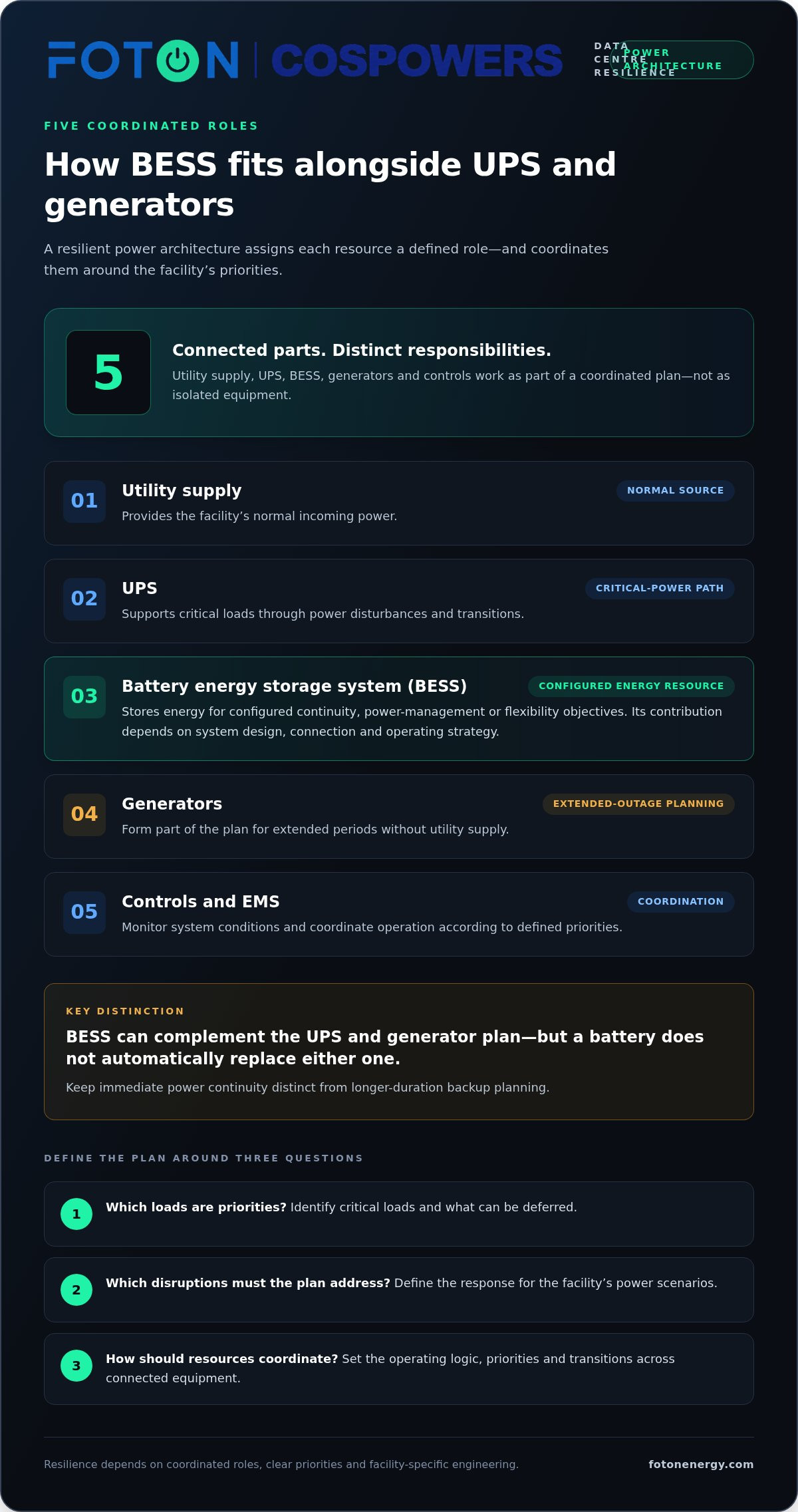
A resilient power architecture depends on coordinated roles, not a single piece of equipment. Utility supply is the normal source. The UPS supports continuity for critical loads during a disruption or transition, while generators form part of plans for extended outages. A battery energy storage system (BESS) adds stored energy that can be used according to its configuration and operating strategy. Control systems monitor conditions and coordinate resources according to defined priorities.
A battery system does not automatically replace either the UPS or the generator. It can complement them, but the right arrangement depends on which loads need support, how power systems are connected, and how the facility should respond to different events. Keep immediate power continuity distinct from longer-duration backup planning.
- Utility supply: Provides the facility’s normal incoming power.
- UPS: Supports the critical-power path through disturbances and transitions.
- BESS: Stores energy for configured continuity, power-management or flexibility objectives.
- Generators: Form part of the plan for extended periods without utility supply.
- Controls and EMS: Monitor system conditions and coordinate operation according to defined priorities.
How do UPS systems and BESS differ?
The UPS is integrated into the critical-power path, with its role defined by the facility’s design and requirements. A BESS is an energy-storage resource whose contribution depends on how it is configured and connected. Assess the interfaces between systems, including how they respond to changes in supply and how the intended operating sequence supports priority loads. Each asset should perform its assigned role without conflicting with the others.
How should batteries coordinate with generators and controls?
Coordination starts with clear operating logic. Define which resource responds to each condition, what priorities govern support, and how the system transitions between operating states. For example, the planned response to a utility interruption should account for the UPS, battery controls and generator sequence rather than treating each asset in isolation. Engineering should establish the sequence for the facility and its equipment.
An energy management system (EMS) can provide visibility into connected energy assets and support coordinated energy management. Foton Energy’s AI-driven EMS supports real-time monitoring, prediction and optimisation, helping inform how storage fits within the wider power strategy. Explore how Foton Energy’s data centre and telco backup solutions connect storage with system-level planning.
Power-quality support and operational flexibility are also possible objectives, depending on system design and integration. For energy storage for data center resilience, define operating scenarios first, then align the UPS, BESS, generators and controls around them. This gives the project team a clear basis for evaluating interfaces, control logic and the responsibilities assigned to each layer.
How to Evaluate Energy Storage for Data Center Resilience
Start with the resilience objective, then assess whether the battery chemistry, integration, controls, safety evidence and expansion approach support it. This project-led framework avoids treating a battery specification or chemistry as the answer on its own. It also helps operators compare options using consistent criteria, even when system configurations differ.
Technology selection should follow project requirements and system design. Use these criteria to structure an initial assessment:
- Resilience objective: Define the service or operational priority storage is intended to support, and the conditions under which it should operate.
- Chemistry: Identify the available battery chemistry and assess it against project requirements instead of assuming one option suits every facility.
- Integration: Map connections with existing power infrastructure, interfaces and coordination responsibilities.
- Controls: Consider how monitoring and operating logic will align with the facility’s power-management strategy.
- Safety evidence: Review applicable testing evidence, documentation and the system’s stated safety architecture.
- Scalability: Consider how the design accommodates future requirements and what changes expansion may involve.
Use these criteria to identify project-specific questions, not to reduce the evaluation to a single score. An architecture intended to support a defined continuity objective, for example, may need different control and integration considerations from one designed primarily for load flexibility. Record assumptions and responsibilities so the design team can assess the complete system, including monitoring and thermal management.
Which battery chemistry fits the project?
Foton Energy’s portfolio includes LFP and sodium-ion battery technologies. Compare them as distinct chemistry options against the facility’s operating requirements, system configuration and project objectives. There is no universal choice for every application. For additional chemistry context, consult the article on sodium-ion batteries for data centres.
What evidence should an operator review?
Review credentials and project documentation alongside the proposed integration approach. Relevant credentials include BNEF Tier 1 and DNV Verified. Safety information should use precise terms: NFPA tested, Safety-tested thermal control and Multi-layer protection with intelligent BMS, fault detection, and fire prevention. Document system interfaces, controls and commissioning responsibilities for the project.
Monitoring is part of the evaluation, not an afterthought. Consider what information the EMS provides for real-time visibility, prediction and optimisation, and how that information supports operational decisions. Review how thermal management and system controls fit into the design as well. Full product specifications and datasheets are available to logged-in partners only for detailed technical evaluation.
Planning a Resilient Data Center Storage Deployment
A well-planned deployment begins with operational requirements, not equipment selection. Before defining a battery system, establish which loads matter most, how the existing power architecture operates, and what the facility needs storage to do. This gives engineering teams a clear basis for design decisions and keeps integration, commissioning and ongoing operations aligned with the resilience objective.
What should the project team define first?
Document critical loads, continuity objectives, current infrastructure and operating priorities. Map how grid supply, UPS equipment, generators, BESS and the EMS connect, noting key interfaces and who owns each one. These records help the project team frame design questions around the site rather than relying on generic assumptions.
Then follow an ordered planning sequence:
- Set resilience objectives. Describe the operational outcomes the storage system is intended to support, including the loads and operating scenarios that matter to the facility.
- Review the existing architecture. Record current power paths, equipment, control arrangements and the interfaces a new system may affect.
- Develop the system design. Align the proposed configuration with project requirements. Include controls, monitoring, thermal management, safety evidence and opportunities for future expansion in the design review.
- Plan integration. Define system handoffs, operating priorities, monitoring responsibilities and how the BESS interacts with other power assets.
- Prepare commissioning. Agree on project-specific commissioning activities, ownership and how the team will assess the integrated system against its design intent.
- Establish operational processes. Plan how teams will use monitoring information, respond to faults, manage system handoffs and maintain oversight as facility needs evolve.
How should integration and operations be planned?
Make responsibilities visible across data centre operations, system integrators and engineering partners. Define who reviews alarms and system information, who coordinates responses, and how operating priorities are maintained when power conditions change. Document how the battery system’s controls relate to the facility’s broader energy management strategy.
Commissioning and operations are connected. A clear handover helps the operational team understand intended system behaviour, monitoring tools and the site’s escalation paths. As the facility changes, expansion planning should account for how additions may affect interfaces, controls, thermal management and operating procedures. Engineering consulting can support this joined-up process, from reviewing project requirements to aligning system design and integration decisions.
For energy storage for data center resilience, a disciplined sequence turns high-level objectives into design and operating decisions without assuming a universal configuration. Discuss your data centre storage deployment with Foton Energy to connect project requirements with storage, EMS and engineering capabilities.
Foton Energy Storage Solutions for Data Center Resilience
Data centre storage works best when its role is designed around the facility, its power architecture and its operational priorities. Foton Energy supplies data centre and telco backup systems, including containerised lithium battery systems, as part of a broader portfolio of energy storage and engineering capabilities. For energy storage for data center resilience, consider the battery system together with controls, thermal management, integration needs and the wider power strategy.
What does Foton Energy bring to a data centre project?
Foton Energy provides data centre and telecommunications storage alongside engineering consulting and intelligent energy management. Engineering support can inform feasibility, system design and project integration, helping align the storage solution with site requirements and existing infrastructure. The focus is a coordinated project approach, not a battery selected in isolation.
Foton Energy’s AI-driven EMS supports real-time monitoring, prediction and optimisation. Thermal management and safety architecture are also part of the system-level picture. Relevant safety descriptions include NFPA tested, Safety-tested thermal control and Multi-layer protection with intelligent BMS, fault detection, and fire prevention. Consider these features in relation to the project’s design and operating requirements.
During early project discussions, organise requirements around:
- Critical services and the intended role of storage within the power architecture
- Interfaces with existing power and control systems
- Monitoring, energy management and thermal management needs
- Project-specific design, integration and future planning considerations
How can operators take the next step?
Begin with the facility’s operating priorities and the role storage is expected to play. A clear project brief gives engineering teams a foundation for discussing system design, integration, EMS and thermal management together. Foton Energy’s engineering consulting and data centre storage offering can be considered as connected parts of that planning process.
Review the solution overview and define the project requirements that will guide technical discussions, including existing infrastructure, operating priorities and integration objectives. This keeps the conversation focused on how a storage system can fit the facility’s resilience strategy, rather than on product details alone.
Explore Foton Energy’s data centre storage solutions and outline your project priorities. Detailed pricing, datasheets and full product specifications are available to logged-in partners only.
Turn Resilience Priorities Into a Project Plan
Translate your facility’s operational priorities into a clear project brief. Define the role storage should play, the systems it must integrate with and the decisions your engineering team needs to resolve. This gives stakeholders a shared foundation for evaluating energy storage for data center resilience as part of a coordinated power strategy.
Foton Energy brings data centre and telco storage solutions together with engineering consulting and intelligent energy management. Its manufacturing partner has over 30 years of manufacturing heritage and has delivered 100+ utility-scale projects worldwide. Foton Energy’s listed credentials include BNEF Tier 1, DNV Verified and NFPA Tested.
Move planning forward by aligning project requirements with a solution designed for your facility’s needs. Explore Foton Energy’s data centre storage solutions and start with a clear project brief focused on your resilience priorities.
Frequently Asked Questions
Is battery energy storage the same as a data center UPS?
No. A UPS and a battery energy storage system (BESS) can have different responsibilities within a facility’s power architecture. A UPS may support a critical equipment path, while a separately configured BESS may serve wider storage or energy-management objectives. During design review, map where each system connects and which loads it serves. This helps prevent the assumption that one system automatically performs the other’s function.
Can battery storage replace generators at a data center?
Not automatically. Whether batteries can meet a continuity objective depends on the facility’s power architecture, operating requirements and system design. Document operating scenarios, load priorities and control interactions to compare the intended role of each resource. For example, consider how the architecture should respond if grid supply is interrupted while critical services remain active. The answer depends on project engineering, not a general assumption about batteries.
How does battery storage support data center resilience?
A BESS can add an energy-storage resource to a facility’s resilience plan when its configuration and controls align with operational priorities. A project may assess whether storage has a defined role in power management during changing supply conditions. The energy storage for data center resilience plan should also account for how the battery interfaces with monitoring and other power assets. Assess the complete architecture rather than treating storage as a standalone safeguard.
What happens to a data center battery system during a grid outage?
Its response depends on the design, controls, interfaces and wider backup arrangement. Use engineering and commissioning documentation to understand the intended sequence for the specific site, including how the BESS relates to critical loads, the UPS and generators. A useful planning exercise is to review an outage scenario with the operations team and trace the documented system handoffs. Do not assume another facility’s battery response will apply to your installation.
Can data center energy storage work with renewable energy?
It can be considered alongside renewable generation when the project design and controls support that arrangement. A facility planning both storage and renewable energy can define their respective objectives and how the energy management strategy should treat them. Keep the goals distinct: renewable integration concerns the use of renewable generation, while resilience planning focuses on continuity priorities. Assess their coordination for the site rather than assuming it from the presence of a battery.
How should a data center evaluate battery storage for resilience?
Start by documenting the critical services and operating scenarios the project needs to address. Then assess how a proposed system fits the facility’s existing equipment, controls, monitoring approach, thermal management needs and future plans. Record assumptions and responsibilities at system interfaces. This creates a project-specific basis for comparing options and shows where decisions depend on other infrastructure, rather than on a single battery feature.


