

Commercial and industrial battery backup systems typically support critical loads for up to four hours. BESS for industrial backup power can keep priority operations running during a grid outage, with performance shaped by the facility’s load, required backup duration, and opportunities to recharge.
Reliable backup involves more than storing energy. The system must deliver enough power to the equipment that matters, respond appropriately when grid supply is disrupted, and work with the facility’s other electrical systems. A battery energy storage system can also support energy management beyond outages, but it does not generate electricity on its own.
This article explains how BESS supports industrial resilience, what capacity means in practice, and how system components and controls manage operation. It also covers how to identify critical loads, plan for outage duration, and distinguish battery storage from an uninterrupted power supply, helping you assess where storage fits in your facility’s backup strategy.
Key Takeaways
- Separate power output, measured in kW, from stored energy, measured in kWh, to understand what a system can run and for how long.
- Prioritize critical loads and outage needs when assessing how storage could support industrial operations.
- Consider how battery storage will coordinate with generators and existing electrical systems.
- Explore how battery management, thermal controls and monitoring contribute to safe, coordinated system operation.
- Assess whether storage can serve as a standalone backup for selected loads or work alongside other resilience measures.
What Is a Battery Energy Storage System (BESS)?
A battery energy storage system stores electricity from another source; it doesn’t generate electricity. In a factory, it can charge from the grid or onsite generation, then supply selected loads when grid power fails. Its role depends on the facility’s electrical connection, operating priorities, and backup plan.
Think of the system as an integrated set of battery modules, power conversion equipment, controls, and protection. The battery stores energy, while conversion equipment manages its flow between the battery and facility circuits. Grid-ready controls coordinate charging and discharge with the site’s electrical supply, directing power to designated loads. A generator can remain part of the design: storage and generator controls must coordinate rather than compete for the same connection.
No single chemistry is best for every industrial backup duty. Lithium-ion batteries have a stated lifespan of 10-20 years, LiFePO4 batteries 15-20 years, flow batteries up to 20 years, and lead-acid batteries 5-8 years. Selection depends on required backup duration, cycling patterns, performance needs, and thermal management.
Integration starts with mapping the site’s one-line electrical diagram, existing generator, switchgear, and priority circuits. For example, a production line and its controls may need higher priority than nonessential office equipment. A microgrid can coordinate storage, generation, and facility loads when the main grid connection is unavailable. Commissioning tests can simulate grid loss, confirm the transition to islanded operation, verify generator coordination, and test reconnection to the grid.
In the United States, permits, fire-code reviews, and utility interconnection requirements depend on the project location, system design, and connection point. The design process accounts for local approvals, fire protection, and the utility’s connection process. Commissioning then tests the approved operating configuration.
For eligible US projects, the federal Investment Tax Credit is stated as 30% of total BESS project costs. Utility programs and other incentives vary by location and program terms, so their value depends on the site and project eligibility.
Manufacturing BESS installations have an estimated payback period of 4-7 years, depending on usage, incentives, and energy rates. Lifespan and performance also depend on operating conditions and maintenance, including battery monitoring, thermal management, and inspection of electrical connections. A site-specific design aligns those factors with the facility’s loads, generator, grid connection, and resilience objectives.
Backup power during grid outages
A grid outage can halt production, interrupt control systems, and disrupt safety-critical processes. BESS for industrial backup power can supply designated electrical loads while the facility manages the interruption. The system’s response depends on which circuits it protects, how quickly power must transfer, and how long operations need support.
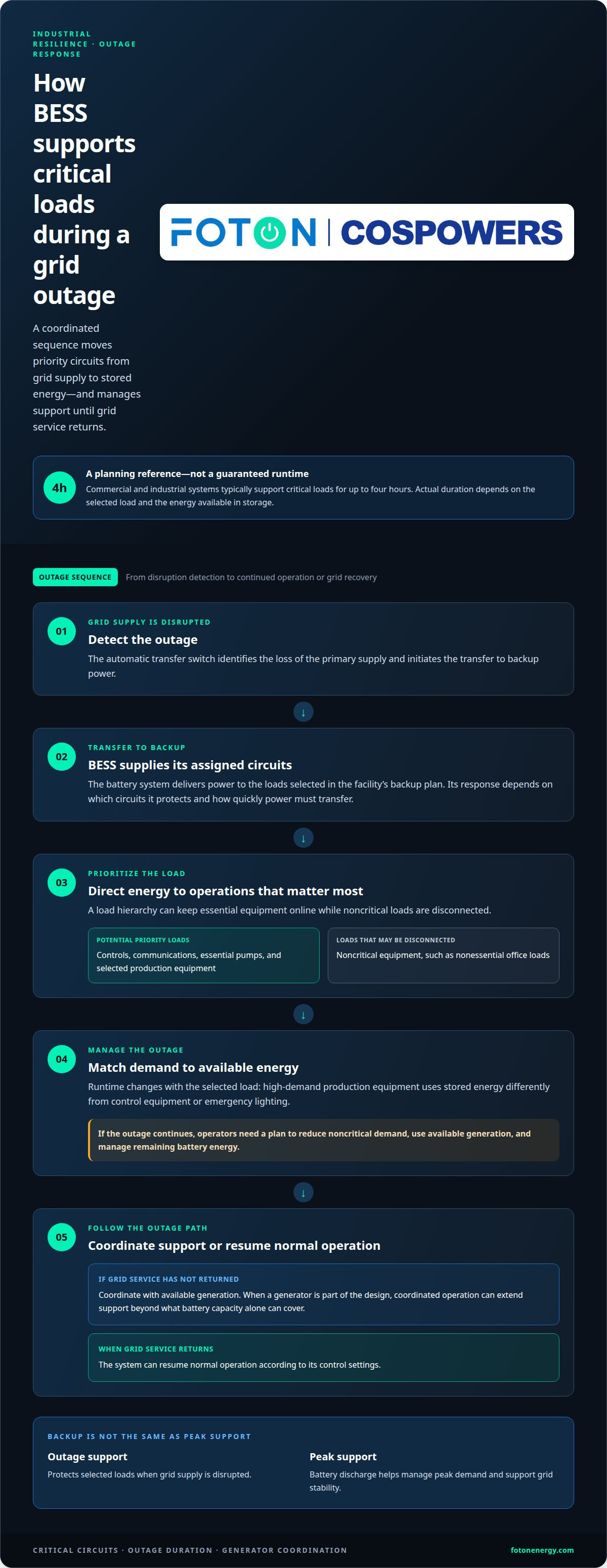
When an outage is detected, an automatic transfer switch identifies the primary supply disruption and initiates the transfer to backup power. The battery system then supplies its assigned circuits. A manufacturing site might prioritize controls, communications, essential pumps, and selected production equipment, while disconnecting noncritical loads. This load hierarchy directs stored energy to the operations that matter most.
Duration needs careful planning. Commercial and industrial battery backup systems typically support critical loads for up to four hours. This is a reference, not a universal runtime: actual duration depends on the selected load and the energy available in storage. A production line with high power demand uses stored energy differently from control equipment or emergency lighting.
Outage response also depends on what happens after the initial transfer. When grid service returns, the system can resume normal operation according to its control settings. If the outage continues, operators need a plan to reduce noncritical demand, use available generation, and manage remaining battery energy. Where a generator is present, coordinated operation can extend support when battery capacity alone cannot cover the outage.
Remote sites and facilities with limited grid access can use BESS as part of an off-grid electrical system. Storage can bridge periods when generation is unavailable, while controls balance supply and demand. At a remote processing facility, for example, the design must align priority equipment with available generation and energy stored for later use.
Storage can also support weak grids without waiting for a full outage. Battery discharge can help manage peak demand and support grid stability, while controls respond to the facility’s electrical needs. This differs from backup: peak support follows operating demand, while outage support protects selected loads when grid supply is disrupted.
For a facility assessing these roles, industrial storage planning can begin with mapping critical circuits, outage priorities, and generator coordination. Those site conditions shape how storage contributes to continuity across normal operation, peak demand, and grid interruptions.
BESS capacity and preconfigured units
Capacity has two linked measures: power and energy. Kilowatts (kW) describe how much power a battery can deliver at a given moment. Kilowatt-hours (kWh) describe the energy stored. Duration depends on both: divide usable energy by the load’s power demand to estimate how long storage can support it.
That distinction frames two design questions. Can the system deliver enough power to run the required equipment, including its starting demand? Does it store enough energy for the planned operating period? A site might have enough stored energy but insufficient output to start several machines together. Conversely, high output cannot sustain operations if stored energy runs out quickly.
Begin capacity planning by defining the mission. Identify the equipment that must keep running, its electrical demand, and how long it needs support. Then account for operating patterns: a continuous process draws power differently from equipment used intermittently. Include planned load changes and the conditions for returning equipment to normal operation. These inputs shape the balance between power rating and energy capacity.
Preconfigured units package storage components in an established arrangement, helping organize deployment and connection planning. They do not eliminate the need for site-specific engineering. The facility’s electrical layout, available space, connection point, operating environment, and integration with generation all affect the final configuration. In a microgrid, controls must also coordinate storage with other power sources and the loads being served.
Large projects illustrate why power and energy figures should be read together. The Collie Synergy battery project in Australia was listed with 2,400 MWh of energy capacity and 500 MW of power, giving a stated duration of 4.8 hours. That example shows how duration relates to the relationship between stored energy and output. It isn’t a sizing template for a factory, whose loads and resilience mission differ.
For industrial planning, compare operating scenarios rather than choosing capacity from a single peak reading. A short interruption affecting controls may require a different configuration from an outage affecting production equipment. Energy storage can also serve a broader purpose, such as managing demand during normal operations while reserving energy for backup. The operating strategy determines when the battery charges, reserves energy, and discharges.
Capacity links technology choices to the facility’s resilience objectives. A clear specification describes the required power and energy, the loads to be served, and how storage interacts with the microgrid or existing electrical system. These design decisions make preconfigured units relevant to a real site, rather than treating a packaged system as a universal fit.
BESS components and control software
An industrial battery energy storage system combines battery modules, power conversion equipment, protection, monitoring, and control software. Each component has a distinct role: batteries store electricity, conversion equipment manages energy flow, and controls coordinate charging and discharge. The electrical connection determines how the system exchanges power with the facility, grid, and connected generation.
The battery management system (BMS) monitors battery cells and operating conditions. It can prevent overcharging and deep discharging while balancing the load among cells, helping maintain consistent operation across the battery pack. Monitoring also gives operators information about charging, discharge, and system status, so they can assess whether stored energy is available for a planned operating period.
Power conversion equipment manages energy flow between the battery and the facility’s electrical system. During charging, it directs electricity from available sources into storage. During discharge, it converts stored energy into power for connected loads. Isolation equipment can separate parts of the system when required, while protection and control functions coordinate its connection with the facility.
Thermal management is another core design element. Battery operation produces heat, so the system manages temperature to support intended operating conditions. Industrial designs also commonly include fire detection and suppression, monitoring, emergency procedures, and alignment with applicable codes. These measures form an integrated safety approach, not substitutes for one another.
Control software determines how components respond to changing conditions. For example, an energy management system can coordinate charging during lower-demand periods and discharge during peak demand. It can also maintain a backup reserve, so routine energy use does not consume all stored capacity. Where generators or renewable sources are connected, control logic can coordinate their contribution with battery charging and facility demand.
During an outage, controls need to respond to changes in grid supply and direct energy to designated loads. They can coordinate with transfer equipment and other power sources according to the facility’s operating configuration. A system connected to a microgrid may need controls that balance storage, generation, and demand while the microgrid operates independently of the main grid.
Commissioning tests demonstrate how system components work together. Testing can cover charging, discharge, monitoring signals, protective responses, and communication among controls. Simulating grid loss can show whether the system follows its intended operating sequence. Ongoing maintenance focuses on equipment condition, monitoring results, thermal management, and electrical connections. Together, these components and controls make battery storage a coordinated resource for industrial operations.
BESS roles in industrial backup power and resilience
Industrial battery storage can serve several roles, but each draws on the same stored energy. A facility may reserve capacity for outages, use some to manage peak demand, or coordinate storage with renewable energy. The operating strategy determines which service takes priority as grid conditions or production needs change.
For backup, resilience means protecting the loads that sustain essential operations, not necessarily powering every machine. A facility might prioritize process controls, communications, and equipment needed for a safe shutdown. This can preserve critical functions while limiting energy use. If a production line needs full power during an outage, its demand and operating duration shape the system’s role.
Battery energy storage can also support renewable generation. Storing excess solar or wind energy lets a facility use that electricity when renewable output falls. In a microgrid, controls coordinate the battery, renewable sources, utility connection, and selected loads. The battery shifts available energy over time; it does not eliminate the need to balance generation and demand.
During normal grid-connected operation, storage may help manage peak demand and support grid stability. These functions can complement backup, but they may also reduce the energy reserved for outages. Operating settings should therefore define reserve levels and dispatch priorities. A facility prioritizing outage readiness over routine energy management will operate its system differently from one focused on daily demand management.
A BESS may replace a generator for selected loads and durations. The decision depends on surge demand, outage length, opportunities to recharge, and required autonomy. A generator may remain useful when outages exceed available stored energy or loads require sustained output. Coordinating both can support continuity across different outage conditions.
U.S. installation requirements depend on local jurisdiction, project configuration, and utility connection conditions. NFPA 855 and UL 9540 may be relevant to project reviews, but their applicability depends on the requirements adopted for the specific installation.
Key safety concerns include battery faults, thermal runaway, fire, and failures in monitoring or control. Industrial designs address these risks through thermal management, isolation, fire detection and suppression, monitoring, and emergency procedures. Cybersecurity matters too: unauthorized access to connected controls could disrupt operation, so access management and network protection belong in the operating plan.
The practical takeaway is to assign each operating role a clear priority: backup reserve, renewable-energy shifting, peak support, or generator coordination. For facilities planning wider resilience infrastructure, explore utility-scale storage and align system operation with the site’s loads, generation, and grid connection.
Foton Energy (Foton Pty Ltd): C&I BESS
Foton Energy (Foton Pty Ltd) offers C&I BESS for commercial and industrial facilities assessing battery storage for backup and resilience. It may be a relevant next step when a site has identified critical loads, outage priorities, or a need to coordinate storage with existing electrical systems.
These requirements help frame the project: which operations need support, how the system should interact with the grid or generation, and whether energy management also matters. Foton Energy’s wider offerings include Data Centre & Telco Backup, Residential Storage Systems, and Utility-Scale Storage for different applications.
To discuss how C&I BESS can fit your facility’s requirements, contact Foton Energy (Foton Pty Ltd).
Build resilience around your next operating priority
Resilience planning connects energy decisions with the facility’s future operating priorities. As production lines change, new equipment comes online, or energy sources evolve, review the backup strategy alongside those changes. This keeps the focus on the work the facility needs to sustain, rather than treating storage as an isolated asset.
For teams evaluating BESS for industrial backup power, the next step is to turn operational priorities into a project discussion: which processes matter most, how storage should fit the site, and what role it could play in a broader resilience plan. Foton Energy (Foton Pty Ltd) offers C&I BESS, Residential Storage Systems, and Utility-Scale Storage for distinct application needs.
Start a conversation with Foton Energy about the resilience requirements shaping your facility’s next decision. A clear project direction can help your team move forward with confidence.
Frequently Asked Questions
Why incorporate BESS?
Incorporate BESS when a facility wants stored electricity to support resilience planning and day-to-day energy management. For example, a plant can design its operating strategy to protect refrigeration controls while coordinating storage with onsite generation. This creates a flexible energy resource rather than equipment reserved solely for outages. The key decision is how storage supports the facility’s priorities and fits its electrical system.
Can a BESS completely replace a diesel generator?
A BESS can replace a generator for selected loads and durations, but it is not automatically a complete substitute. Assess equipment surge demand, expected outage length, opportunities to recharge, and required autonomy. A facility with extended outages or high starting loads may use storage alongside a generator. This arrangement can assign immediate response and longer-duration support to different resources.
How much space does it take up?
The footprint depends on system configuration and the facility’s electrical and operating requirements. Battery enclosures are only one part of the site layout: conversion equipment, protection, maintenance access, and thermal management also shape space planning. A compact indoor area and an outdoor installation present different layout considerations. Site planning should account for equipment access and the system’s connection to facility circuits.
Is it worth buying a BESS?
A BESS can be valuable when its operating roles match the facility’s priorities. Consider whether storage will support critical processes during outages, coordinate with onsite generation, or serve energy management needs during normal operation. A plant using the system for multiple purposes may gain broader operational value. The business case should connect those uses to operating patterns, resilience objectives, and system design.
What is a battery energy storage system (BESS) for industrial backup power?
A BESS for industrial backup power is an integrated system that stores electricity and makes it available to selected facility loads. Its controls and electrical connection determine how stored energy is directed during a disruption. For a manufacturing plant, the system can be configured around defined production or support loads. It can also coordinate with other power sources as part of a wider site energy strategy.
What BESS capacity and power rating does an industrial facility need for its critical loads and backup duration?
The required rating depends on the equipment the facility intends to keep operating and its backup plan. Review electrical demand across operating modes, including equipment starting or changing load, then determine how long each priority circuit needs support. The power rating must meet instantaneous demand; stored energy must cover the intended operating period. Load records and operating scenarios help turn these requirements into system design inputs.
How much does an industrial BESS cost in the United States, including installation and maintenance?
Industrial BESS pricing depends on system configuration, installation scope, site integration, and the maintenance plan. A useful project estimate separates equipment requirements from site work and ongoing service needs. Partner login is required for pricing, datasheets, and project configuration. No single cost figure describes every installation, because facility loads, connection requirements, and the selected operating strategy shape the project scope.
How does industrial BESS compare with diesel generators and UPS systems for backup power?
A UPS is designed to maintain uninterrupted critical power, while BESS can support broader storage and energy management uses. A diesel generator produces power from fuel; a battery system supplies stored electricity. Their roles can complement one another when immediate continuity, selected-load support, and longer outage response call for different resources. The right arrangement depends on load characteristics, outage expectations, recharge options, and the facility’s continuity priorities.


