

Around 60% of global cobalt comes from the Democratic Republic of the Congo, where mining carries heightened risks of poor health and safety conditions and child labor. Ethical sourcing of battery materials means looking beyond a battery’s performance to the origins of its minerals and the conditions under which they are extracted and processed. EV batteries can contain materials such as lithium, cobalt, nickel, graphite and manganese, with their mix depending on the battery chemistry.
The appeal of electric vehicles is clear, but their supply chains raise important questions about human rights, working conditions, water use, biodiversity and emissions. Understanding these risks helps businesses and decision-makers assess what responsible sourcing requires, rather than treating a battery as a product with an invisible history.
This article explains where key battery materials come from, how responsible-mining standards and due diligence can support better practices, and what battery passports can reveal about materials and manufacturing. It also examines the environmental and social impacts associated with cobalt, lithium and nickel, showing where transparency matters most across the battery lifecycle.
Key Takeaways
- Learn how battery chemistry shapes the mix of materials and the supply chains behind them.
- Understand how responsible-mining standards and due diligence can help identify and address supply-chain risks.
- See how battery passports can make material origins and lifecycle information more visible.
- Distinguish the environmental and social concerns associated with cobalt, lithium and nickel sourcing.
- Explore how energy storage systems fit into the wider battery lifecycle and responsible sourcing conversation.
What are EV batteries made of, and where do these materials come from?
EV battery chemistry determines its mineral mix, while mining and processing shape supply chains. These chains create environmental, social and governance risks before materials reach a battery factory.
Battery Mineral Supply Chains
Battery mineral supply chains connect extraction, processing and manufacturing across multiple locations. Lithium, nickel and cobalt are key materials, though battery chemistry affects which materials and quantities are used. Mining can create risks involving worker safety, labor rights, water use and habitat impacts, making the origin and handling of each mineral relevant to responsible procurement.
The Democratic Republic of the Congo supplies around 60% of global cobalt. Its cobalt mining sector carries increased risks of poor health and safety conditions and child labor. In Lualaba and Haut-Katanga, field research compared two pilot projects with general conditions in artisanal and small-scale cobalt and copper mining. This illustrates why origin alone may not show how a material was produced.
Cobalt Supply-Chain Traceability
Cobalt traceability means following the mineral through extraction, trading, processing and battery production. It matters because material may pass through several intermediaries, making mine-level conditions harder to connect with a finished battery. Documented chain-of-custody records can show where information originates, where it changes hands and where responsible-sourcing checks need attention.
The Democratic Republic of the Congo is particularly associated with labor risks in cobalt mining, including child labor and unsafe working conditions. These risks point to a serious sourcing concern, but do not establish a comparative ranking of conflict risks across mining countries.
Four upstream responsible-sourcing initiatives have been reviewed, and three engage with artisanal and small-scale mining in the Democratic Republic of the Congo. Their on-the-ground work focuses on improving working conditions, an important complement to tracing material through commercial records.
Recycled and Newly Mined Materials
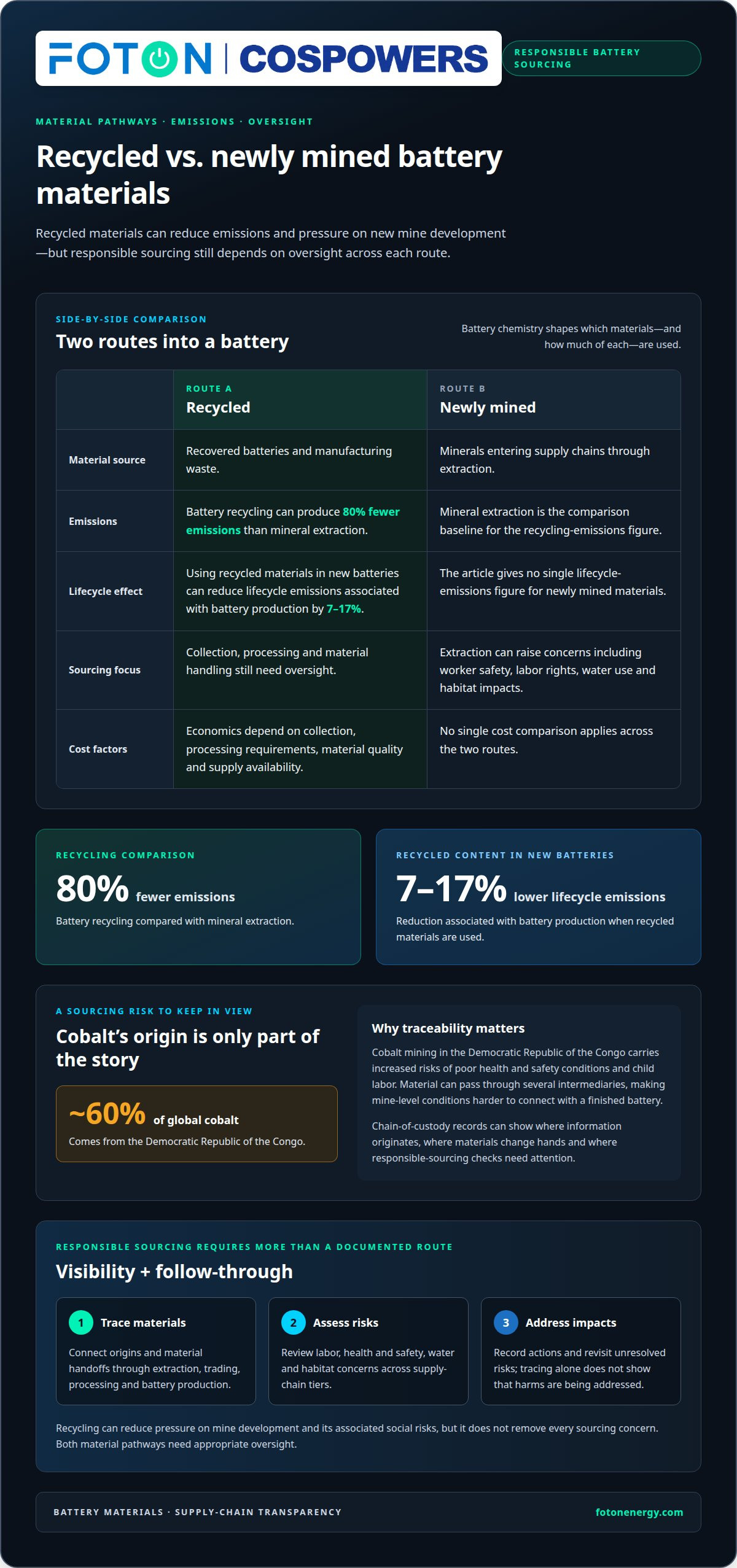
Recycled materials come from recovered batteries and manufacturing waste, while newly mined materials enter supply chains through mineral extraction. Recycling can reduce pressure on mine development and its associated social risks, but it does not remove every sourcing concern, since collection, processing and material handling also require oversight.
Battery recycling can produce 80% fewer emissions than mineral extraction. Using recycled materials in new batteries can also reduce lifecycle emissions associated with battery production by 7-17%. No single cost comparison applies across both routes: collection, processing requirements, material quality and supply availability shape the economics.
Challenges of Improving Ethical Sourcing
Improving ethical sourcing means tracing materials, assessing risks and addressing harmful practices across different tiers of a supply chain. These steps require coordination among miners, processors, traders and manufacturers, especially where artisanal mining and informal trade make records difficult to connect.
Costs and practical barriers depend on the depth of traceability, the reliability of records, the location of extraction and the resources needed for monitoring and remediation. The key distinction is between a documented material pathway and evidence that labor and environmental risks are being addressed. Ethical sourcing of battery materials therefore requires both supply-chain visibility and follow-through on identified impacts.
Responsible mining standards and due diligence
Responsible-mining standards translate human-rights and environmental principles into expectations for mineral supply chains. Due diligence helps companies identify risks, respond to them and track whether their actions address the underlying concerns.
Corporate and EU Due Diligence Obligations
Corporate sustainability due diligence is a process for identifying and addressing adverse impacts connected with a company’s operations and supply chains. It matters because mining risks can occur far upstream, beyond a battery manufacturer’s direct operations. The European Union identifies the EU Battery Regulation as Regulation (EU) 2023/1542, a key part of the region’s battery framework.
EU Regulation 2017/821 requires EU importers of tin, tungsten, tantalum and gold to conduct supply-chain due diligence in line with OECD guidance. Those minerals are not the main focus of every EV battery, so the rule should not be mistaken for a blanket battery-mineral requirement. The OECD Due Diligence Guidance for Responsible Supply Chains of Minerals, in its 3rd edition from 2016, provides a broader reference for responsible mineral supply chains. Directive (EU) 2024/1760 is identified as the Corporate Sustainability Due Diligence Directive, adding another named element to the EU policy landscape.
Supplier Due Diligence Frameworks
Supplier due diligence means assessing material suppliers and their upstream connections for environmental and human-rights risks. It matters because a supplier’s records, risk controls and responses affect how much visibility a manufacturer has beyond its direct contracts.
A practical assessment can map suppliers and mineral origins, identify potential harms, record actions, and revisit unresolved risks. The UN Guiding Principles on Business and Human Rights, OECD guidance and the World Bank Environmental and Social Framework are reference points for mineral-supply-chain due diligence. The BASE project received funding from Horizon Europe’s Research and Innovation Actions under grant agreement No. 101157200. Its due diligence framework belongs in this broader discussion, while those named sources provide explicit reference points for evaluating supply-chain risks.
Actions for Manufacturers and Consumers
Manufacturers can support responsible sourcing by mapping suppliers, applying recognized due-diligence guidance, recording risks and following up on corrective actions. These steps link purchasing decisions to conditions further upstream, rather than treating a supplier declaration as the whole picture.
Consumers can favor clear sourcing information and consider durability, repair and reuse when assessing battery-powered products. The UN Declaration on the Rights of Indigenous Peoples offers a reference for respecting free, prior and informed consent in decisions affecting Indigenous Peoples. Supplier assessments, meaningful engagement and transparent records make responsible sourcing more actionable. Sustainable mining depends on addressing identified harms, not just publishing standards.
Battery passports and lifecycle transparency
A battery passport is a structured record linking a battery to information about its materials, production and lifecycle. It matters because supply-chain visibility depends on records that can follow the battery beyond the factory gate.
Companies can trace materials by linking records at each handoff: mine or recovery source, processor, material supplier, cell maker and battery manufacturer. Each stage records relevant origin and transaction information, then passes it on with the material or product. Continuous records help show where information is complete, where it changes and where additional due diligence can address blind spots.
A battery passport can record manufacturing history, provenance, materials, recycled content and environmental, social and governance information. These details connect a finished battery to upstream sourcing records and downstream lifecycle information. For example, a record of recycled content can distinguish recovered inputs from newly mined materials, while provenance fields can link mineral origin to supplier documentation.
The European Union’s Regulation (EU) 2023/1542 provides for Digital Battery Passports for certain batteries from 2027. The passport is intended to make lifecycle information more accessible through a digital record. Its value depends on the accuracy and consistency of the information entered across the supply chain, not simply on the existence of a digital record.
In practice, manufacturers need to align data from suppliers, processors and production systems. A mine-origin record may use different identifiers from a processor’s shipment record, so systems need a reliable way to associate both with the relevant material. Clear data ownership also matters: each supply-chain participant must know what information it supplies and receives at the next handoff.
Passports support transparency, but they do not independently prove that a mine or processor meets responsible-sourcing expectations. A record can show declared origin and reported practices; due diligence assesses the risks and responses behind those declarations. Pairing passport data with supplier assessments, audit records and corrective-action tracking gives companies a stronger basis for evaluating information and finding gaps.
Lifecycle records can follow a battery beyond its first application. When a battery is retired from a vehicle, information about its manufacturing history and materials can support decisions about reuse, repurposing or recycling. The same data can help downstream handlers identify materials for recovery and preserve provenance as they return to production. Used this way, a passport becomes a shared information tool across manufacturing, use and end-of-life management.
Environmental and social impacts of mining
Battery mineral extraction and processing carry environmental and social impacts beyond a mine boundary. Mining can alter land, consume water and generate emissions, while working conditions and community rights shape the social consequences. Minerals mining and processing are responsible for 10% of all greenhouse gas emissions. That figure makes the emissions profile of extraction and refining relevant to the full battery lifecycle, not just factory operations.
For hard-rock lithium, the carbon dioxide footprint deserves particular attention. The mining method, energy used in extraction and processing, and distance traveled all influence that footprint. Mine-level information is therefore useful: a mineral name alone cannot show the energy sources or practices behind production. Environmental assessment can distinguish impacts at the extraction site from those created during processing.
Lithium sourced from brine raises concerns about water use and engagement with local communities. Water is central to brine extraction, so its use needs to be considered alongside local conditions and community priorities. A responsible assessment considers how water needs interact with existing uses and how decisions are communicated to affected people. The same mineral can present different concerns depending on its source and extraction context.
Indigenous Peoples’ free, prior and informed consent should be central to decisions about projects that may affect them. Meaningful engagement needs to take place before decisions are settled, give communities relevant project information and allow them to express their views. Consent does not replace environmental assessment; both help identify impacts and inform decisions about project design, operation and mitigation.
Social impacts also depend on labor conditions, health and safety, and how the benefits and burdens of mining are distributed. Assessments need to look beyond formal policies to how work is organized and concerns are handled on site. For example, monitoring workplace conditions and recording responses to reported harms can make corrective action more accountable. These checks connect responsible-mining practices with day-to-day operations.
A practical environmental and social review can assess water use, emissions, land impacts, labor conditions and community engagement as connected issues. It should identify the location and activity behind each risk, the people or ecosystems affected, and the action intended to address it. Tracking these points over time supports stronger oversight because conditions can change as a project develops. For battery buyers, this detail clarifies what a sustainability claim covers and where impacts remain unresolved.
Responsible sourcing risks for cobalt, lithium and nickel
Responsible sourcing requires mineral-specific assessment: location, extraction method and supply-chain controls shape the risks. Cobalt, lithium and nickel each raise distinct environmental and social concerns, while graphite and manganese also warrant scrutiny in battery supply chains.
For cobalt, the Democratic Republic of the Congo is a key focus. Cobalt mining there carries increased risks of poor health and safety conditions and child labor. These concerns make labor practices and worker protections central to responsible-sourcing assessments. A mineral’s country of origin is a useful starting point, but it cannot show conditions at a particular mine or actions taken to address identified harms.
Lithium risks depend partly on the extraction method. Brine-sourced lithium raises concerns about water use and engagement with local communities. Hard-rock lithium requires particular attention to its carbon dioxide footprint. These are different impact pathways, so an assessment needs to connect the extraction method with local environmental conditions and community interests, rather than relying on one generic checklist.
Nickel sourcing in Indonesia requires particular attention to tailings management and biodiversity impacts. Tailings are mining residues that need responsible handling, while biodiversity assessment considers effects on surrounding habitats. These issues call for site-specific information about operational controls and the environment near extraction and processing activities. Country-level sourcing information alone cannot show how a particular project manages either concern.
For graphite and manganese, responsible assessments should examine labor conditions, health and safety, community impacts and environmental controls across extraction and processing. Specific risks depend on where and how materials are produced. This approach avoids assuming that every mine has the same impacts while applying consistent expectations across the supply chain.
A practical review can organize each material’s risks by origin, extraction method and evidence of management:
- Cobalt: assess worker safety and child-labor risks, especially in the Democratic Republic of the Congo.
- Lithium: examine brine-related water and community concerns, and hard-rock carbon dioxide impacts.
- Nickel: review tailings management and biodiversity impacts in Indonesia.
- Graphite and manganese: assess site-specific labor, community and environmental controls.
For each concern, trace the relevant supplier connection, document the evidence and record any response. That makes responsible sourcing more specific than a broad sustainability claim. To connect sourcing priorities with energy-storage planning, explore energy storage solutions.
Foton Energy (Foton Pty Ltd)
Foton Energy (Foton Pty Ltd) supports energy-storage planning when responsible sourcing informs project requirements. Its Residential Storage Systems, Utility-Scale Storage and Data Centre & Telco Backup offerings serve different applications, from household energy needs to larger infrastructure and backup requirements.
For project teams, the next step is to connect sourcing priorities with the intended use, system scale and operational context. Foton Energy can discuss how its storage offerings fit those project needs, while keeping system selection distinct from supply-chain due diligence.
Contact Foton Energy (Foton Pty Ltd) to discuss your energy-storage requirements.
Make sourcing priorities part of the next decision
Ethical sourcing of battery materials is an ongoing responsibility, not a single procurement milestone. As projects move from planning to operation, keep responsible sourcing connected to decisions that shape system requirements and long-term use. Clear priorities can align supply-chain expectations with the purpose and scale of an energy-storage project.
For organizations putting those priorities into practice, Foton Energy (Foton Pty Ltd) offers C&I BESS, Residential Storage Systems and Utility-Scale Storage. These offerings serve different project contexts, while sourcing assessment remains a distinct part of procurement and supply-chain oversight. A considered next step is to bring project needs and sourcing expectations into the same planning conversation.
Contact Foton Energy (Foton Pty Ltd) to discuss your energy-storage requirements. Each informed decision helps build a more transparent and resilient energy future.
Frequently Asked Questions
What does ethical sourcing of battery materials mean?
It means considering how battery minerals are extracted, processed and traded, not just whether they meet technical requirements. A practical assessment connects sourcing records with labor conditions, environmental impacts and actions taken when risks arise. For example, a purchasing team can distinguish a supplier’s policy statement from evidence showing how a specific concern was assessed and addressed. Traceability supports that review but does not replace it.
Which materials are used in batteries, and where are they mined and processed?
Battery chemistries can use lithium, cobalt, nickel, graphite and manganese, with the mix depending on the design. Cobalt production is strongly associated with the Democratic Republic of the Congo, which supplies around 60% of global cobalt. Each material passes through processing before battery manufacturing, and extraction and processing locations can differ. For a particular battery, chemistry and supplier records help clarify which materials and origins are relevant.
What environmental impacts result from mining and processing battery materials?
Impacts can include greenhouse gas emissions, water use, land disturbance, biodiversity pressure and mining residues. Concerns vary by material and extraction method: brine lithium raises water-use questions, while hard-rock lithium’s carbon footprint merits attention. Processing also matters because energy use and operational controls shape impacts after extraction. A useful review distinguishes mine-site effects from processing impacts and records which locations and activities each assessment covers.
What laws and regulations govern ethical sourcing of battery materials in the United States and internationally?
Requirements depend on jurisdiction, product and supply-chain role. The European Union’s battery framework includes Regulation (EU) 2023/1542. EU Regulation 2017/821 covers due diligence for EU importers of tin, tungsten, tantalum and gold, rather than all battery minerals. For US activity, businesses need to identify applicable federal, state and trade requirements for their specific circumstances; EU rules do not automatically apply to every US transaction.
Which battery sourcing standards, certifications, and due diligence frameworks are recognized?
Useful reference frameworks include the OECD Due Diligence Guidance for Responsible Supply Chains of Minerals, the UN Guiding Principles on Business and Human Rights, and the World Bank Environmental and Social Framework. The Initiative for Responsible Mining Assurance standards address transparency and accountability around mine-site human rights, environmental and labor conditions. These frameworks guide assessment; mentioning them alone does not establish that a supplier or mine has been independently certified.


