

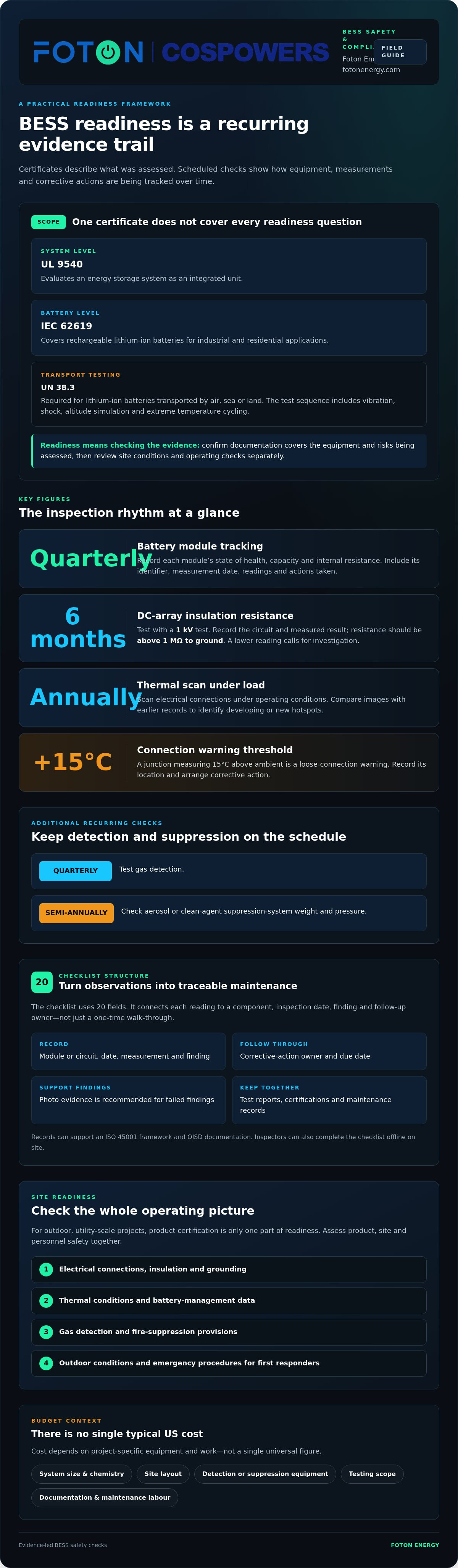
One certification alone can’t establish that a BESS is ready for a site. A BESS safety and compliance checklist should distinguish between system-level certification and battery-level standards: UL 9540 evaluates an energy storage system as an integrated unit, while IEC 62619 covers rechargeable lithium-ion batteries for industrial and residential applications, according to the International Electrotechnical Commission. The right question is whether the documentation covers the equipment and risks you need to assess.
That distinction matters especially for outdoor, utility-scale projects, where product certification is only one part of site readiness. Electrical connections, emergency procedures, gas detection, fire suppression, and outdoor conditions all require separate checks.
This guide provides a practical way to assess certification scope and work through site checks. It explains what to review in system and battery documentation, what to examine in electrical and thermal-management systems, and how to assess emergency readiness, detection and suppression provisions, and outdoor site risks. The goal is a clear, evidence-based view of readiness, not simply a count of certificates.
Key Takeaways
- Assess certification by what it covers: system-level documentation and battery-level standards address different parts of BESS safety.
- Build scheduled checks into maintenance records, including quarterly tracking of each module’s state of health, capacity, and internal resistance.
- Include insulation resistance, grounding, connections, and thermal scanning in electrical inspections, with qualified personnel following local requirements.
- Test gas detection quarterly and check aerosol or clean-agent suppression-system weight and pressure semi-annually.
- For outdoor utility-scale sites, assess product, site, and personnel safety together, and keep emergency procedures ready for first responders.
How is a scheduled battery energy storage (bess) safety check different from a general inspection?
A general inspection records visible condition; a scheduled battery energy storage safety check follows a repeatable test plan. It compares measurements over time, documents findings, and assigns corrective actions. For owners and operators, the difference is evidence: a checklist can connect a reading to a component, inspection date, finding, and follow-up owner. A useful BESS safety and compliance checklist therefore turns observations into a traceable maintenance record, rather than a one-time walk-through.
Battery chemistry affects which hazards and equipment require attention. Lithium-ion checks focus on battery-management data, thermal conditions, electrical connections, and system-specific safety documentation. Lead-acid and flow battery checks need to reflect their distinct cell designs, electrolyte systems, containment, and operating procedures. Apply the documentation and inspection criteria for the installed technology and configuration. Don’t assume a checklist for one chemistry covers another.
Set a recurring schedule around the equipment and its maintenance requirements. Record each battery module’s state of health, capacity, and internal resistance each quarter, so gradual changes can be compared across the pack. Include the module identifier, measurement date, reading, and any action taken. Inspection records can support an ISO 45001 framework and OISD documentation. The checklist uses 20 fields, recommends photo evidence for failed findings, and allows corrective actions to carry owners and due dates. Inspectors can also complete it offline on site.
Keep product certification, battery testing, and operating inspections distinct. IEC 62619 is an international safety standard for rechargeable lithium-ion batteries used in industrial and residential applications, according to the International Electrotechnical Commission. UL 9540 addresses the integrated energy storage system, while battery-level documentation addresses the battery itself. For lithium-ion batteries transported by air, sea, or land, UN 38.3 testing is required under international law. Its test sequence includes vibration, shock, altitude simulation, and extreme temperature cycling. Retain relevant test reports and certification documents with the project’s equipment records.
For stationary BESS in the European Union, Regulation (EU) 2023/1542 requires safe operation and use under normal conditions. A general inspection alone cannot show whether the system’s records, test results, and maintenance actions remain aligned with its design and applicable requirements.
There is no single typical US cost for BESS safety equipment and compliance. Budget drivers include system size and chemistry, site layout, required detection or suppression equipment, testing scope, and the labour needed to document and maintain the system.
- Identify the battery chemistry and system configuration before selecting inspection tasks.
- Log module state of health, capacity, and internal resistance each quarter.
- Keep transport-test reports, system and battery certifications, and maintenance records together.
- Document inspection evidence and assign every failed finding a corrective-action owner and due date.
Electrical connections, insulation, and grounding
Electrical inspections should assess the condition of the energy path, not just confirm that equipment is running. Loose terminals, damaged insulation, poor grounding, and heat at connection points can undermine reliability. Use equipment drawings to locate DC conductors, junctions, protective devices, and grounding connections, then compare field conditions with the approved design. Record the test method, reading, location, and corrective response so future inspections can identify changes.
Schedule insulation-resistance testing on the DC array every six months using a 1 kV test. Confirm that DC-array insulation resistance exceeds 1 MΩ to ground, and record the circuit tested and measured result. A reading below that threshold calls for investigation before the system is treated as ready for normal operation. Follow equipment instructions and safe isolation procedures during testing; a qualified electrician should perform electrical work in accordance with local regulations.
Thermal scanning adds evidence that a visual inspection cannot provide. Scan electrical connections annually under load, when operating conditions can reveal abnormal heating. Flag a junction measuring 15°C above ambient as a loose-connection warning, then document its location and arrange corrective action. Compare images with previous inspection records to distinguish a developing hotspot from a new finding. A thermal scan supports maintenance decisions, but it doesn’t replace insulation or grounding tests.
- Inspect conductors and terminals: Look for damaged insulation, corrosion, movement, or discolouration, then record the affected circuit.
- Test insulation: Perform the 1 kV DC-array test every six months and record whether resistance exceeds 1 MΩ to ground.
- Check connections under load: Complete the annual thermal scan and investigate junctions 15°C above ambient.
- Review protection and grounding: Compare installed components and connections with project drawings, then document discrepancies and corrective actions.
UL and IEC certifications are based on independent, third-party testing, but certificates don’t replace site-level electrical inspection. UL 1741 covers inverters, converters, and controllers used in solar and storage systems; IEC 62109 specifies safety requirements for photovoltaic power-conversion equipment. Match equipment documentation to the installed components, and verify that field wiring, protective devices, and grounding follow the project design and local regulations.
For NFPA 855, the 2023 edition, and IFC 1207, the 2023 edition, are relevant stationary BESS fire-safety frameworks. Assess spacing, fire protection, and emergency access against the applicable adopted requirements and site configuration, with equipment separation and responder routes shown in project plans.
For projects connecting storage equipment to electrical infrastructure, review utility-scale storage systems as part of the wider site-readiness assessment.
Emergency management and first responder engagement
A written emergency response procedure should connect battery alarms to clear site actions. Document who receives alerts, who can isolate equipment, how responders enter, and where they find system information. Include the battery chemistry, energy capacity, site layout, shutdown locations, and emergency contacts. Keep the current procedure available at the control point and in a format responders can use during an incident.
Battery management systems should monitor cell and module voltage, temperature, current, and communication status. Configure alarms for abnormal readings and system faults, with protective responses such as limiting operation or initiating shutdown in line with the system design. Operators need to know which alarms require escalation, who can confirm the condition, and how to record the event and response.
Prepare first responders before an incident. Walk through access routes, isolation points, site signage, and system-document locations together. A site map should identify battery enclosures, electrical equipment, deflagration vents, and restricted areas. Explain that vent discharge zones must remain clear, and show responders where not to stand during an emergency. Record questions and update reference materials when site conditions change.
- Confirm alarm routing: Identify who receives each BMS alarm and who has authority to initiate the documented response.
- Review shutdown steps: Use the manufacturer’s operating sequence and distinguish routine shutdown from emergency isolation.
- Check vent areas: Keep deflagration-vent discharge paths unobstructed and include them on the responder site plan.
- Run a shutdown drill: Practise communication, access, role assignment, and the approved shutdown sequence without improvising equipment actions.
- Close the loop: Document drill findings, assign corrective actions, and confirm completion with the responsible owner.
Drills should test decision-making as well as equipment. For example, simulate a temperature alarm followed by a communications fault, then ask operators to follow escalation steps and responders to locate the isolation point. An independent observer can record unclear instructions, delayed handoffs, or missing reference materials. Address those gaps in the procedure and repeat the relevant scenario.
Emergency records should include alarm history, shutdown events, drill dates, participants, observed issues, corrective-action owners, and evidence of completion. Keep revisions traceable so responders and operators use the same current document. For residential storage, keep household instructions concise and align them with the system’s documented shutdown method. At utility-scale sites, include control-room roles, responder access, and coordination between operations and emergency services. Clear responsibilities help turn monitoring signals into a consistent response.
Gas detection and fire-suppression checks
Gas detection and suppression checks should test the full response chain, from sensor input to alarm and system action. In lithium-ion energy storage systems, abnormal battery conditions can release gases before visible flames appear. A detector that works locally but fails to communicate with the control system leaves operators without a usable warning. Include sensor status, alarm routing, suppression readiness, and inspection evidence in the site’s fire-safety records.
Use recognised frameworks to structure the review. NFPA 855, 2023 edition, and IFC 1207, 2023 edition, are relevant to stationary BESS fire-safety compliance. They provide a reference point for reviewing the installation alongside its design, local requirements, and authority having jurisdiction. A checklist should identify the applicable design documents and record how each tested safety function aligns with them.
- Function-test gas detection quarterly: Test carbon monoxide (CO), hydrogen (H₂), and electrolyte off-gas detection, then record sensor response and alarm transmission.
- Verify alarm pathways: Confirm each detector produces the intended local and remote notification, because missed signals can delay operator response.
- Check suppression equipment semi-annually: Record aerosol or clean-agent system weight and pressure, since either reading can indicate reduced readiness.
- Inspect discharge and detection locations: Compare installed sensors and suppression components with the approved technical layout, so obstructions or altered equipment don’t compromise coverage.
- Track corrective actions: Assign an owner and due date to each failed test, then document closure evidence before restoring the affected function.
Detection and suppression have different roles. Gas sensors can alert operators to an abnormal condition, while suppression equipment is designed to respond to a fire scenario. Neither replaces battery-management monitoring, temperature controls, or the site’s emergency procedures. For a utility installation paired with renewable generation, review how alarms reach the control room and how operating teams coordinate actions across connected equipment.
Thermal-runaway prevention starts with reviewing trends, not just annual or quarterly testing. Compare battery-management alarms, temperature readings, and maintenance findings to spot recurring changes. For example, investigate and document follow-up for a repeated temperature warning on one enclosure. Keep detectors and suppression components accessible, and record work that could affect sensor placement or discharge paths.
Close each inspection by checking test records against equipment identifiers and dates. A complete record should show the device tested, method, result, alarm response, defect, assigned action, and closure. This evidence helps owners distinguish a successful sensor test from a complete system-level response and supports consistent fire-safety oversight across storage projects.
Guidelines for outdoor, utility-scale lithium-ion BESS
Outdoor utility-scale lithium-ion BESS projects need an assessment that joins product, site, and personnel safety. The guidelines cover systems with a maximum DC voltage of 1500 V, a maximum AC voltage of 1000 V, and energy storage capacity exceeding 20 kWh. Treat those limits as scope boundaries, then match each project’s equipment and operational conditions to its applicable requirements.
Start with certification scope. UL 9540 evaluates an energy storage system as an integrated unit, including its battery, inverter, and control software. IEC 62619 addresses lithium-ion battery safety, while UL 1973 covers batteries used in stationary applications. Check UL 9540 and UL 9540A at the unit level, and retain full certification documentation and independent testing reports. One certificate doesn’t establish that every component, site condition, or operational risk has been addressed.
Translate the design into site-readiness checks. The annual BESS site walk should align with the authority having jurisdiction, using NFPA 855 §4.1 and IFC 1207 as references. Walk the full equipment footprint and document access, equipment condition, ventilation, drainage, protective barriers, and signs of impact or corrosion. Compare the installed layout with approved drawings, and record deviations with a corrective-action owner.
- Check thermal balance: Keep the intra-pack temperature gradient under 3°C during a 1C discharge cycle, since uneven temperatures can signal cooling or operating issues.
- Review liquid cooling: Check coolant pH against the 8.0-10.5 range every 90 days, and record the result with the inspection.
- Test coolant loops: Conduct semi-annual pressure testing at 1.5× operating pressure to identify leaks or pressure loss.
- Validate temperature sensors: Cross-check 10% of pack thermistors annually against a reference probe, and replace sensors outside ±1°C of the reference.
- Respond to excess gradient: Schedule coolant-flow balancing and an HVAC-capacity review within 14 days when the gradient exceeds 3°C.
These checks make thermal-management performance measurable rather than assumed. Record readings, test conditions, equipment identifiers, and follow-up actions so developing faults can be assessed against previous results. Review the data alongside operating alarms and maintenance history: a single reading rarely explains the cause of a temperature change.
For a utility-scale project, use these checks to connect certification evidence with site-specific conditions and ongoing operations. Explore utility-scale storage solutions as you plan a BESS around the project’s safety and performance requirements.
Foton Energy (Foton Pty Ltd): C&I BESS
Foton Energy (Foton Pty Ltd) offers C&I BESS for commercial and industrial energy storage projects. If your site-readiness review has clarified operational needs, electrical constraints, and safety priorities, this offering can be considered as part of your project planning. Aligning those requirements early helps frame system selection around the facility’s intended use and integration context.
A practical next step is to bring your site requirements and readiness findings into the project discussion. This creates a shared basis for assessing how a C&I battery energy storage system fits the facility, alongside the compliance and operational factors in this checklist.
To discuss your project, visit the Foton Energy website.
Turn site readiness into a confident project plan
A completed BESS safety and compliance checklist can do more than close inspection items. Use its findings to guide the next project decision: define operational priorities, identify design constraints, and align storage capacity with the site’s intended role. This turns a safety review into a practical foundation for planning, procurement, and long-term system integration.
Foton Energy (Foton Pty Ltd) offers C&I BESS, Residential Storage Systems, and Utility-Scale Storage. These offerings serve different project contexts, from commercial and industrial facilities to residential and larger-scale energy storage needs. Start the discussion with your site objectives and the requirements identified in your readiness review.
Contact Foton Energy (Foton Pty Ltd) to discuss your energy storage project. A clear next step can help move your plans forward with purpose.
Frequently Asked Questions
Can I trust an ESS that only has one certification?
One certification alone doesn’t show that every part of an ESS has been assessed. First identify what the certificate covers: the integrated system, battery, inverter, or another component. Then compare its scope with the equipment list and project design. For example, a battery certificate doesn’t by itself demonstrate that an inverter and control software were assessed as part of the complete system.
Do all lithium batteries need UN 38.3 testing?
Lithium-ion batteries transported by air, sea, or land are required by international law to pass UN 38.3 testing. The tests include vibration, shock, altitude simulation, and extreme temperature cycling. For a project receiving battery modules or containers, keep the applicable test documentation with shipping and equipment records. This transport-testing requirement is distinct from the checks used to assess a battery system during installation or operation.
Is a CE mark the same as UL or IEC certification?
No. A conformity mark alone may not show which requirements or product configuration the documentation covers. It is not equivalent to UL or IEC certification. Certification schemes can differ in how products are assessed and documented. When reviewing documentation, distinguish the mark or certificate from the test report, and confirm which product and configuration each document covers. This helps prevent different conformity processes from being treated as interchangeable.
What do HSE engineers, asset integrity engineers, maintenance planners, and inspection engineers check on it?
HSE engineers review hazards, emergency procedures, access, and how workers respond to alarms. Asset integrity engineers assess equipment condition, degradation indicators, and whether findings threaten continued operation. Maintenance planners turn defects and test results into scheduled work, parts, and assigned responsibilities. Inspection engineers examine physical condition and test evidence, then record defects against equipment identifiers. For example, a recurring enclosure alarm may require both a technical assessment and a tracked maintenance task.
What evidence does it require?
Build an evidence file that links each safety claim to the relevant equipment and project requirement. Include certification documents, independent testing reports, drawings, inspection results, alarm and maintenance records, and corrective-action closure evidence. For supplier acceptance, retain full-system factory acceptance test results and compare voltage, capacity, and efficiency with contractual specifications. Buyers can witness testing in person or use a third-party inspection before approving shipment.
What is the most important certification for an ESS in the United States?
For a complete home energy storage system in the United States, UL 9540 is identified as the most critical certification. It evaluates the energy storage system as an integrated unit, including its battery, inverter, and control software. Check that the certification applies to the system configuration being considered, rather than assuming a battery-level document covers the complete installation. Other component standards address different equipment or safety scopes.
What codes and standards apply to battery energy storage system safety in the United States?
Relevant references include NFPA 855, 2023 edition, and IFC 1207, 2023 edition, for stationary BESS fire-safety compliance. UL 9540 addresses the integrated system, while UL 1973 covers batteries used in stationary applications. UL 1741 covers inverters, converters, and controllers used in solar and storage systems. Treat these as distinct scopes, then map project equipment and design documents to the applicable framework.
What fire codes and permitting requirements apply to BESS installations by state and locality?
Fire-code and permit reviews depend on the requirements adopted for the project’s jurisdiction and the site design. NFPA 855 and IFC 1207 are relevant stationary BESS fire-safety frameworks, while the NYSERDA BESS guidebook includes a chapter presenting the 2020 New York State Uniform Fire Prevention and Building Code. Prepare system drawings, equipment documentation, and fire-safety plans for review against the jurisdiction’s adopted requirements.


