

A BESS safety strategy is only as strong as the evidence behind each layer. BESS thermal runaway prevention technologies can reduce the likelihood of failure or limit its spread, but detection and suppression systems may manage consequences rather than prevent the initiating event. Knowing which function a safeguard serves matters when comparing solutions for a project.
It is reasonable to expect safeguards at several levels. Cell design, battery management, thermal control, module-level barriers, and system-level detection or fire protection each intervene at different points. No single measure eliminates risk. The challenge is to determine what each technology is designed to do, how it performs alongside other safeguards, and whether the supporting evidence applies to the proposed system and site.
This guide compares prevention layers by intervention point and the evidence available to assess them. You’ll learn how thermal runaway can begin and propagate, what to examine in test reports and project documentation, and how to structure a project-specific safety review with qualified technical partners. The goal is a clearer, more rigorous basis for design and procurement decisions.
Key Takeaways
- Distinguish measures that reduce the chance of cell failure from systems designed to detect, contain, or manage its consequences.
- Map safeguards across cell, module, rack, container, controls, and site levels to identify where protection depends on integration.
- Compare BESS thermal runaway prevention technologies by intervention point, intended function, supporting evidence, and limitations.
- Use a project-specific checklist to review hazards, operating conditions, system interfaces, commissioning, and local requirements.
- Assess safety as a coordinated architecture, and verify product-specific safeguards and test evidence before relying on them.
BESS thermal runaway prevention technologies: what they prevent, and what they do not
Safety depends on knowing which stage each safeguard addresses. Thermal runaway is a self-accelerating cell failure process: heat generated within a cell can drive further reactions and generate additional heat. The sequence and severity can vary. The thermal runaway overview explains the underlying process, but project teams need to assess how it could unfold in their specific battery design and site conditions.
Prevention reduces the chance of initiation; propagation control limits what may happen next. Detection identifies abnormal conditions, while emergency response manages hazards after an event develops. These functions can work together, but they are not interchangeable. UL 9540A, the test method for evaluating thermal-runaway fire propagation in BESS, focuses on how failure may spread. This illustrates why limiting propagation is a different objective from preventing initiation.
How thermal runaway can begin and spread in a BESS
Potential triggers include electrical abuse, internal faults, or external heating. If a cell enters runaway, heat may transfer to nearby cells. Further failures can increase the heat and fire hazard beyond the initiating cell, with consequences that depend on system design and conditions. Cell chemistry influences battery characteristics, but no chemistry replaces system-level safety design. Layered safeguards can reduce risk, not eliminate it.
Prevention, detection, propagation control, and response
Use these terms precisely when evaluating BESS thermal runaway prevention technologies:
- Prevention: Design, operating, and quality controls intended to reduce the likelihood of a failure starting. Cell selection and operating limits may contribute, but do not establish a guarantee.
- Detection: Monitoring intended to identify abnormal conditions early enough to trigger defined system actions. Review which conditions are monitored, how alerts are handled, and what actions follow.
- Propagation control: Barriers or design measures intended to limit heat or fire transfer from a failed cell or unit to others. These address spread, not necessarily the initial failure.
- Response: Fire protection, emergency procedures, and site coordination intended to manage hazards once an incident develops. These are essential layers, but they do not prevent initiation.
For a project review, ask vendors to state where each safeguard intervenes and provide evidence relevant to the proposed configuration. Separate claims about early detection from evidence that a design limits propagation. Confirm how controls, hardware, operating procedures, and site planning work together. A credible safety case explains both what each layer is designed to do and what remains outside its scope.
How BESS thermal-runaway prevention technologies work across the system
Safety is built across layers, not supplied by a single component. BESS thermal runaway prevention technologies act at different points. Some reduce the chance of cell failure, while others monitor conditions, limit heat transfer, or support site-level response. Evaluate how each layer connects to the others, and confirm that the proposed design suits the project’s operating profile and site.
A useful review follows the system from the cell outward. Cell quality and chemistry influence the starting risk, while module and enclosure design, control logic, thermal management, and site planning shape how the system operates and responds. The NFPA 855 standard is one reference for identifying applicable installation and fire-safety provisions. Confirm the relevant edition and local requirements for the project.
Cell, module, and enclosure-level safeguards
At cell level, selection, manufacturing quality assurance, and traceability are upstream risk controls. Chemistry also matters: LFP and sodium-ion systems have different characteristics, but neither chemistry alone guarantees prevention. At module and rack levels, component layout and physical separation can influence heat transfer and propagation. Enclosure design adds another layer, but should be assessed against relevant evidence rather than treated as proof against every failure scenario.
Monitoring, operating controls, and thermal management
Monitoring systems track relevant electrical and temperature conditions. Control logic can compare readings with defined limits or trends, flag abnormalities, and initiate predetermined actions, such as changing operation or issuing an alert. Review what the system measures, how thresholds are set, and what happens when a signal is missing or abnormal. Thermal management helps maintain operating conditions. It is not the same function as fire suppression.
- Cell: Assess chemistry, quality controls, and traceability evidence.
- Module and rack: Review layout, separation, and evidence relevant to propagation.
- Container and site: Evaluate enclosure, placement, access, and interfaces with site plans.
- Controls and thermal management: Verify monitored conditions, operating limits, response logic, and cooling design.
System safety depends on coordinated design, monitoring, and operating controls, each verified for the project. Ask suppliers to explain how safeguards interact across the architecture and provide documentation relevant to the proposed configuration. For teams assessing those interfaces, BESS engineering consulting can be part of a project-specific design review.
Compare BESS thermal-runaway technologies by function, evidence, and limitations
Compare safeguards by what they do, where they act, and what proves the claim. BESS thermal runaway prevention technologies may reduce the likelihood of initiation, identify abnormal conditions, manage operating temperatures, or limit propagation. A vendor statement can describe intent, but project decisions need documentation showing how the safeguard performs in the proposed configuration.
| Layer | Intervention point and intended function | Evidence to request | Integration needs and limitations |
|---|---|---|---|
| Cell quality and chemistry | Upstream selection and manufacturing controls aim to reduce cell-level risks. | Cell specifications, quality-control documentation, traceability, and relevant test records. | Review how the supplied cell relates to the project configuration. Chemistry alone cannot establish system safety. |
| System and physical design | Module, rack, and enclosure features may manage heat transfer or limit propagation. | Design details and test evidence for the configuration and failure scenario being proposed. | Performance depends on layout, installation, and interfaces. A test of one boundary or configuration may not represent another. |
| Thermal management | Cooling or other thermal controls help manage operating conditions. | Design basis, operating limits, and documentation relevant to intended duty. | Must align with system operation and maintenance. Thermal management is not, by itself, fire suppression. |
| Monitoring and controls | Monitoring identifies abnormal conditions; control logic can initiate defined actions. | Monitored conditions, thresholds, response logic, and records demonstrating the intended behavior. | Effectiveness depends on sensor coverage, reliable signals, control response, and ongoing maintenance. Detection alone does not stop cell failure. |
What each prevention layer can, and cannot, do
Upstream quality controls address risks before installation; physical design influences how an event may affect neighboring components; operational safeguards act during use. Each layer has dependencies. For example, an alert is useful only if the condition is monitored, the signal reaches the control system, and a defined response follows. Ask who owns configuration, testing, maintenance, and response procedures.
How to read safety testing and standards claims
For any report, check the tested system configuration, failure scenario, test boundary, and conclusions. UL 9540A is a test method for evaluating thermal-runaway fire propagation in BESS; it is not itself a project approval. NFPA 855 addresses installation of stationary energy storage systems, but applicable requirements depend on the edition adopted and the project’s jurisdiction. A test method, certification, code requirement, and approval are distinct. Ask qualified project professionals to confirm which evidence and requirements apply.
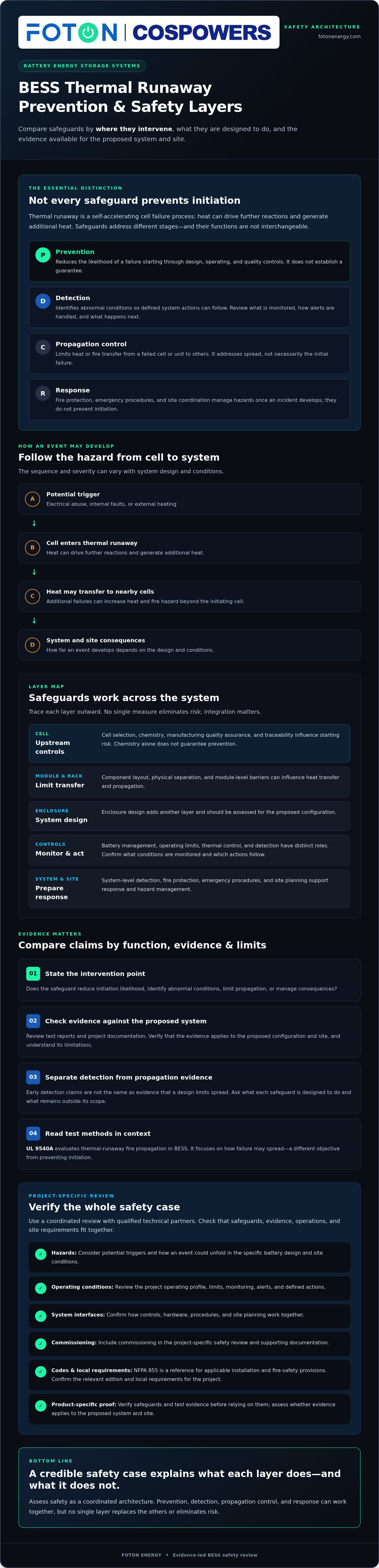
A project checklist for selecting and verifying BESS prevention technologies
Turn safety claims into project requirements before procurement. A review of BESS thermal runaway prevention technologies should account for the site, system configuration, operating profile, interfaces, and applicable local requirements. Use this sequence with qualified engineering and safety professionals to connect design assumptions with evidence and operational responsibilities.
Questions to ask during design and procurement
- 1. Define the project context. Document site conditions, system scale, intended operating profile, layout constraints, and interfaces with electrical, control, and site systems.
- 2. Complete a hazard assessment. Identify credible hazards and how the project’s design and operating assumptions affect them. Confirm which local codes and requirements apply with qualified professionals.
- 3. Map each safeguard to its function. Ask suppliers which measures reduce the likelihood of initiation and which address detection, propagation control, or emergency response. Request an explanation of dependencies between battery modules, thermal management, controls, and site systems.
- 4. Request configuration-specific evidence. Ask for test documentation that identifies the tested configuration, scenario, test boundary, results, and limitations. Establish whether it represents the proposed system and what additional review may be needed.
- 5. Review integration and assumptions. Confirm operating limits, control logic, interfaces, maintenance needs, and conditions assumed by each safety claim. Clarify who is responsible for coordinating design changes across suppliers and project teams.
Verification after installation and during operation
- 6. Verify commissioning. Confirm that checks cover installed equipment, operating limits, alarm pathways, control responses, and communication between relevant systems. Assign accountable owners for receiving alarms, assessing them, and initiating the defined response.
- 7. Maintain the safety case through operations. Establish inspection and maintenance plans, software-update review, incident procedures, and a process for documenting lessons learned. Reassess safeguards when equipment, settings, operating practices, or site conditions change.
Keep a record of the evidence reviewed, open questions, accountable owners, and decisions. This makes it easier to trace how the safety architecture was selected and identify where further verification is needed. For a broader project review, explore BESS engineering consulting services and discuss how engineering consulting can support project-specific design and integration considerations.
Integrate prevention into a bankable BESS safety architecture
A bankable safety case is built from coordinated layers and project-specific evidence. BESS thermal runaway prevention technologies should be assessed alongside operating procedures, accountable ownership, and the interfaces between equipment and site systems. No single feature establishes the safety of a complete installation, and no design removes all risk. The objective is to show how safeguards work together, what evidence supports their intended functions, and who is responsible for maintaining them.
Align chemistry, architecture, and project requirements
Chemistry selection is one input to a broader design decision. Foton Energy (Foton Pty Ltd) supplies LFP and sodium-ion storage systems, but neither should be treated as universally preferable or as eliminating thermal-runaway risk. Compare options against the project’s verified performance needs, operating profile, site conditions, integration requirements, and safety evidence. Then review how the selected system’s hardware, monitoring, thermal management, and site planning support those requirements.
For commercial and industrial projects, consider the storage system in the context of the full application, including its operating demands and connection to other site systems. Review a BESS architecture as an integrated configuration, not as a chemistry choice in isolation. Verify product-specific safeguards and test documentation for the configuration under consideration before relying on them.
Move from technology selection to engineering review
A project engineering review can bring evidence and interfaces into one discussion. Examine how safeguards depend on one another, whether their documented scope matches the proposed system, and which operating assumptions or maintenance activities they rely on. Review control and monitoring functions in context as well. An energy management system may coordinate system operation, but project teams should confirm its actual functions and how it interacts with safety controls.
Foton Energy (Foton Pty Ltd) provides engineering consulting and safety-architecture integration for energy storage projects. These capabilities can support a structured review of design assumptions and integration needs; they are not a guarantee of a particular safety outcome. Developers, EPCs, and asset owners can bring project requirements, system context, and available test evidence to identify questions that need resolution with qualified technical partners.
Bring the layers together before finalizing the project design. Contact Foton Energy (Foton Pty Ltd) to discuss your BESS requirements and engineering review needs, including how chemistry, hardware, controls, thermal management, and site planning should be evaluated for your application.
Build a stronger safety case for your BESS project
Effective safety is a coordinated design decision, supported by project-relevant evidence. BESS thermal runaway prevention technologies serve different functions: some aim to reduce the likelihood of initiation, while others detect abnormal conditions, limit propagation, or support response. Evaluate each layer by its intervention point, evidence, integration needs, and operating dependencies.
Then bring the layers together. Chemistry, hardware, controls, thermal management, site planning, and operating procedures all need review against the project’s requirements. Verify safeguards and test documentation for the specific system configuration rather than relying on broad technology claims.
Foton Energy (Foton Pty Ltd) offers engineering consulting and safety-architecture integration, and supplies LFP and sodium-ion energy storage systems. Drawing on deep industry expertise, Foton Energy (Foton Pty Ltd) can work with project teams to examine requirements and integration needs without treating any single technology as a guarantee of safety.
Discuss your BESS safety architecture and project requirements with Foton Energy (Foton Pty Ltd). An evidence-led review can help your team identify what is established, what needs further verification, and who is responsible for the next steps.
Frequently Asked Questions
What is thermal runaway in a BESS?
Thermal runaway is a self-accelerating cell failure process in which heat-generating reactions can lead to further heat and escalating failure. It may start after electrical abuse, an internal fault, or external heating, though the sequence and effects can vary. If heat transfers to nearby cells, failure may spread and create broader system hazards. The initiating event, cell design, system configuration, and site conditions all influence how it develops.
Can thermal runaway be completely prevented in a battery energy storage system?
No technology or chemistry can guarantee that thermal runaway will never occur. Project teams can reduce the likelihood of initiation through cell quality controls, design, operating limits, and maintenance, while monitoring and propagation-limiting measures address other stages of risk. Fire protection and emergency procedures help manage consequences. A robust safety approach combines these layers, verifies their relevance to the installed configuration, and assigns clear responsibility for operation and upkeep.
Which technologies help prevent thermal runaway in BESS?
BESS thermal runaway prevention technologies include cell and system design choices, manufacturing quality controls, electrical operating limits, thermal management, monitoring and control logic, and physical measures intended to limit propagation. These safeguards act at different points and should not be treated as interchangeable. For example, monitoring may identify abnormal conditions and prompt a defined action, while physical separation may help limit spread. Ask for evidence of each measure’s function and limitations in the proposed system.
How does thermal management reduce BESS thermal-runaway risk?
Thermal management helps maintain battery operating conditions by controlling or removing heat during system operation. Its design should be matched to the system configuration and expected operating profile, with operating limits and maintenance needs clearly documented. It can contribute to risk reduction, but it is not the same as fire suppression and cannot guarantee that cell failure will not occur. Project teams should review thermal management alongside monitoring, controls, physical design, and relevant test evidence.
What is the difference between thermal-runaway prevention and fire suppression?
Prevention aims to reduce the likelihood that a cell failure begins, through measures such as quality controls, design, and operating limits. Fire suppression is intended to manage a fire after an incident has developed; it does not necessarily prevent the initiating cell failure. Detection and propagation control have separate roles as well. A project safety review should identify where each measure acts, what response it supports, and what evidence demonstrates its intended function.
Does LFP chemistry eliminate thermal-runaway risk?
No. LFP chemistry does not eliminate thermal-runaway risk, and chemistry should not be treated as a complete safety strategy. It is one factor to assess alongside cell quality, system design, operating conditions, monitoring, thermal management, and site planning. Compare LFP and other chemistry options against the project’s verified performance and safety requirements, using evidence relevant to the proposed system. Confirm product-specific safeguards and test documentation rather than relying on chemistry claims alone.
How should project teams verify BESS thermal-runaway safety claims?
Ask for documentation that identifies the tested system configuration, failure scenario, test boundary, results, and limitations. Check whether the evidence applies to the equipment and integration proposed for the project. Distinguish test methods, certifications, code requirements, and project approvals, and confirm applicable standards and local requirements with qualified professionals. Review how safeguards depend on controls, installation, maintenance, and operating procedures, then document who owns commissioning checks, alarm response, and ongoing review.


