

NFPA 855 compliance for BESS installations reaches beyond fire suppression. The 2026 edition of the standard covers the design, construction, installation, commissioning, operation, maintenance, and decommissioning of stationary energy storage systems. Its requirements address how projects identify and mitigate hazards, protect against fire and explosion, and document safety measures.
That broad scope matters because battery-system safety depends on how equipment, its enclosure, detection and protection systems, and emergency procedures work together. The applicable requirements also depend on the installation’s technology, setting, and size, while local adoption determines which edition governs a project’s approvals. This guide explains what NFPA 855 covers and how its provisions shape hazard analysis, fire protection, testing, documentation, commissioning, and explosion relief. You’ll see how these elements connect across a BESS project, from design decisions to operational readiness, so you can understand the compliance picture and the questions it raises.
Key Takeaways
- Use the applicable NFPA 855 edition to frame hazard analysis, accounting for battery technology, installation conditions, and the relevant threshold.
- Align fire barriers and suppression with the project’s configuration; NFPA 855 calls for sprinkler systems designed in accordance with NFPA 13.
- Understand how UL 9540 equipment listing and UL 9540A test data support compliance, and how local code adoption affects approvals.
- Bring commissioning and acceptance tests together with the records needed to demonstrate that the installation is ready for operation.
- Assess whether battery vent gases could create a deflagration hazard, then apply the relevant explosion prevention or relief approach.
Hazard Mitigation Analysis and qualified professional oversight
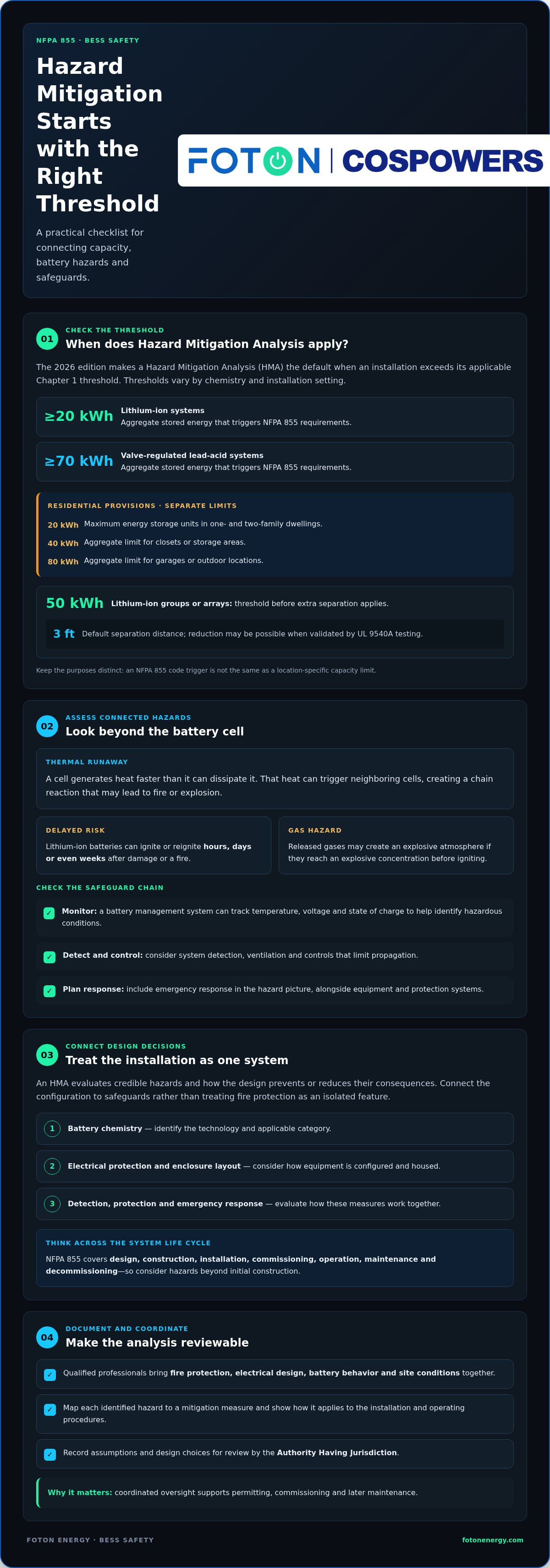
NFPA 855 sets minimum hazard-mitigation requirements for stationary energy storage systems. The 2026 edition makes a Hazard Mitigation Analysis the default when an installation exceeds its applicable Chapter 1 threshold.
Hazard Mitigation Analysis
A Hazard Mitigation Analysis evaluates credible hazards and how the design prevents or reduces their consequences. Under NFPA 855, the analysis helps connect system configuration with safeguards rather than treating fire protection as an isolated feature.
For example, assess battery chemistry, electrical protection, enclosure layout, detection, and emergency response as related parts of one system. NFPA 855 covers design, construction, installation, commissioning, operation, maintenance, and decommissioning. That scope helps project teams consider hazards throughout the system’s life, not only during initial construction.
Thermal-Runaway and Toxic-Gas Hazards
Thermal runaway occurs when a battery cell generates heat faster than it can dissipate it. The heat can trigger neighboring cells, causing a chain reaction that may lead to fire or explosion.
Lithium-ion batteries can ignite or reignite hours, days, or even weeks after damage or a fire. Thermal runaway can also release gases that may form an explosive atmosphere in an energy storage room or container if they reach an explosive concentration before igniting. Prevention therefore considers cell-level monitoring, system detection, ventilation, and controls to limit propagation. A battery management system can monitor temperature, voltage, and state of charge to help identify hazardous conditions.
Battery Capacity and Spacing Limits
NFPA 855 thresholds differ by chemistry and installation setting, so identify the applicable category before treating a capacity figure as a project limit. Lithium-ion systems with aggregate stored energy of at least 20 kWh and valve-regulated lead-acid systems with at least 70 kWh trigger NFPA 855 requirements.
Residential provisions separately limit energy storage units in one- and two-family dwellings to 20 kWh. Aggregate limits are 40 kWh for closets or storage areas, and 80 kWh for garages or outdoor locations. For lithium-ion groups or arrays, 50 kWh is a threshold before extra separation applies; the default separation distance is 3 ft, subject to possible reduction validated by UL 9540A testing. These figures serve different purposes, so don’t confuse a code trigger with a location-specific capacity limit.
There is no single compliance cost for a BESS installation. Costs depend on chemistry, capacity, site configuration, hazard analysis, testing, and required protection measures. The project scope and quote are shaped by those design and approval requirements.
Qualified Professional Oversight
Qualified professional oversight brings fire protection, electrical design, battery behavior, and site conditions together in a coherent hazard analysis. Design professionals can map each identified hazard to a mitigation measure and show how it applies to the installation and its operating procedures.
For example, an engineer assessing a containerized lithium-ion system can connect thermal-runaway risks to decisions about detection, ventilation, and separation. The project team can then document its assumptions and design choices for review by the Authority Having Jurisdiction. This coordination supports permitting, commissioning, and later maintenance.
Fire-resistant barriers and suppression systems
NFPA 855’s fire-protection criteria depend on battery technology, installation setting, system size, spacing, and suppression design. These elements work together to limit fire spread and support an effective response.
Fire-Resistant Barriers
Fire-resistant barriers or compartments separate battery equipment from other areas and can help limit fire propagation. They are important because a BESS enclosure can concentrate heat and restrict access to the equipment inside.
For example, a project’s layout can use barriers to separate battery groups or protect adjacent spaces. NFPA 855’s fire-protection criteria consider the technology and installation setting, so barrier decisions belong alongside spacing and suppression design. The selected arrangement should match the tested system configuration and the site’s fire-protection strategy.
Suppression and Off-Gas Detection
Suppression systems control or cool a fire, while off-gas detection can identify gases released during a battery failure. Together, these measures can support an earlier, more coordinated response to an evolving incident.
NFPA 855 requires a sprinkler system designed in accordance with NFPA 13 for battery ESS fire protection. Detection and suppression serve different functions: a sensor identifies a developing condition, while a suppression system acts on the fire. System design should account for enclosure geometry, because walls and internal equipment can obstruct water from reaching the fire’s seat.
Water is the most effective agent for cooling a BESS fire in the testing described in the research. A cited UL study demonstrated safe water application up to 1000 volts DC, from 5 ft, using an adjustable nozzle with a minimum 10-degree fog pattern under specified conditions. Those parameters describe that study, not a universal firefighting procedure.
Large-scale fire testing adds evidence about how a battery system behaves under fire exposure. NFPA 855 requires UL 9540A testing, including large-scale fire testing, when a battery energy-storage group exceeds 50 kWh or the separation between groups is less than 3 ft (0.9 m). The 6th edition of UL 9540A expands its certification framework to address spacing and fire propagation directly.
Use UL 9540A data to connect the tested configuration with the proposed installation. Differences in spacing, barriers, or system arrangement can affect how test findings apply. This makes test data useful for evaluating fire protection as an integrated design, rather than treating each safeguard as a standalone feature.
For projects evaluating utility-scale storage system design, align suppression, detection, spacing, and test evidence within the same fire-protection plan.
UL 9540, UL 9540A, UN38.3, and local approvals
Equipment evaluation and locally adopted codes shape how battery energy storage projects demonstrate fire safety. Permit submissions should identify the governing code edition and include relevant equipment, testing, and hazard-mitigation records.
Equipment Standards and Local Approvals
UL 9540 listing, UL 9540A test data, and UN38.3 documentation address distinct parts of battery-system evaluation. Together, they help reviewers assess equipment and thermal-propagation evidence, but they don’t replace local approval.
Relevant codes require U.S. energy storage systems to comply with and be listed to UL 9540. Lithium battery systems may also require UL 9540A, UN38.3, and local authority approval. UL 9540A data can help explain how a tested configuration relates to the proposed installation. Keep the evidence tied to the actual system design, since differences in configuration can affect its relevance.
AHJ Permits and Required Documentation
The Authority Having Jurisdiction, or AHJ, applies locally adopted requirements during permit review. A useful submission identifies the applicable code edition and organizes site plans, equipment listing information, test data, and hazard-mitigation details for review.
NFPA 855 compliance requirements vary by location and project type. The AHJ determines which adopted requirements govern the permit, while design professionals connect the project documents to those requirements. Include the system layout and the safety measures associated with it, so the reviewer can understand how the equipment, separation, and fire-protection approach fit together. This directly answers what permits and records support review: the local permit application, applicable plans, and project-specific compliance evidence.
Local Compliance and Code Enforcement
NFPA 855 is a consensus standard, not a law by itself; it gains legal effect when a jurisdiction adopts it. U.S. model codes must likewise be adopted in whole or in part by states or local jurisdictions to become enforceable.
The 2024 International Fire Code references NFPA 855-2023, not the 2026 edition, and Chapter 12 incorporates many NFPA 855 tables. That difference makes edition identification important. A municipality may adopt the 2019 or 2023 edition of a relevant code, and local amendments can change how provisions apply. So a reference to the newest NFPA edition alone doesn’t establish the permit basis.
For a project team, the practical sequence is to identify the AHJ, establish the adopted code edition, then align design documents and test evidence with its review. NFPA 1 Chapter 52 addresses energy storage systems, while NFPA 855 supplies detailed installation requirements where adopted. Local fire authorities, code enforcement agencies, and design professionals each contribute to understanding the applicable compliance path. Treat local approval as part of the design process, not a final paperwork step.
Compliance documentation and commissioning
For stationary energy storage systems, compliance evidence connects the approved design with the installed system and its operating procedures. Commissioning, emergency planning, and maintenance records help show how safety measures work across the project lifecycle.
Testing and Emergency Planning
NFPA 855 requires commissioning and acceptance tests, followed by ongoing inspection, testing, and maintenance under referenced NFPA standards and manufacturer instructions. Its 2026 edition also requires an annual review and yearly refresher training for emergency planning provisions. These requirements help teams verify installation readiness and keep response plans aligned with system operations.
Commissioning records can capture test procedures, results, deficiencies, and resolutions. For example, acceptance testing can document whether installed equipment and safety functions operate according to the design and manufacturer instructions. Inspection and maintenance records provide a traceable history of system condition, repairs, and recurring issues. Organize these records so operators can find relevant evidence during reviews or emergency preparation.
Emergency plans should set out response roles, emergency disconnect procedures, and clear instructions for an ESS fire. Personnel and first responders need training suited to the site’s equipment and response plan. The plan should explain how to communicate an incident, isolate equipment where appropriate, and coordinate actions. This gives staff a practical reference when thermal runaway or another hazard requires prompt decisions.
NFPA 855’s development also has a documented committee timeline. The first-draft committee meeting was scheduled in Salt Lake City for October 3-5, 2023. Second-draft meetings were scheduled in Atlanta for August 26-29, 2024, and Quincy for October 1-3, 2024. These meetings form part of the standard’s technical review process.
Developer Compliance Steps
Developers can structure compliance work around the project’s governing requirements, design evidence, and operating readiness. Start by identifying the applicable NFPA 855 edition and relevant referenced standards, then map each requirement to a design feature, test, document, or operating procedure. This creates a practical record of how the project addresses safety from installation through maintenance.
Assemble project-specific materials in a coordinated package. Include the system layout, equipment information, hazard analysis, fire-protection design, relevant test evidence, and emergency response plan. Keep every document consistent with the actual installation. A plan showing a different arrangement can undermine the link between design assumptions and commissioning results.
Before operation, record commissioning and acceptance test results, open items, and corrective actions. Set inspection, testing, and maintenance activities according to the referenced NFPA standards and manufacturer instructions. Assign responsibility for maintaining records and updating emergency plans after relevant system or site changes. This structured approach helps developers show how design decisions, installed safeguards, and operational controls fit together.
Deflagration venting and explosion relief
Battery cells can release flammable gases during thermal runaway, creating explosion hazards inside an enclosure. NFPA 855 connects deflagration analysis with local gas concentration where cell venting occurs, helping teams assess explosion-control needs.
Assessing Deflagration Risk
A deflagration is rapid combustion of a flammable gas mixture, which can generate damaging pressure inside a battery room or container. NFPA 855 requires a deflagration study under NFPA 68 based on local gas concentration at the point of cell venting.
This matters because gas concentration can vary within an enclosure. An analysis should consider where gases may collect, how they move, and whether they could reach an ignitable mixture before detection or ventilation changes conditions. For a lithium-ion installation, the analysis connects cell venting behavior with enclosure design instead of assuming gases disperse evenly.
When a credible deflagration hazard exists, NFPA 68 is the standard for calculating and verifying explosion relief. The resulting assessment informs whether venting or another engineered control is appropriate for the specific enclosure. Relief direction and placement matter because an opening can discharge pressure and flame toward nearby equipment, access routes, or occupied areas.
Explosion Control and Ventilation
Explosion control reduces the likelihood or consequences of an ignitable gas mixture. NFPA 69 addresses explosion-control evaluations for lithium-ion energy storage systems, including maintaining flammable-gas concentration below 25% of the lower flammable limit.
Ventilation affects how quickly gases disperse, where they travel, and whether pockets can accumulate. Design analysis should consider the enclosure’s volume and layout, likely gas-release points, airflow paths, and exhaust location. For example, obstructed airflow in a container may allow gases to collect away from a sensor or exhaust opening. The assessment should connect these conditions to detection and control measures.
Monitoring can support response by identifying abnormal conditions before personnel approach a potentially hazardous enclosure. Detection placement should reflect likely release locations and gas movement, while emergency procedures should explain how alarms affect access and system isolation. NFPA 855’s emergency-planning provisions can connect those technical safeguards with clear actions for site personnel and first responders.
Good engineering practice treats ventilation, gas detection, and pressure relief as related protections, not interchangeable devices. Ventilation manages gas accumulation; detection identifies a developing condition; explosion relief addresses pressure if ignition occurs. Project documentation should explain how each measure fits the hazard analysis and enclosure design.
Bring explosion relief into the design review early, while enclosure layout and ventilation paths remain coordinated. Review your BESS explosion-relief design as part of the broader safety planning process.
Foton Energy (Foton Pty Ltd): C&I BESS
Foton Energy (Foton Pty Ltd) offers C&I BESS for commercial and industrial energy storage projects. After mapping NFPA 855 requirements, teams can consider how a BESS fits their site, operational needs, and project design. The standard’s fire-safety provisions make system configuration, protection measures, and local approval requirements important considerations alongside energy-storage objectives.
Foton Energy also offers Utility-Scale Storage, Residential Storage Systems, and Data Centre & Telco Backup for other applications. For a commercial or industrial project, explore Foton Energy’s C&I BESS offering, taking the applicable code edition and AHJ requirements into account when making project decisions.
To discuss Foton Energy’s C&I BESS offering, contact Foton Energy.
Turn compliance planning into project alignment
Use your compliance work to shape the next design decisions. Planning NFPA 855 compliance for BESS installations is also an opportunity to align the project’s energy-storage goals with site requirements, operational priorities, and the approval pathway. A clear project brief can help stakeholders carry those priorities into equipment selection and system integration.
Foton Energy (Foton Pty Ltd) offers C&I BESS, Residential Storage Systems, and Utility-Scale Storage for different project contexts, from commercial and industrial needs to residential and grid-scale applications. Consider which application best fits your intended use, then bring that context to your next project discussion.
Discuss your energy storage project with Foton Energy and take the next step toward a design aligned with your project objectives.
Frequently Asked Questions
What Does NFPA 855 Cover?
NFPA 855 covers stationary energy storage systems across their lifecycle, from design and construction through operation, maintenance, and decommissioning. It addresses installation conditions and safety measures for different energy-storage technologies. For a project team, that means reviewing more than the battery enclosure: supporting electrical systems, emergency procedures, and eventual equipment retirement also matter. The applicable provisions depend on the system and installation context.
Does Compliance Differ for C&I vs Utility-Scale BESS?
Yes. The same standard applies, but project requirements can differ with system size, technology, layout, and installation setting. A commercial building system and a utility-scale site may have different arrangements, separation needs, and fire-protection designs. For example, a project’s location and nearby occupied areas can affect how its safety measures are planned. Local code adoption also determines which NFPA 855 edition applies to permitting.
Does It Apply to All Battery Chemistries?
NFPA 855 covers multiple energy-storage technologies, including lithium-ion, lead-acid, and flow batteries, as well as hydrogen fuel cells and other advanced storage solutions. It applies to stationary energy storage systems, including mobile or portable systems installed in a stationary situation. Requirements aren’t identical across technologies: the relevant provisions depend on the system type, stored energy, and installation conditions. Identify the technology before assessing applicable requirements.
Is NFPA 855 a Law or a Standard?
NFPA 855 is a consensus standard, not a law by itself. It becomes enforceable when a state or local jurisdiction adopts it, either directly or through an adopted code. This distinction matters because a project must follow the edition incorporated into its local requirements, not simply assume the newest edition governs. The Authority Having Jurisdiction determines the applicable code basis during permitting and enforcement.
I’ve heard that an ESS can reignite several days after a fire has been extinguished; is this true?
Yes. A damaged lithium-ion battery can ignite or reignite hours, days, or even weeks after damage or a fire. Heat or internal damage may persist after visible flames are gone, and the battery may retain electrical energy. This creates potential shock hazards during overhaul as well as renewed fire risk. Emergency plans should account for continued monitoring and careful coordination after the initial incident.
What are some of the hazards of ESS?
Energy storage system hazards include thermal runaway, short circuits, and flammable materials. A cell in thermal runaway can heat neighboring cells, potentially causing fire or explosion. Released gases can also accumulate and create an explosive atmosphere if they reach an explosive concentration before igniting. Enclosures may obstruct water from reaching a fire’s seat, complicating heat dissipation. The hazard profile depends on the system and site configuration.
What is the best extinguishing agent for a fire in a battery ESS?
The testing described identifies water as the most effective agent for cooling a battery energy storage system fire. Cooling matters because battery cells can continue heating and may contribute to propagation or reignition. This does not mean every application is identical: equipment arrangement, electrical hazards, and site procedures matter. Emergency response plans and responder training should guide actions for the specific installation.
What does NFPA 855 cover for battery energy storage system installations?
For installations, NFPA 855 addresses siting, clearances, separation, hazard signage, ventilation, and fire-protection measures. It also covers electrical considerations such as cable management, grounding, and circuit protection. These provisions connect equipment placement with the site’s safety design. For example, the selected enclosure location affects how teams plan access, ventilation, and separation from other areas. Installation requirements depend on the technology and project conditions.


