

Power system analysis shows whether a battery can support the grid at its connection point. A BESS for power quality improvement can quickly absorb or supply active power to help balance generation and demand, while reactive power control can support voltage regulation. Its impact depends on more than its power rating: state of charge and grid location determine how much support is available and where it can help.
Battery capacity is important when planning renewable integration, but electrical conditions around the connection matter too. This article explains how BESS supports frequency control, voltage regulation, and smoother renewable output, and why analysis of the grid, controls, and operating conditions helps clarify its role. It also covers how state of charge affects response headroom, why a weak feeder can experience different power quality effects from a strong connection, and how coordinated controls can help storage contribute to a stable, reliable system.
Key Takeaways
- Understand how storage can balance changing supply and demand while supporting frequency and voltage regulation.
- See why state of charge affects the energy available for response, and how grid connection location shapes the system’s impact.
- Learn how active and reactive power, ramp smoothing, and harmonic compensation can address different power quality needs.
- Explore why response speed depends on inverter controls and why coordinated action can be more effective than speed alone.
- Discover how grid studies and suitable control strategies help align storage performance with local network conditions.
How Does BESS Support Frequency Control?
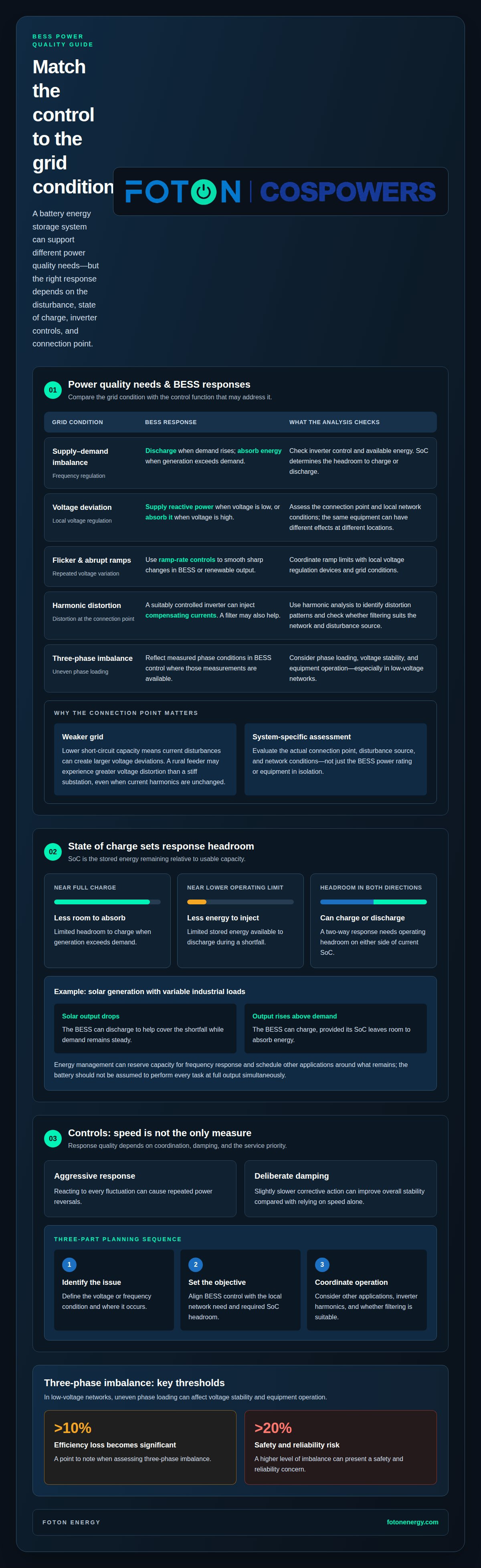
Grid stability depends on balancing electricity generation and consumption while keeping frequency and voltage within acceptable operating limits. A battery energy storage system (BESS) helps by responding to changes in supply or demand. If demand rises suddenly, it can discharge active power; if generation exceeds demand, it can absorb excess energy. This two-way response supports frequency regulation and helps balance the wider electrical network.
Frequency and voltage relate to different grid conditions. Active power helps address an imbalance between electricity supply and demand. Reactive power supports voltage regulation: a BESS can supply it when voltage is low or absorb it when voltage is high. Its power conversion system can manage both types of power, helping storage respond to local network needs rather than treating every disturbance as the same problem.
Voltage fluctuations can also cause flicker, particularly when changing output creates repeated voltage variations. Ramp-rate controls limit how quickly a BESS or connected renewable source changes its power output. Coordinating those limits with local voltage regulation devices can mitigate flicker. For example, a controller can smooth a sharp renewable generation ramp, reducing abrupt changes at the connection point while allowing the BESS to respond to grid conditions.
Location matters. The same power conversion system may cause greater voltage distortion on a rural feeder than at a stiff substation, even if its current harmonics remain unchanged. A weaker grid has lower short-circuit capacity, so current disturbances can create larger voltage deviations. A filter may help address harmonic distortion, but its suitability depends on network conditions and the source of the disturbance. That is why power quality analysis should consider the connection point, not just the storage equipment.
Three-phase imbalance is another concern in low-voltage networks. An imbalance above 10% is a point at which efficiency loss becomes significant; above 20%, it can present a safety and reliability risk. Uneven phase loading can affect voltage stability and equipment operation, so BESS control needs to reflect phase conditions where those measurements are available. It can support reliability by responding to network requirements, but its effectiveness depends on system size and location relative to the disturbance. For a facility, the practical sequence is to identify the voltage or frequency issue, assess its grid location, then align the BESS control objective with that condition. This connects fast response with stable operation, rather than speed alone.
Frequency control and state of charge
Frequency response depends on both inverter control and the energy available in the battery. State of charge (SoC) describes how much stored energy remains relative to the system’s usable capacity. It therefore determines the operating headroom for charging or discharging. A system held near full charge has less room to absorb surplus generation; one near its lower operating limit has less energy available to inject.
This creates a practical trade-off for industrial energy storage systems. A controller focused on one-way discharge may preserve capacity for rising demand but leave limited room to absorb excess energy. A controller designed to respond in both directions needs operating headroom on either side of its current SoC. The right balance depends on expected disturbances, renewable output patterns, facility loads, and the frequency-support objective.
Consider a distributed site combining solar generation with variable industrial loads. If solar output drops while demand remains steady, the BESS can discharge to help cover the shortfall. If output rises above demand, it can charge, provided its SoC leaves room. Energy management coordinates these actions with the site’s operating priorities. It can reserve energy for frequency response while scheduling other applications around available capacity, rather than assuming the battery can perform every task at full output simultaneously.
Control quality matters as much as speed. A frequency controller that reacts aggressively to every fluctuation can cause repeated power reversals. Deliberate damping, with slightly slower corrective action, can improve overall stability compared with relying on speed alone. The appropriate response depends on grid conditions and controller coordination. During microgrid operation, the BESS can coordinate with renewable sources, generators, and electrical loads to balance supply and demand as conditions change.
Harmonic control is a separate but complementary function. Inverters can contribute harmonic distortion, while a suitably controlled BESS can inject compensating currents to counter harmonics at the connection point. Harmonic analysis identifies distortion patterns and can indicate whether a filter is appropriate. SoC governs energy availability, while the inverter’s control capability governs how it shapes current. Both should be evaluated when designing a BESS for power quality improvement.
For a sound operating strategy, define the priority service, establish the SoC headroom it requires, and coordinate dispatch with other applications. Then assess inverter harmonics and the need for filtering within the same system study. This integrated view is relevant across energy storage system applications, from facility support to larger grid-connected projects.
BESS services for power quality improvement
A BESS can address several power quality needs through coordinated active and reactive power control. It can shift electricity between periods, support frequency response, regulate voltage, and smooth renewable generation ramps. In four-quadrant operation, it can supply or absorb active and reactive power, allowing its inverter to respond to multiple network conditions. The appropriate service depends on the disturbance, connection point, and available energy.
How does it compare with UPS systems, STATCOMs, and capacitor banks? A UPS is primarily used to maintain supply to protected loads, while a STATCOM and capacitor bank provide reactive power support without the BESS’s stored-energy function. A BESS can combine energy shifting with dynamic voltage support, provided its controls and operating headroom suit the site.
At a facility with variable renewable generation, the BESS can absorb surplus electricity and discharge when generation falls. Reactive power control can also support local voltage requirements. These services need coordination: a dispatch schedule that prioritizes energy shifting may affect the headroom available for frequency response or voltage support. The operating strategy should therefore define which service takes priority when events overlap.
Power quality studies help convert those objectives into system requirements. A useful assessment includes short-circuit current estimates, harmonic scans, and worst-case ramp scenarios. It should also define local performance indicators, such as total harmonic distortion (THD) at the point of common coupling, flicker index, and voltage unbalance. IEEE 519 and IEC 61000 provide relevant power quality limits for grid-connected projects. These measures clarify what the BESS must address and how performance will be assessed during staged commissioning.
What are the steps for designing and installing a BESS for power quality improvement? First, identify the disturbance and connection conditions. Then complete power quality and load-flow studies, select the BESS control objectives and equipment, and commission against agreed site indicators. The studies should come before equipment procurement and grid connection approval, ideally during concept design.
Control coordination is essential when a BESS operates alongside capacitor banks or on-load tap changers. Feeder-level supervisory control can assign objectives to individual storage units, reducing oscillations and conflicting actions. If reactive power setpoints interact with a capacitor bank, coordination and slight hysteresis can help limit repeated switching. This is particularly relevant on weaker grids, where the same current disturbance can create larger voltage deviations.
The practical takeaway is to match each service to a measured need. A BESS may combine frequency response, voltage regulation, and renewable ramp smoothing, but one control strategy cannot resolve every disturbance automatically. Define the site’s power quality indicators, model relevant operating cases, and coordinate inverter behavior with existing network equipment before commissioning.
How fast can a BESS respond to power quality disturbances, and what response times are typical?
Grid-stabilization controls in a BESS can act at the millisecond level. This describes fast control action, not a universal response time for every installation or disturbance. Delivered response depends on detection, control processing, inverter operation, available power, and the network connection. A facility should distinguish the control system’s response from the time needed to correct a measured power quality condition.
Response begins when sensors and control logic detect a change. The inverter then adjusts its output, supplying or absorbing active or reactive power as directed. For example, a sudden load increase may prompt active power injection, while a local voltage rise may call for reactive power absorption. Each action has a different control objective, so one response-time figure cannot describe every BESS service.
The type of disturbance matters too. A sharp change in renewable generation creates a different control requirement from repeated voltage flicker or harmonic distortion. Ramp-rate control can smooth changing output, while harmonic compensation shapes current to counter distortion. These functions depend on inverter settings and system integration. A controller tuned for gradual renewable ramps may not be configured to prioritize a short, local voltage event.
Network strength shapes the result. A power conversion system connected to a rural feeder can cause greater voltage distortion than the same system at a stiff substation, even if current harmonics remain unchanged. In a weaker grid, current disturbances can cause larger voltage deviations. Fast action alone may not resolve the issue if the control response conflicts with local equipment or amplifies an existing oscillation.
Coordination matters as much as speed. A BESS operating alongside a capacitor bank or an on-load tap changer needs control settings that account for those devices. Otherwise, one controller may counteract another, causing repeated voltage adjustments. During staged commissioning, teams can assess the response against site indicators such as THD at the point of common coupling, flicker index, and voltage unbalance. These measurements show whether the intended action addresses the actual disturbance.
For a useful response-time assessment, define the event, identify the required control action, and measure performance at the relevant connection point. Then test representative operating conditions, including changes in renewable output and load demand. The practical answer is that BESS controls can act at the millisecond level, but effective response depends on the complete control path, inverter configuration, and grid conditions, not speed alone.
What BESS inverter controls and technologies are used for power quality support?
A BESS inverter translates control instructions into changes in electrical output. For voltage support, its controller can adjust reactive power based on measured network conditions. A voltage-drop control structure can respond to undervoltage, while another arrangement can govern voltage rise. The selected mode depends on the disturbance and connection point. Capacitor placement and reactive power management can also be considered together when voltage instability affects the network.
Harmonic control addresses a different problem. A harmonic scan identifies distortion patterns, and inverter control can provide active harmonic compensation when the system design supports it. Tuned passive filters are another option, but their tuning must match site impedance. If network impedance makes a passive filter unsuitable, an active filter or retuned control may be more effective. The choice should follow measured harmonic conditions, not a generic equipment preference.
Phase imbalance calls for controls that reflect conditions on each phase. Phase-by-phase current control can shape the BESS response to individual phase requirements. A phase-shifting transformer is another possible measure. Scheduling rules can also avoid certain injections during periods of high single-phase load. These options address different aspects of imbalance, so the control design should link the identified cause to the relevant intervention.
For systems combining several functions, a layered control architecture can coordinate local response with network-level priorities. Tuned passive filters, active harmonic compensation, and supervisory control can work as complementary layers. During critical events, hierarchical controls can give the grid operator supervisory authority. At feeder level, assigning objectives to individual BESS units can reduce oscillations and prevent conflict with capacitor banks or on-load tap changers. Slight hysteresis in reactive power setpoints can further reduce oscillations between a BESS and capacitor bank.
Control selection should follow the power quality study. Short-circuit current estimates, harmonic scans, and worst-case ramp scenarios help define the operating conditions. Project teams can then set local indicators, including THD at the point of common coupling, flicker index, and voltage unbalance, and validate them during staged commissioning. This ties inverter settings to measurable outcomes rather than assuming one control mode solves every issue. For a project with voltage-drop, harmonics, or phase concerns, discuss inverter control requirements as part of the system design.
Foton Energy (Foton Pty Ltd): C&I BESS
Foton Energy (Foton Pty Ltd) supplies C&I BESS for commercial and industrial facilities assessing storage alongside power quality objectives. Its systems can be considered for frequency support, voltage regulation, renewable integration, or changing electricity demand. The right system role depends on the facility’s load profile, grid connection, operating priorities, and the power quality issues identified through analysis.
For a project team, the next step is to define the conditions the storage system needs to address and how performance will be assessed. This connects the BESS design to operational requirements, rather than making capacity the only decision. Contact Foton Energy (Foton Pty Ltd) to discuss your C&I BESS project and its power quality objectives.
Turn power quality priorities into a project direction
The next step is to translate operational priorities into clear design criteria. Identify which disturbances matter most to the facility, how storage should interact with existing electrical infrastructure, and which measurements will demonstrate performance. This alignment keeps the control strategy, grid connection, and operating requirements connected as the project develops.
For BESS for power quality improvement, the central design question is not simply how much energy to store. It is how the system should respond under the site’s actual operating conditions and how those responses fit with future energy plans. A well-defined project scope gives technical teams a stronger basis for evaluating these decisions and coordinating the system with facility needs.
Foton Energy (Foton Pty Ltd) offers C&I BESS, Residential Storage Systems, and Utility-Scale Storage. If you’re considering storage for a facility or broader project, contact Foton Energy to discuss the requirements. A clear starting point can help move your energy strategy forward with confidence.
Frequently Asked Questions
Why Is Power System Analysis Important for BESS Owners?
Power system analysis connects a BESS design to the facility’s actual electrical conditions. For example, load-flow analysis can identify when peak demand may overload network equipment, while short-circuit estimates inform how the connection behaves during faults. Reviewing these conditions early helps align equipment selection, control priorities, and grid connection design. It also gives project teams a basis for assessing whether the proposed storage system addresses the facility’s main constraints.
Why power quality matters for modern BESS?
Power quality matters because a BESS inverter interacts with the electrical network while charging and discharging. Current harmonics can increase I²R losses in filters, cables, and transformers, adding heat and contributing to faster degradation of capacitors and semiconductors. Voltage distortion can also vary by connection location, even when inverter current harmonics remain unchanged. Assessing these effects helps ensure storage supports the network without creating avoidable electrical stress.
How Does BESS Help With Voltage Regulation?
A BESS helps regulate voltage by adjusting reactive power in response to local network conditions. For example, its control system can absorb reactive power during a voltage rise or supply it when voltage falls. This response is most useful when coordinated with other voltage-control equipment, such as capacitor banks or tap changers. The connection point and local grid strength influence how the control action affects nearby equipment and voltage conditions.
How Does BESS Improve Grid Stability?
A BESS contributes to grid stability by adjusting its power exchange as system conditions change. In a microgrid, coordinated control can balance renewable generation, conventional generators, and electrical loads. During a supply disruption, storage can also support continuity, with its effectiveness shaped by system size and location relative to the network failure. The design objective should reflect whether the priority is balancing supply and demand, maintaining local service, or supporting both.
How Does BESS Improve Power Reliability?
A BESS can support continuity of supply during network contingencies, potentially reducing outage duration and the number of affected customers. Its contribution depends on whether stored energy and system placement align with the location of the failure. A BESS designed for backup needs an appropriate architecture and protection scheme, not simply battery capacity. For a critical facility, the key design question is which loads require continuity and how the storage system connects to them.
How Does BESS Manage Industrial Load Variations?
A BESS can charge during lower-demand periods and discharge when an industrial facility’s load rises. For example, a site with predictable production cycles can coordinate storage dispatch with its operating schedule to help balance electrical loads. Load-flow analysis can show where peak demand creates overloading scenarios. The operating plan then needs to account for the facility’s load profile, renewable generation, and the energy headroom reserved for other services.
What Are the Main Benefits of BESS for Industries?
Industrial BESS can support peak demand management, renewable energy integration, and power quality objectives within one coordinated system. It can store surplus solar or wind generation for use when output decreases, while helping balance facility loads. The operational value depends on the site’s demand pattern, network conditions, and chosen control priorities. A project assessment should link each intended benefit to measurable site requirements rather than assume one configuration suits every application.
How do battery energy storage systems improve power quality?
Battery energy storage systems improve power quality through inverter controls that manage active and reactive power, smooth changing output, and compensate for harmonic currents where configured. A BESS for power quality improvement should be assessed against site indicators such as THD at the point of common coupling, flicker, and voltage unbalance. Staged commissioning can then evaluate whether measured performance aligns with the project’s objectives and relevant limits, including those in IEEE 519 or IEC 61000.


