

A Tier 1 label can signal market recognition, but it doesn’t certify that a battery system is safe, reliable, or suitable for your project. If you’re asking “what is a Tier 1 battery manufacturer,” look beyond the label: different organisations publish Tier 1 lists using different criteria, and those rankings aren’t technical certifications.
A recognised manufacturer can be a useful starting point, but a ranking alone can’t answer project-specific questions about performance, safety evidence, integration, or long-term support. This guide explains what Tier 1 status means, who defines it, and what it doesn’t prove. It compares the purpose of major industry lists, outlines the evidence to consider when assessing an energy storage manufacturer, and shows how to use market recognition as one part of due diligence. The aim is to help you evaluate manufacturers against your project’s requirements rather than rely on a label to make the decision.
Key Takeaways
- To understand what is a Tier 1 battery manufacturer, identify which organisation published the list and how it defines Tier 1 status.
- BloombergNEF and S&P Global use distinct assessment frameworks, so interpret each list according to its own criteria.
- Treat Tier 1 recognition as a market signal, not proof of safety, durability, warranty performance, or project suitability.
- Check the list’s date, then assess technology fit, operating profile, system architecture, safety evidence, and lifecycle support against your project needs.
- Consider how Foton Energy (Foton Pty Ltd)’s strategic partnership with Cospowers fits into a broader energy storage project, beyond manufacturer recognition alone.
What Is a Tier 1 Battery Manufacturer? Meaning and Scope
Tier 1 is a classification that an industry research organisation applies to manufacturers under its own published methodology. If you’re asking what is a Tier 1 battery manufacturer, the answer depends on who issued the list, what it assesses, and the period it covers. BloombergNEF and S&P Global, for example, publish distinct industry assessments. Their labels aren’t interchangeable or a universal battery grade.
For developers, investors, and procurement teams, a Tier 1 listing can be a useful first signal of a manufacturer’s market standing and visibility. It may help narrow an initial field of candidates, but it won’t determine whether a particular system meets a project’s technical, operational, or commercial needs. To interpret the label, identify the organisation behind it and review the list’s scope, criteria, and assessment date.
What does Tier 1 mean in battery energy storage?
In battery energy storage, Tier 1 describes an organisation-specific assessment of manufacturers, not a single global standard. One list may emphasise evidence of project deployments; another may assess a broader set of commercial and corporate indicators. The criteria and outcomes vary. A Tier 1 designation is a market signal within a particular framework, not a guarantee of quality, safety, performance, or financing.
A ranking announcement can sound more definitive than it is. The classification may support an initial market assessment, but it doesn’t replace technical review, product evidence, or due diligence against your project’s requirements.
Does Tier 1 refer to a battery, cell, or manufacturer?
Tier 1 status generally refers to the manufacturer assessed by the list. It doesn’t automatically apply to every cell, module, container, or integrated system associated with that company. A manufacturer-level designation doesn’t certify each product configuration, establish how it will perform in a particular application, or show how components will work together in a deployed system.
A Battery energy storage system (BESS) stores electrical energy and makes it available for an application. Depending on its design, it can bring together battery cells and modules with power conversion, controls, and other equipment. The cell is one component; the BESS is the complete system configured for use. Assess each level using its own evidence rather than treating a manufacturer’s Tier 1 recognition as product-level certification.
How BloombergNEF and S&P Global Assess Tier 1 Manufacturers
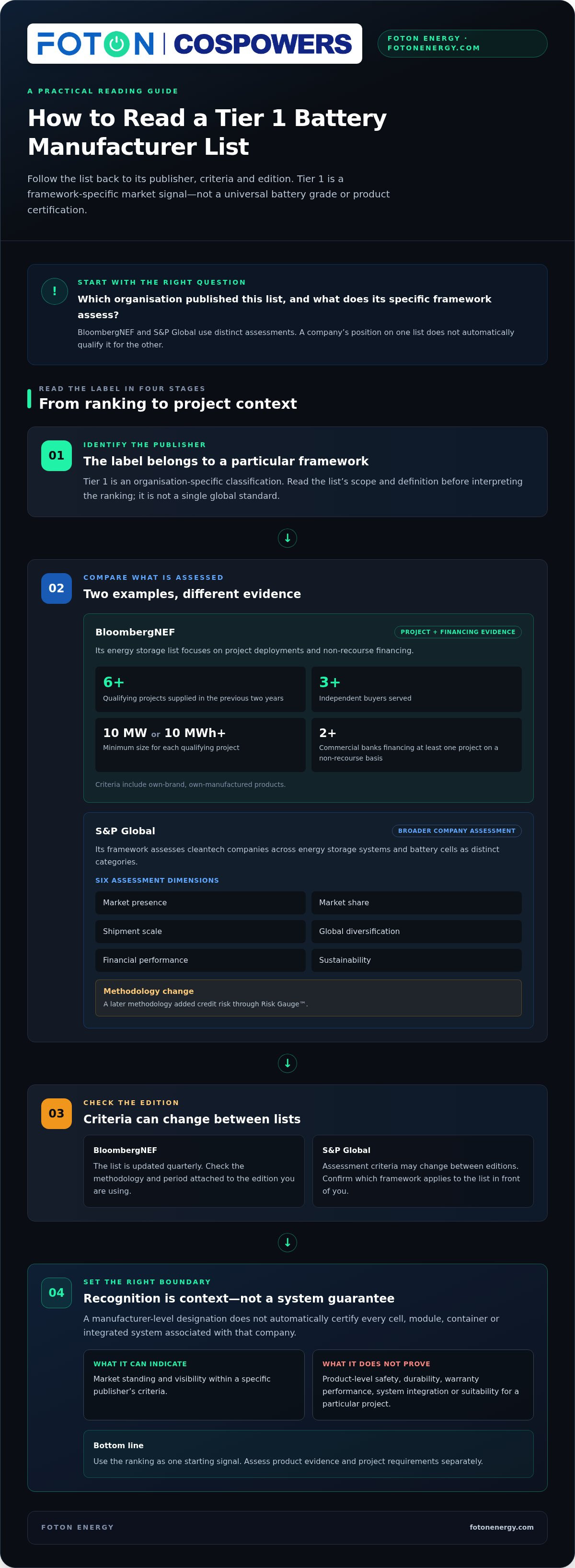
To understand what is a Tier 1 battery manufacturer in practice, look at the specific list, not just the label. BloombergNEF and S&P Global publish separate assessments with different purposes and criteria. A company’s position on one list doesn’t automatically qualify it for the other.
| Organisation | List purpose | Stated criteria | Assessment period |
|---|---|---|---|
| BloombergNEF | Assess energy storage manufacturers using project deployment and financing evidence. | Current criteria include own-brand, own-manufactured products supplied to at least six qualifying projects, with at least three independent buyers, plus non-recourse financing from at least two commercial banks for at least one project. | List updated quarterly; criteria updated August 15, 2026. The Q2 2026 list was published May 25, before that methodology update. |
| S&P Global | Classify cleantech companies across sectors, including energy storage systems and battery cells. | Its 2025 framework assessed market presence, market share, shipment scale, global diversification, financial performance, and sustainability. The 2026 methodology added credit risk through Risk Gauge™. | 2026 list published July 7, 2026; assessment criteria may change between editions. |
What is the BloombergNEF Tier 1 list?
BloombergNEF’s energy storage list focuses on evidence of manufacturers’ project supply and access to non-recourse financing. Under the criteria updated on August 15, 2026, qualifying project evidence includes supplying own-brand, own-manufactured products to at least six projects of 10 MW or 10 MWh or larger in the previous two years, serving at least three independent buyers, and having at least one project financed on a non-recourse basis by two or more commercial banks.
Pay attention to dates. BloombergNEF published its Q2 2026 list on May 25, before the August methodology update. Don’t assume a later criterion applied to an earlier edition. Check the methodology and period attached to the list you’re using.
How does the S&P Global list differ?
S&P Global’s 2025 assessment described a broader company-level framework across six dimensions, rather than BloombergNEF’s specific project and financing thresholds. For 2026, S&P added a credit-risk assessment, and its cleantech list covered energy storage system suppliers and battery cell suppliers as distinct categories. Its classification reflects S&P Global’s own framework, not BloombergNEF’s.
BloombergNEF and S&P Global Tier 1 frameworks aren’t interchangeable: each label means a company met the criteria of a particular publisher, list, and assessment period. For a project-level perspective on how energy storage solutions bring manufacturer and system considerations together, explore Foton’s energy storage approach.
What Tier 1 Status Can, and Cannot, Tell You
Tier 1 recognition is useful context, not a guarantee. Depending on its methodology, a list may indicate that a manufacturer has market visibility, relevant project experience, or evidence of commercial activity. That can help developers and buyers frame an initial assessment. It doesn’t show how a specific product configuration will perform in a particular application or resolve the technical and commercial questions attached to an individual project.
Separate the manufacturer-level signal from the evidence needed to evaluate the system. Application, system design, operating conditions, and project requirements all affect what a suitable solution must demonstrate. A ranking can inform the conversation, but it can’t replace product-specific review or project due diligence.
Does Tier 1 status guarantee battery quality or safety?
No. A manufacturer ranking shouldn’t replace product-specific standards, testing records, or safety evidence. Manufacturer classification, cell testing, system certification, and site-level safety design address different things. A designation for a company doesn’t automatically certify every cell or system configuration it supplies, or establish how a complete installation will operate under the conditions of a particular site.
Assess the evidence relevant to the system and application. Consider how the components are integrated, how the system is intended to operate, and whether the available technical documentation addresses the project’s requirements. The ranking alone can’t answer those questions.
Does Tier 1 automatically mean bankable?
No. A Tier 1 listing isn’t a financing decision and doesn’t guarantee that a project is bankable. Financiers may consider the project as a whole, including technology, contracts, counterparties, and the risks associated with delivery and operation. A manufacturer’s recognition can be one input, but it doesn’t replace evaluation of those separate factors.
This distinction is especially relevant for commercial and industrial projects, where the storage system needs to align with the site’s operating profile and project objectives. For a deeper look at the wider considerations, see this commercial and industrial BESS strategic guide.
Treat Tier 1 status as a starting point for questions, not the conclusion. Review the underlying list, then assess the specific product evidence, system design, operating conditions, and project arrangements. This keeps market recognition in perspective and focuses the decision on relevant proof.
How to Evaluate a Tier 1 Battery Manufacturer for a Project
A useful evaluation starts with the claim, then moves to the project. If you’re asking what is a Tier 1 battery manufacturer, remember that the label describes recognition under a particular list’s methodology. It doesn’t establish that a manufacturer’s system fits your application.
Use this sequence:
- Identify the list: Record the organisation, the category assessed, and the criteria it applies.
- Verify the date: Check the edition and assessment period. Lists and methodologies can change.
- Review project evidence: Assess product documentation, system design, operating fit, safety provisions, relevant deployment experience, and lifecycle support.
Practical checklist: Confirm the list and its date, then compare technology fit, operating profile, product and system evidence, safety architecture, relevant deployment references, integration responsibilities, engineering and commissioning arrangements, monitoring, and lifecycle support with the project’s requirements.
Which evidence should be considered beyond the ranking?
Review the specific equipment and configuration proposed, not only the manufacturer’s overall profile. Examine applicable product documentation and test evidence, how the system is designed, and how its safety architecture relates to the intended application. Consider deployment references that match the project’s scale and operating conditions. A reference for a different use case may offer limited insight into this one.
Map responsibilities across the project, too. The manufacturer, system integrator, and engineering and support teams may have different roles. Understand how integration, commissioning, monitoring, and lifecycle support are handled, and whether those arrangements align with the project’s operating needs.
How should the evaluation change by project type?
The most relevant evidence depends on the application. For commercial and industrial BESS, assess the site’s load profile, energy management needs, physical constraints, and integration requirements. For utility-scale projects, examine grid connection, dispatch needs, system architecture, and asset management. For data centre or telecom backup, focus on resilience, backup requirements, and the operating needs of critical loads.
These are distinct evaluation questions, even when the same manufacturer appears on a Tier 1 list. A technology that suits one operating profile may not suit another. Define the project’s requirements first, then judge the evidence against them.
For project-focused support spanning engineering and intelligent energy management, explore Foton’s energy storage solutions.
Cospowers and Foton: Putting Tier 1 Recognition in Context
A manufacturer’s recognition is one part of an energy storage project, not the whole delivery model. The partnership illustrates how manufacturing and project-level support can play distinct, connected roles. The battery manufacturer and its strategic partner are not the same entity.
What does the strategic partnership add to the picture?
Foton Energy (Foton Pty Ltd) describes its manufacturing partners as Tier 1 energy storage producers with extensive industry heritage. Foton Energy (Foton Pty Ltd) acts as the exclusive global strategic partner, not the battery manufacturer itself. This distinction clarifies who makes the equipment and who supports deployments through project-level capabilities.
When assessing a specific ranking, tie the claim to the organisation, list, and edition involved, since criteria can vary between publishers and editions. Manufacturer recognition offers useful context, while a project also depends on how equipment, engineering, controls, safety, and thermal management come together.
Where can Foton Energy (Foton Pty Ltd) support an energy storage project?
Foton Energy (Foton Pty Ltd) supports deployments involving LFP and sodium-ion systems, alongside engineering consulting, intelligent energy management, and safety and thermal management capabilities. These services address different project needs: engineering supports system-level planning, energy management helps coordinate system operation, and safety and thermal management contribute to the broader design and operation of a deployment. The appropriate configuration depends on the project and its requirements.
For utility-scale projects, manufacturer credentials are only one part of procurement. Grid requirements, system architecture, project delivery, and asset management also shape the evaluation. Foton Energy (Foton Pty Ltd)’s utility-scale BESS procurement guide explores those considerations in more detail.
In a real project, a Tier 1 battery manufacturer is one recognised under a particular assessment framework. Project suitability still depends on evidence, integration, and support aligned with the application. To explore how those elements connect across energy storage deployments, explore Foton Energy (Foton Pty Ltd)’s energy storage solutions.
Make Your Next Storage Decision With Confidence
Knowing what is a Tier 1 battery manufacturer helps put a ranking in perspective: it reflects an organisation’s assessment under a specific framework, not a universal product certification or a guarantee of project suitability. Use the list’s criteria and date as context, then assess the evidence against your application, system design, operating conditions, safety needs, and lifecycle requirements.
That broader view also clarifies how different partners contribute. Cospowers has more than 30 years of manufacturing heritage, and Foton is its exclusive global strategic partner. Foton supports deployments with engineering, intelligent energy management, safety, and thermal management capabilities. Manufacturer recognition is one part of the picture; integration and project-level support matter, too.
Ready to connect your project requirements with an energy storage approach? Explore Foton’s energy storage solutions and take the next step toward a well-informed project decision.
Frequently Asked Questions
What is a Tier 1 battery manufacturer?
A Tier 1 battery manufacturer is a manufacturer recognised under an industry organisation’s own assessment framework. The phrase what is a Tier 1 battery manufacturer doesn’t refer to one universal grade: the meaning depends on the organisation, list criteria, and assessment period. BloombergNEF and S&P Global use separate frameworks. Treat a listing as market context, then assess whether the manufacturer’s products and evidence suit the project.
Is Tier 1 a battery certification?
No. Tier 1 is a classification or ranking assigned under an organisation’s methodology, not a universal product-level safety certification. It generally assesses a manufacturer rather than certifying every cell, module, container, or complete battery energy storage system it supplies. For a project assessment, review applicable product documentation and test evidence, the proposed system design, and the safety information relevant to the specific application.
Does BloombergNEF Tier 1 status guarantee battery quality?
No. BloombergNEF Tier 1 status indicates that a manufacturer met the criteria for a particular edition of its list. It doesn’t establish the quality, safety, durability, or performance of every product or system configuration from that manufacturer. Evaluate the specific equipment and application using relevant technical and safety evidence, operating requirements, and system design. Check the list’s date and methodology, too, since criteria can change between editions.
Are BloombergNEF and S&P Global Tier 1 lists the same?
No. BloombergNEF and S&P Global publish separate lists and apply distinct assessment frameworks. BloombergNEF’s energy storage assessment includes project deployment and financing evidence, while S&P Global assesses companies across its own stated dimensions, such as market presence, shipment scale, financial performance, and sustainability. A designation from one organisation doesn’t automatically mean a company qualifies for the other’s list. Check the publisher, category, criteria, and edition.
Does a Tier 1 manufacturer mean a BESS project is bankable?
No. A manufacturer’s Tier 1 listing isn’t a financing decision or a guarantee that a battery energy storage system project is bankable. Financiers may assess the project’s technology, contracts, counterparties, and other risks alongside manufacturer recognition. The ranking can provide context, but project-specific evidence and commercial arrangements still matter. Assess the complete project rather than relying on a manufacturer label as a proxy for financing suitability.
How can I evaluate a Tier 1 battery manufacturer?
Start by identifying the organisation behind the list, the category assessed, and the list’s publication date. Then compare the proposed system with the project’s technology needs, operating profile, site constraints, and system architecture. Review relevant product documents, test and safety evidence, and deployment references. Finally, examine integration roles, engineering, commissioning, monitoring, and lifecycle support arrangements. This process helps distinguish market recognition from evidence specific to your project.
Is Cospowers a Tier 1 energy storage manufacturer?
Foton describes Cospowers as a Tier 1 energy storage manufacturer with more than 30 years of manufacturing heritage. Foton is Cospowers’ exclusive global strategic partner, not the battery manufacturer. Tier 1 recognition should be understood in the context of the organisation and list involved; it doesn’t establish product-level certification or project suitability. For a procurement decision, consider the proposed system’s technical evidence and fit with the intended application.


