

A battery can support ESG progress, but it can’t prove its own impact. Using battery storage to meet ESG targets means connecting system design and operation to measurable outcomes, not assuming that storing electricity automatically reduces emissions.
That distinction matters. ESG commitments can feel distant from day-to-day energy decisions, and unclear emissions accounting can make a project’s contribution difficult to substantiate. Storage may help integrate renewable electricity, shift when energy is used and strengthen resilience, but the result depends on how the system is charged, dispatched and measured.
This guide explains which environmental, social and governance goals battery storage can support and how to assess its role without overstating the case. It covers practical metrics, the evidence to retain and the operating factors that influence emissions impact. It also considers safety, reliability and governance alongside decarbonisation. With project-specific engineering and intelligent energy management, battery storage can become enabling infrastructure for an ESG strategy supported by operational data rather than broad claims.
Key Takeaways
- Connect battery storage to a defined ESG outcome, then align system design and operation with that goal.
- Assess emissions impact using project-specific energy flows, charging sources, dispatch timing and suitable emissions factors.
- Installing a battery alone doesn’t demonstrate ESG progress; compare intended benefits with operating evidence and state the limits of the claim.
- Build a reporting workflow around clear boundaries, relevant metrics, reliable data collection, validation and disclosure.
- Using battery storage to meet ESG targets requires more than technology: integrate engineering, intelligent energy management and safety planning into the project case.
How can battery storage support ESG targets? Start with the outcome
Start with the outcome, not the equipment. A battery energy storage system (BESS) stores electricity and can charge or discharge it at different times in response to site or grid needs. A Battery energy storage system can provide flexibility and help manage when electricity is used, but its ESG value depends on the project’s purpose, design and operation.
A BESS is enabling infrastructure that can store, shift or dispatch electricity to support defined energy and operational objectives. It may contribute to ESG outcomes, but does not by itself guarantee emissions reductions or achievement of organisational targets. To use battery storage to meet ESG targets credibly, measure the project’s contribution within a clear boundary and keep it distinct from the organisation’s overall ESG performance.
Which ESG priorities can a battery project support?
Battery storage can relate to all three ESG pillars, although the outcomes to measure depend on the site and operating strategy:
- Environmental: Storage can help match renewable generation with later electricity demand and increase operational flexibility. Emissions implications depend on the electricity used to charge the battery, when it discharges and the accounting boundary. The battery’s presence alone isn’t proof of lower emissions.
- Social: A system designed for appropriate backup or continuity needs may support essential site operations during interruptions. Worker safety and potential effects on nearby communities also belong in project planning, including attention to system controls and safety architecture.
- Governance: Defined operating controls, assigned accountability and consistent records can help oversight teams understand system performance. Reliable operational data supports transparent reporting and helps substantiate what the project did, and what it did not demonstrate.
Where does BESS fit within an organisation’s ESG strategy?
Map the project to a material ESG topic and a documented organisational target. For an operational emissions target, specify which facilities and energy flows are in scope. For a resilience target, define the continuity outcome the project is intended to support. Then identify the evidence needed to assess the project’s contribution. This makes the connection between an energy asset and an organisational commitment clear without treating the asset as the whole strategy.
Keep direct operational outcomes distinct from broader claims about battery supply chains, manufacturing or product life cycles. Those claims involve different boundaries and need their own evidence. A project’s operating data can substantiate its measured energy flows, but it shouldn’t automatically be presented as proof of impacts beyond that scope.
For broader system context, explore the commercial and industrial BESS strategic guide. Connecting material priorities to technical design and accountable operation is the foundation for a practical, defensible project case.
How battery storage influences energy use, emissions and resilience
How a battery operates matters as much as why it was installed. Charging, storing and discharging electricity are distinct operating choices, each with consequences for energy use, costs, emissions and continuity. A system charged during periods of renewable generation may help shift that electricity to a later demand period. If it charges from the grid at another time, the emissions implications may differ. Storage losses and the organisation’s accounting boundary also affect what can be claimed.
For a project-specific emissions estimate, document the quantity of electricity charged and discharged, its source, the location and timing of each energy flow, relevant grid conditions and emissions factors, and the accounting boundary and methodology. Use suitable, location- and time-relevant factors where available, and have methodology choices reviewed before reporting. Don’t label stored electricity as renewable unless its source and accounting method support that claim.
When can battery dispatch support lower-emissions electricity use?
The potential contribution depends on the relationship between renewable generation, site demand and the dispatch schedule. A facility with surplus on-site renewable generation at one time and higher demand later might use storage to shift some electricity between those periods. The result depends on actual charging records and the accounting approach, not simply on having a battery connected to renewable generation. Grid conditions and dispatch timing can affect the emissions profile of both charging and discharging.
Plan the schedule around the intended outcome, then compare recorded energy flows with a clearly defined baseline. If renewable utilisation is the goal, track when renewable electricity is available, stored and later used. If the aim is emissions reduction, calculate the change using a consistent method and suitable emissions factors.
How do resilience and energy management contribute to ESG?
Resilience is a separate operational outcome from emissions reduction. A battery configured to support selected loads during an interruption may help maintain continuity, but the evidence should describe the system’s intended role and recorded performance rather than imply uninterrupted service. The GSA's use of energy storage offers context for considering storage alongside clean-energy goals and resilience planning.
An energy management system (EMS) can support oversight by recording energy flows, dispatch events and system performance. These records help teams compare actual operation with the project’s stated objectives. Explore this AI-driven energy management systems guide for more on monitoring and optimisation. Foton’s engineering consulting and energy management capabilities can help connect operating objectives with system design and data needs.
Does installing a battery guarantee ESG progress? Assess trade-offs
No. Installing storage is an input, not proof of an ESG result. A battery may be designed to support renewable use, operational continuity or more flexible energy management, but the outcome depends on how it is built and operated. For teams using battery storage to meet ESG targets, a credible claim connects the intended benefit to measured performance and states clearly what the evidence can’t establish.
Test each proposed claim with three questions: What benefit was intended? What operating or lifecycle evidence supports it? What are the limits of that evidence?
| Intended benefit | Relevant evidence | Claim limitation |
|---|---|---|
| Lower operational emissions | Energy flows, dispatch records and suitable emissions factors | Results depend on charging source, timing, grid conditions and accounting boundary. |
| Greater continuity | Recorded availability, dispatch events and performance against defined operating needs | Resilience evidence doesn’t, by itself, demonstrate emissions reductions or uninterrupted service. |
| Reduced lifecycle impact | Available data on manufacturing, use, maintenance and end-of-life management | Incomplete lifecycle data limits comparisons and broader sustainability claims. |
What trade-offs should project teams evaluate?
Assess operational emissions alongside reliability, safety, resource use and end-of-life planning. A dispatch strategy that supports one objective may involve different operating patterns from a strategy focused on backup or another site requirement. Record those priorities and the assumptions behind them, including expected charging patterns, operating conditions, system lifespan and available lifecycle data. Separate measured outcomes from forecasts and scenario estimates. Label projections clearly and explain which assumptions could change the result. McKinsey’s Battery 2030 report provides broader context on transparency, sustainability and circularity across the battery value chain.
How should teams assess different battery chemistries?
Compare chemistry against the project’s duty, performance needs, safety design and available lifecycle evidence. LFP and sodium-ion are technology categories, not universal ESG winners. Without comparable, verified lifecycle data, don’t claim one has superior environmental performance. Instead, document the evidence and trade-offs relevant to the specific system and application. For additional market context, read the 2026 sodium-ion commercial availability analysis.
How to measure and report a battery’s ESG contribution
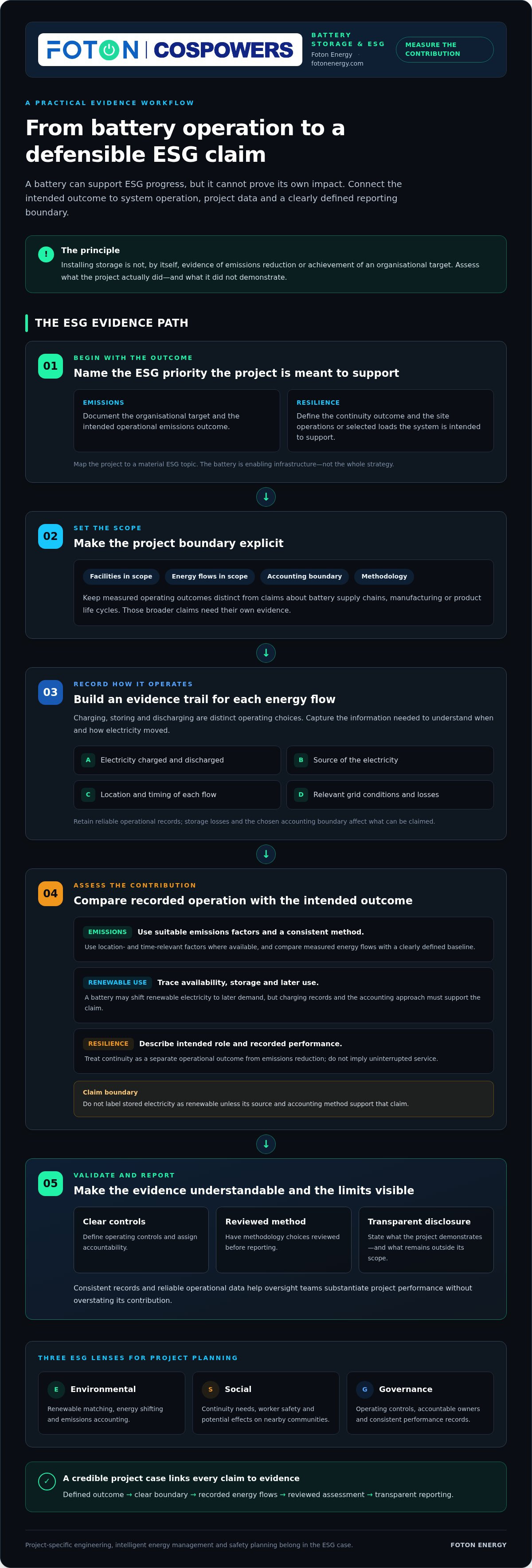
Credible reporting starts with a defined claim and a traceable evidence trail. Before using battery storage to meet ESG targets, agree on the outcome the project is intended to support, how it will be assessed and who is accountable for the data. A disciplined workflow helps distinguish measured results from forecasts and unsupported assumptions.
- Define the target. Connect the project to a documented organisational goal, such as operational emissions, renewable electricity utilisation or site availability.
- Set the boundary. Specify the facility, energy flows, assets and reporting period included. State what falls outside the calculation.
- Choose a suitable metric. Match indicators to the target and establish a baseline. Potential measures include electricity charged and discharged, renewable energy stored and later used, calculated emissions within the stated boundary, or system availability.
- Collect operating data. Identify data sources and owners. An energy management system (EMS) can support records of energy flows, dispatch events and system performance.
- Validate the calculation. Document assumptions, calculation methods and emissions factors, then have responsible energy, sustainability and reporting teams review them. Emissions estimates should use suitable factors and disclose material limitations.
- Disclose with context. Present the result alongside the boundary, baseline, period, methodology and limitations. Label targets, estimates and modelled scenarios clearly so they aren’t confused with actual results.
Which indicators and evidence should teams retain?
Choose indicators that reflect the project’s intended contribution. For an energy or emissions objective, track relevant energy flows and renewable utilisation against a defined baseline and period. For a continuity objective, report availability or documented operating events separately. Keep safety indicators distinct from environmental measures. Combining unlike outcomes can obscure what the evidence actually shows.
For each metric, record its data source, accountable owner, calculation method and limitations. Retain EMS records, commissioning information, operating logs and the approved assumptions used in calculations. These records help reviewers retrace how a result was reached and distinguish operational evidence from projections.
Frameworks such as the GHG Protocol, GRI and IFRS S2 may be relevant to an organisation’s reporting approach, but their application and local requirements depend on the organisation and jurisdiction. Verify current applicability rather than assuming a framework or disclosure obligation fits every project. For project-design context, see the BESS engineering consulting guide.
Align measurement needs with system design from the outset. Foton’s BESS engineering and measurement capabilities can help connect operating objectives, monitoring and reporting evidence.
Turn ESG priorities into a bankable battery storage project
A credible project begins with a defined priority and ends with evidence of how the system performed. Using battery storage to meet ESG targets calls for a practical path from organisational commitments to engineering decisions, operating controls and transparent reporting. Storage can enable progress, but project design and measured operation determine what contribution the evidence can support.
What should an ESG-led BESS project plan include?
Build the project plan around the target it is intended to support. Establish the baseline, reporting boundary, operating objectives and stakeholders accountable for design, operation, safety and ESG disclosures. Then translate those requirements into a technical brief:
- Match design to site needs. Assess energy use, intended dispatch, continuity requirements and other operating conditions. Select system components and controls, including thermal management and safety architecture, to align with the project’s requirements.
- Plan for evidence. Specify which energy flows and performance events must be recorded, how data will be reviewed and how it will feed into reporting. Assign ownership so records remain usable across operational and sustainability teams.
- Review performance over time. Compare actual operation with the defined objectives and baseline. Record material changes to operating assumptions, and distinguish measured results from estimates or projections.
This sequence makes the project case more robust: the ESG priority informs the design, the design shapes operation, and operating records support a proportionate account of results.
How can Foton Energy (Foton Pty Ltd) support the project pathway?
Foton Energy (Foton Pty Ltd)'s commercial and industrial BESS, engineering consulting, safety architecture and AI-driven energy management support project planning from technical requirements through monitoring considerations. The EMS can help capture system data and inform energy-management decisions, giving teams an operational basis for review. Foton Energy (Foton Pty Ltd) offers LFP and sodium-ion systems; the appropriate technology depends on project requirements, not a universal ESG ranking.
Foton Energy (Foton Pty Ltd) provides an established foundation for project discussions grounded in manufacturing experience, while system design and operation remain specific to each site and objective.
Bring your target, site requirements and evidence needs into the planning conversation. Foton Energy (Foton Pty Ltd)'s battery storage project capabilities bring together system options, engineering support and energy management for a project-specific approach.
Build ESG progress on evidence and operational intent
Battery storage can support environmental, social and governance priorities, but the project must be designed around a defined outcome. Strong project cases connect a material ESG target to clear operating objectives, suitable metrics and reliable records. They also distinguish measured results from estimates, and resilience benefits from emissions claims.
Using battery storage to meet ESG targets is a project discipline as much as a technology choice. Charging sources, dispatch decisions, safety planning and reporting boundaries all shape what the evidence can credibly demonstrate. Aligning these factors early helps organisations build a practical, accountable case for storage.
Foton brings together LFP and sodium-ion storage systems, an intelligent EMS, safety architecture and engineering support. As the exclusive global strategic partner of Cospowers, a Tier-1 energy storage manufacturer with over 30 years of manufacturing heritage, Foton supports planning grounded in manufacturing experience and project-specific requirements.
Put your ESG priorities into a technically grounded project plan. Discuss a battery storage project with Foton and explore an approach aligned with your site, operating needs and evidence requirements. Measurable progress starts with a clear objective and a sound plan.
Frequently Asked Questions
Can battery storage help a company meet ESG targets?
Yes, battery storage can support specific ESG objectives when its design and operation align with a documented target. A system may help a business shift electricity use, make better use of renewable generation or support continuity for selected operations. Using battery storage to meet ESG targets still requires evidence: define the project boundary, choose relevant metrics and report what the system demonstrably contributes without treating it as proof of overall ESG performance.
Does battery storage automatically reduce carbon emissions?
No. Emissions outcomes depend on the electricity used to charge the battery, when it discharges, local grid conditions, system losses and the accounting boundary. A battery charged from a higher-emissions grid period could have a different impact from one charged using renewable electricity that would otherwise go unused. To support a reduction claim, compare project energy flows against a clear baseline using suitable emissions factors and transparent calculation assumptions.
How can a business measure the ESG impact of a BESS?
Start by defining the ESG objective, baseline, reporting boundary and period. Then choose a metric that matches the intended outcome, such as electricity charged and discharged, renewable energy stored and used later, calculated emissions within the boundary, or system availability. Collect operating records, document data sources and calculation methods, and have responsible teams review the results. Separate measured performance from targets, forecasts and modelled scenarios.
What ESG metrics should a company track for battery storage?
Track metrics that correspond to the project’s purpose. For an environmental objective, useful indicators may include energy flows, renewable electricity utilisation and emissions calculated using appropriate factors. For operational continuity, record availability and relevant dispatch events. Track safety indicators separately rather than combining them with environmental measures. For every metric, document its baseline, reporting period, data source, accountable owner, calculation method and limitations so the result can be interpreted consistently.
Can a battery improve renewable energy use at a business site?
It can help shift renewable electricity from times of generation to times of demand if the system is designed and operated for that purpose. For example, a site may store some surplus renewable generation and discharge it later when facility loads require electricity. Actual contribution depends on generation, demand, dispatch decisions and recorded energy flows. Don’t describe stored electricity as renewable unless its source and the applied accounting method support that claim.
How does an energy management system support ESG reporting?
An energy management system can support reporting by monitoring and recording energy flows, dispatch events and system performance. These records help teams compare operation with project objectives and provide traceable inputs for relevant metrics. An EMS doesn’t validate an ESG claim by itself: teams still need to define boundaries, select appropriate emissions factors where relevant, document calculation assumptions and review the data. Clear ownership and consistent records strengthen the evidence trail.
Which battery chemistry is more sustainable, LFP or sodium-ion?
Neither chemistry can be called universally more sustainable without comparable, verified lifecycle evidence. Assess LFP and sodium-ion against the project’s operating requirements, safety design, performance needs, supply chain information and available data on manufacturing, use, maintenance and end of life. The result may depend on the project and the lifecycle boundary used. A responsible comparison identifies evidence gaps and avoids ranking chemistries based on a single attribute.
Which ESG reporting frameworks apply to battery storage projects?
Framework applicability depends on the organisation, its reporting scope and the jurisdictions where it operates. The GHG Protocol may help structure greenhouse gas accounting; GRI or IFRS S2 may be relevant to broader sustainability or climate-related disclosures. A battery project doesn’t automatically trigger a particular framework or obligation. Confirm current requirements and applicability for the organisation, then align project metrics, boundaries and evidence with its reporting approach.


