

The modular vs monolithic BESS architecture decision is not about choosing a universally better design. It is about matching the system to your growth plans and operating priorities. Modular systems can support capacity expansion by adding modules, while monolithic systems can suit stable applications where simplicity and the initial configuration matter. The right fit depends on how much flexibility, redundancy and room for change your project needs.
Both approaches can store energy, but their differences shape more than the initial installation. This comparison explains how they affect expansion, investment, deployment, lifecycle costs, maintenance, uptime and conversion. You’ll see where modularity can add operational flexibility, where a monolithic design may be more straightforward, and which trade-offs matter when planning a BESS for long-term use.
Key Takeaways
- Match the architecture to your growth plans: modular systems allow capacity to expand in stages, while monolithic designs can suit stable requirements.
- Compare the full lifecycle, not just the initial investment. Deployment timing, future expansion and operating needs all shape the economic trade-off.
- Module-level isolation can help a modular system maintain partial operation during a fault, making redundancy and maintenance important uptime considerations.
- Converting an existing system requires assessing compatibility, controls and integration needs before deciding whether a modular transition is practical.
- Use the architecture comparison to clarify your priorities, then align the BESS design with the application and operating requirements.
Capacity expansion and phased investment
Modular designs let operators add storage capacity in stages, while monolithic systems are generally planned around a fixed initial configuration. The choice affects how closely investment can follow changing demand.
Scalability Across Capacity Needs
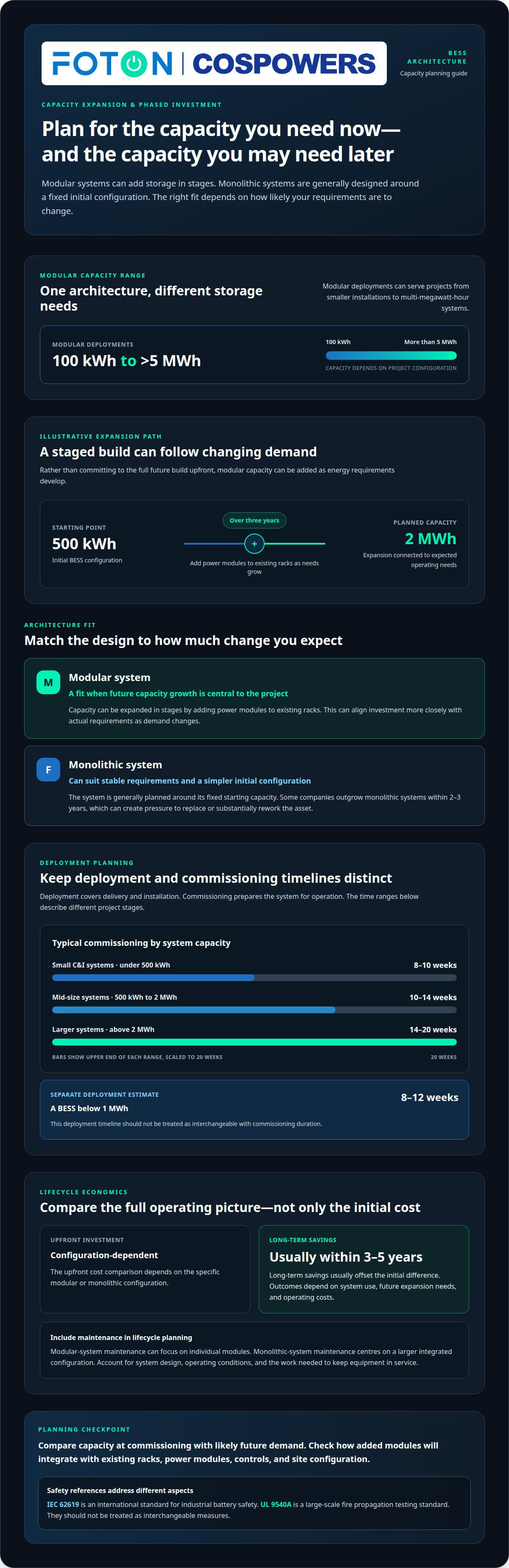
Scalability is the ability to increase a BESS’s capacity as energy requirements grow. Modular deployments can range from 100 kWh to more than 5 MWh, so the architecture can serve projects with different storage needs. For operators, this matters when demand forecasts may change: adding capacity can align the system more closely with actual requirements instead of committing to the full future build upfront.
Modular designs can increase capacity by adding power modules to existing racks. For example, a system can grow from 500 kWh to 2 MWh over three years. This staged approach connects expansion to changing needs, such as higher consumption or a larger storage requirement. By contrast, some companies outgrow monolithic systems within 2-3 years, creating pressure to replace or substantially rework an asset designed around its original capacity.
Phased Capacity Expansion
Phased capacity expansion means installing an initial BESS and adding capacity as project requirements develop. It matters because the investment can be divided across distinct growth stages rather than sized only for a later, larger demand. A 500 kWh starting point, for example, can be planned to reach 2 MWh over three years, connecting each expansion to the expected operating need.
For staged expansion to work, the plan must account for how added modules integrate with the installed system. Existing racks, power modules, controls and site configuration all shape the practical options. A monolithic design can remain suitable when requirements are stable and simplicity is the priority. Modular architecture becomes more relevant when future capacity growth is central to the project.
Expansion planning also involves safety standards and fire-propagation testing. According to the International Electrotechnical Commission, IEC 62619 is an international standard for industrial battery safety. UL 9540A is a large-scale fire propagation testing standard, according to UL Standards & Engagement. These references address different aspects of safety evaluation, so they should not be treated as interchangeable measures.
Compare the capacity required at commissioning with what the project may need later. A modular design supports staged additions, while a monolithic system is built around its initial configuration. This distinction helps determine whether expansion flexibility should take priority in the architecture decision.
Deployment timelines and lifecycle costs
Project duration depends on system scale, commissioning scope and site integration. Typical commissioning takes 8-10 weeks below 500 kWh, 10-14 weeks from 500 kWh to 2 MWh, and 14-20 weeks above 2 MWh.
Upfront and Long-Term Costs
Upfront cost covers the initial system and deployment; lifecycle cost also reflects operation, maintenance and future capacity needs. This distinction matters because a lower initial investment does not always mean lower total costs over the asset’s operating life.
The upfront cost comparison between modular and monolithic systems depends on the specific configuration. Their long-term savings usually offset that initial difference within 3-5 years. The outcome depends on how the system is used, the need for later expansion and the costs associated with operating the chosen configuration.
Maintenance Requirements
Maintenance requirements include the inspections and servicing needed to keep a BESS functioning throughout its operating life. Access to components and the ability to address faults can affect both maintenance work and operational planning.
With modular systems, maintenance can focus on individual modules; with monolithic systems, it centres on a larger integrated configuration. A suitable maintenance plan accounts for the system design, operating conditions and work needed to keep equipment in service. Include these considerations in lifecycle planning, not just commissioning.
Deployment schedules also vary with project scale. A BESS below 1 MWh can have a deployment timeline of 8-12 weeks, while commissioning estimates distinguish smaller and larger systems. These figures describe different project stages, so they shouldn’t be treated as interchangeable: deployment covers delivery and installation, while commissioning prepares the system for operation.
For planning purposes, compare commissioning timelines by capacity:
- Small C&I systems under 500 kWh: 8-10 weeks.
- Mid-size systems from 500 kWh to 2 MWh: 10-14 weeks.
- Systems above 2 MWh: 14-20 weeks.
Operating life adds another dimension to the cost comparison. A modular BESS asset can have a 15-20 year operating life, while modular and monolithic battery systems can each last 10-15 years with proper maintenance. Assess the expected service period alongside installation and servicing needs, rather than judging architecture on commissioning time alone.
To assess a project, compare capacity, commissioning scope, maintenance needs and expected operating life. A project-level BESS assessment can help connect those factors to the system’s intended use.
Module-level maintenance, redundancy, and uptime
In a modular BESS, a fault can be contained at module level rather than affecting every battery module. A modular system can typically continue operating at 80-95% capacity through a module fault. That remaining capacity can help maintain partial service while the affected component is addressed.
A key operational difference is how each architecture handles component failure. In a modular system, a failed module can be isolated and replaced without disrupting the entire system. By contrast, a monolithic system uses one rectifier and one inverter, with no built-in redundancy. This makes the system more dependent on those shared components.
For operators, uptime means more than whether the BESS is switched on. It also concerns how much usable capacity remains available during a fault or maintenance. If a module fails in a modular design, the remaining modules can continue supplying part of the system’s capacity. A monolithic design has no built-in redundant rectifier or inverter to take over if either shared component fails.
Module-level isolation can also narrow the scope of maintenance. A technician can separate a failed module from operating modules, then replace it without stopping the complete system. This matters for facilities that rely on stored energy as part of ongoing operations. The effect depends on how much capacity remains available after the fault.
Replacement planning should account for the role of the affected module and the system’s remaining capacity. For example, if a modular BESS continues operating at 80-95% capacity during a module fault, the operator can plan around reduced output while the failed unit is replaced. This is partial operation, not a claim that the system runs at full capacity or avoids all disruption.
Redundancy is an architectural property, not simply a maintenance task. Modular designs divide capacity across modules, so a failed unit can be isolated while others remain in operation. A monolithic system’s single rectifier and single inverter create shared dependencies, with no built-in redundancy. These differences shape how much of the system is exposed to a component-level fault.
When comparing designs, consider the impact of reduced capacity as well as a complete interruption. Map which modules or shared components support the BESS, then assess how a fault in each would affect available output. In a modular system, module isolation and replacement can preserve partial operation. In a monolithic system, the single rectifier and inverter deserve particular attention in uptime planning.
The practical trade-off is clear: modular architecture supports targeted replacement and continued operation at reduced capacity during a module fault. Monolithic architecture has a simpler shared configuration, but no built-in redundancy for its single rectifier and inverter. For sites where partial operation matters, this distinction should inform the architecture decision.
Q2: Can I convert my existing monolithic system to a modular?
Converting a system is not simply a matter of adding battery modules. Assess the existing battery, power conversion system, controls, electrical connections and site configuration to determine how modular equipment could integrate.
Start with the system’s design documents and identify how its components work together. A monolithic BESS is built around an integrated configuration, so its battery modules, inverter, rectifier and controls may not support direct substitution or expansion. The conversion approach depends on compatibility between the existing equipment and the proposed modular system.
Evaluate the major interfaces before planning a transition. In particular, assess:
- Battery configuration: Determine whether the existing battery arrangement can connect with modular units.
- Power conversion: Review how the inverter and rectifier would operate with the revised system.
- Controls: Assess how system controls would coordinate the original equipment and added modules.
- Site integration: Consider the electrical connections and physical layout needed for the new configuration.
These checks help distinguish partial integration from full system replacement. For example, if the original inverter or controls cannot coordinate with new modules, retaining the existing battery while adding modular capacity may not be practical. Even when the components can operate together, integration must account for how the revised system will be controlled and maintained.
Monolithic systems remain suitable for stable, low-risk applications where simplicity and the initial configuration matter. A facility with predictable storage needs may value that straightforward arrangement over capacity that can expand in stages. Conversion is not automatically the better decision: the existing system’s condition, future requirements and integration demands all matter.
For U.S. installations, UL 9540 identifies certification for overall BESS systems, while UL 9540A is a large-scale fire propagation testing standard. NFPA 855 is identified as a fire code requirement for modular BESS safety. These references address distinct scopes and should not be treated as interchangeable.
IEC 62619 is an international standard for industrial battery safety, according to the International Electrotechnical Commission. For a conversion project, standards and system integration are separate considerations: component compatibility determines whether equipment can work together, while applicable safety references inform system design and evaluation.
The practical question is whether the existing system can integrate with modular components while meeting the project’s operating needs. If stable demand and simplicity remain priorities, retaining a monolithic design may make sense. If requirements have changed, assess the complete system architecture before deciding between integration and replacement.
Modular and monolithic BESS architecture comparison
Neither architecture is universally better: modular systems suit changing needs, while monolithic designs suit stable, low-risk applications. Footprint, siting and permitting depend on the system configuration and site, so compare these factors alongside the application requirements.
Footprint, Siting, and Permitting
Footprint, siting and permitting concern the space a BESS needs, where it is placed and the reviews involved. Battery racks, power conversion equipment and site access all shape how a design fits a project.
A modular layout distributes capacity across modules, while a monolithic design groups equipment into an integrated configuration. For either approach, compare available site area, equipment arrangement and access for installation and servicing. These factors influence the workable footprint; architecture alone does not determine it.
Permitting also depends on the proposed system and its location. Providing the BESS configuration, equipment arrangement and site plan gives reviewers project-specific information. Do not assume one architecture automatically requires less permitting. A modular design needs a coherent site plan, just as a monolithic system does.
Application Suitability
Application suitability means matching the architecture to the storage task and operating priorities. It matters because a utility-scale project and an industrial facility may value different features, even when both use battery storage.
For utility-scale applications, modularity can fit projects where capacity needs may change. Commercial and industrial operators can weigh that flexibility against the simplicity of a monolithic design. For stable, low-risk applications where initial cost and simplicity matter, monolithic systems remain a suitable choice.
No architecture is the clear winner across utility-scale, commercial and industrial applications. Compare the expected operating profile, growth plans and required system flexibility. A project that prioritizes adaptable capacity may favour modular design; a stable application that prioritizes simplicity may favour monolithic design.
Architecture Design Differences
Architecture describes how battery and power conversion components are arranged and connected. The distinction matters because shared components and modular units affect system flexibility, redundancy and operation.
Modular BESS designs organize storage in modules that can work as part of a larger system. They can achieve up to 99% efficiency. Monolithic systems use one rectifier and one inverter, without built-in redundancy. That shared configuration can make the design straightforward, but it concentrates power conversion in those components.
Compare how each architecture meets the system’s core requirements, rather than treating efficiency as the only measure. A project that emphasizes modularity may value storage divided across units, while a stable application may prioritize the simplicity of a monolithic configuration. The relevant trade-off depends on the project’s priorities.
Use three decision points: site layout, operating needs and system configuration. For utility-scale projects, assess how planned capacity and site constraints align. For commercial and industrial applications, weigh adaptability against simplicity. To discuss utility-scale BESS architecture, take the next step with a project-focused conversation.
Foton Energy (Foton Pty Ltd): C&I BESS
Foton Energy (Foton Pty Ltd) offers C&I BESS for businesses assessing storage architecture against their operating requirements. The comparison above can help clarify priorities: capacity growth, site configuration, system integration and the importance of maintaining partial operation during a module fault.
For commercial and industrial projects, the next step is to connect those priorities with the application. Consider whether demand is expected to change, whether a modular configuration fits the site, and how the system should support operations. Foton Energy also offers Utility-Scale Storage, Residential Storage Systems, and Data Centre & Telco Backup for those applications.
To discuss a BESS project, contact Foton Energy or visit fotonenergy.com.
Shape the next stage of your storage strategy
The architecture decision is an opportunity to align energy storage with how your site may evolve. Before committing to a design, bring together operational priorities, site constraints and future plans. This shared view can make the next design discussion more focused, whether you are planning a new system or reassessing an existing one.
Choosing between modular and monolithic BESS architecture is not just a technical preference. It reflects how you want the system to support your operations as requirements develop. Clear project priorities provide a stronger basis for evaluating the trade-offs and identifying a design direction that fits.
Foton Energy (Foton Pty Ltd) can discuss your BESS project in relation to its intended application and architecture considerations. Contact Foton Energy to discuss your BESS and take the next step with a clearer view of your project goals.
Frequently Asked Questions
Modular vs Monolithic Pack Designs: Which is Better?
Neither design is better for every project. Modular packs suit requirements that may grow or change, while monolithic packs can fit stable applications that prioritize simplicity. For example, a site planning future expansion may value modularity; a site with a predictable load may prefer a fixed design. Compare expected use, site constraints and operational priorities before choosing.
Q1: How much more expensive are modular systems upfront?
Modular systems typically cost 15-25% more upfront than comparable monolithic systems. That percentage describes the reported difference between system architectures, not a project quote. For a useful comparison, keep the required capacity and system scope consistent, then distinguish the initial investment from costs over the operating life. Phased additions can also change when investment is made, rather than requiring the full planned capacity at the outset.
Q3: Which design is safer for mission-critical applications?
Neither architecture is automatically safer for every mission-critical application. Safety depends on how the complete system manages battery faults, thermal conditions, controls and fire risks. Availability is related but separate: a design may preserve some operation during a fault without eliminating the underlying hazard. Assess the system’s safety design and fault response against the consequences of an interruption at the site.
Q4: How does efficiency compare at partial loads?
Peak efficiency alone does not establish which design performs better at partial loads. The comparison depends on how the power conversion system is sized and how much energy the site draws during typical operation. For example, a system often serving a small portion of its rated output may behave differently from one operating near its design load. Evaluate performance against the site’s expected dispatch profile, not just a maximum efficiency claim.
Q5: What’s the typical lifespan difference between these designs?
With proper maintenance, modular and monolithic battery systems can each last 10-15 years, so the available lifespan comparison doesn’t show a typical difference by architecture alone. Battery chemistry and operating conditions also matter. For example, typical LFP BESS cycle life is 6,000-10,000 cycles at 80% depth of discharge. Compare expected cycling and maintenance needs alongside the architecture when estimating service life.
What Is a Modular BESS?
A modular BESS is a battery energy storage system built from coordinated units rather than one fixed, monolithic arrangement. Those units work together to store and deliver energy as part of the larger system. Organizing capacity across modules can support a design sized around project needs. When assessing a proposed system, consider how the modules connect to power conversion and controls.
What Makes These Designs Different?
The central difference is how storage and supporting equipment are organized. A modular design distributes storage across units, while a monolithic design centres on an integrated configuration. This affects how a project can adapt, how components connect and how the system operates. To compare proposals, look beyond the battery arrangement and consider power conversion equipment, controls and the intended operating profile together.
What is modular BESS architecture versus monolithic BESS architecture?
Choosing a modular vs monolithic BESS architecture means deciding between storage arranged in coordinated modules and a more integrated system configuration. Modular designs can suit projects that value adaptable capacity; monolithic designs can suit stable needs and simpler planning. Neither option is universally preferable. Start the comparison with the site’s operating requirements, expected changes and the role storage must play in daily operations.


