

A single storage technology rarely meets every power demand equally well. The benefits of a hybrid energy storage system come from combining two or more storage technologies in one coordinated system, so complementary components can handle different needs, such as sustained energy delivery and rapid, high-power response.
Reliable power matters whether the priority is keeping critical loads supplied during an outage or balancing changing generation and demand. A hybrid system can help by coordinating storage technologies and, in some designs, renewable generation with other power sources.
This article explains how hybrid energy storage systems work and where their advantages matter most. You’ll learn how they can support backup power, grid stability, renewable integration, and frequency regulation, along with the design considerations that shape performance. The key is matching the system to its operating needs.
Key Takeaways
- See how pairing complementary storage technologies can match different power demands within one system.
- Explore how batteries can work alongside diesel generators to support remote and off-grid power needs.
- Understand how storage can help balance supply and demand and support frequency regulation.
- Learn what affects backup capability, including the loads a system needs to serve and how it is designed.
- Discover when Foton Energy’s C&I BESS may fit a facility’s energy storage needs.
What is a Hybrid Energy Storage System (HESS)?
A hybrid energy storage system combines two or more storage technologies in one operating system, assigning different tasks to components with complementary strengths. For example, a battery can provide sustained energy while a supercapacitor responds to brief, high-power demand. This division of roles can improve efficiency and reduce strain on a single storage device. The advantages depend on how the system is controlled and matched to its loads, not simply on adding more equipment.
Renewable energy integration is one application. Solar panels and wind turbines produce variable output, which may not align with demand. A battery can store surplus electricity and dispatch it when solar or wind production falls. In a battery-supercapacitor arrangement, the battery can manage longer fluctuations while the supercapacitor responds to rapid changes. Coordinated controls manage charging, discharging, and power flow. This can smooth renewable intermittency and provide a steadier supply, but it cannot eliminate variability, especially in an off-grid system.
Storage can also be coordinated with heating and cooling loads. For example, thermal storage can hold energy as chilled water or heat, while a battery stores electrical energy. A controller can shift when heating or cooling equipment draws power, then dispatch stored electricity for other loads. This links building demand with energy storage rather than treating each asset separately. The design needs to account for load timing, renewable output, and the required balance between electrical and thermal energy.
Generator integration adds another operating resource. In a remote site, renewable generation can serve demand first, batteries can cover shortfalls, and a diesel generator can supply power when needed. Battery storage can also provide fast response while a generator handles sustained demand. For a system designated X250KT, assess its documented power and energy ratings, operating limits, interfaces, and compatibility with the generator. A model label alone doesn’t explain how the unit performs or integrates; those specifications determine its role in the combined system.
Grid-connected HESS designs can also support ancillary services. Batteries and other storage devices can inject or absorb electricity as supply and demand change, helping with frequency regulation, voltage support, and load balancing. A flywheel-battery combination, for instance, can pair fast response with stored energy. Controls coordinate these functions with renewable generation and site loads. Storage can therefore help manage power quality and support grid stability, not just provide backup. Integration planning must align the storage technologies, controller, generator, and grid connection with the intended operating duties.
Diesel generators paired with battery storage
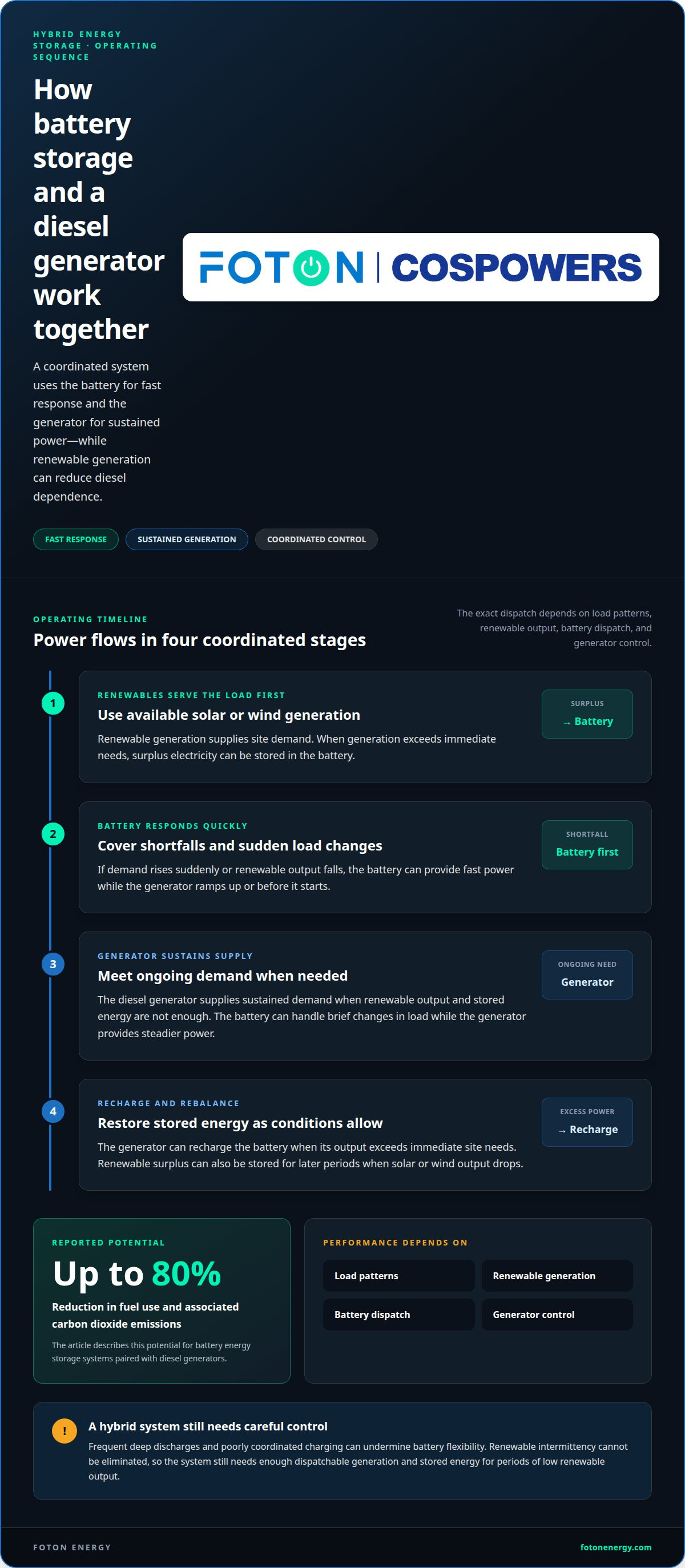
Pairing a battery with a diesel generator combines fast power response with sustained generation. The operating strategy determines how this arrangement supports reliability, fuel use, and renewable energy applications.
Battery Health and Cycle-Life Protection
Protecting battery health means controlling charge, discharge, and operating conditions to limit unnecessary stress. In a generator hybrid, the battery can handle short changes in load while the generator supplies steadier demand. This division can reduce battery cycling and help preserve capacity over time. The controller’s dispatch strategy matters: frequent deep discharges and poorly coordinated charging can undermine the intended flexibility.
At a remote site, a battery can respond to a sudden load increase while a diesel generator ramps to meet demand. The generator can then recharge stored energy when its output exceeds immediate site needs. This arrangement may reduce generator operation at inefficient low loads and lower fuel use. Battery energy storage systems paired with diesel generators can reduce fuel use and associated carbon dioxide emissions by up to 80%. Actual performance depends on load patterns, renewable generation, battery dispatch, and generator control.
Adding solar or wind generation changes the operating sequence. Renewable output can serve the load first, with surplus energy stored in the battery. When clouds reduce solar output or wind generation drops, the battery can supply power before the generator starts or increases output. This can reduce diesel dependence, but it cannot eliminate renewable intermittency. The system still needs enough dispatchable generation and stored energy for periods when renewable output remains low.
Other combinations serve different applications. A superconducting magnetic energy storage unit stores electricity in a magnetic field and can deliver rapid power, while a battery provides longer energy delivery. Coordinating their roles can improve response flexibility, although the added equipment and controls increase integration complexity. Thermal storage paired with a battery takes a different approach: stored heat or cooling can shift thermal demand, while the battery supplies electrical loads. These systems need to coordinate generation, thermal demand, and battery charging.
Safety, Maintenance, and Degradation Risks
Hybrid-system risks include battery degradation, conversion losses, incompatible components, and the added maintenance needs of separate technologies. These factors matter because a battery, generator, thermal store, and superconducting unit each have distinct operating requirements. Poorly coordinated charging can increase battery stress; inadequate control or maintenance can also reduce system performance. For grid-scale projects, utility-scale storage solutions can form part of planning for coordinated storage and generation.
Grid stability and frequency regulation
In the United States, project cost depends on storage technologies, system size, controls, grid integration, and intended services. Lifespan depends on operating conditions and cycling, while payback reflects energy savings and revenue from grid services. These factors vary by application, so one typical figure would not describe every project. A facility focused on peak shifting, for example, has different operating demands from a grid asset providing frequency regulation.
Frequency regulation helps balance electricity supply and demand as conditions change. A battery-supercapacitor system can divide the work: the battery handles lower-frequency fluctuations, while the supercapacitor responds to rapid variations. The controller directs the assets to inject or absorb electricity as needed. This coordinated response can support grid frequency and voltage while helping balance intermittent renewable energy with demand. A flywheel-battery combination can also pair fast response with stored energy.
These services apply across utility, commercial, and industrial settings. A grid-scale storage asset can shift energy between periods of lower and higher demand, while a commercial facility can discharge stored electricity during its own peak. Industrial parks can use storage for peak shifting, valley filling, and frequency regulation. These roles may reduce reliance on more costly frequency regulation and spinning reserve services. Consumer savings depend on how the system’s energy use and services align with local rates and market opportunities.
Remote and off-grid systems face a different challenge: balancing local generation with changing loads without continuous grid support. In an islanded microgrid, batteries can smooth changes in solar or wind output and deliver electricity when generation falls. A diesel generator can provide another source when stored energy and renewables cannot meet demand. This combination can improve reliability, but it cannot eliminate renewable intermittency or remove the need to match capacity with critical loads.
Grid reliability depends on integration, not storage alone. A controller must coordinate batteries, generators, renewable sources, and site demand while responding to operational signals. In the United States, each regional transmission organization (RTO) and independent system operator (ISO) has its own grid-integration processes. Whether a storage asset can provide ancillary services depends on the relevant operator’s rules and the asset’s configuration. Industrial and utility planners assess interconnection, dispatch, and service requirements together to define whether the system’s primary role is resilience, frequency regulation, peak management, or a combination.
Costs vary with storage technologies, system size, controls, grid integration, and services provided. Lifespan depends on operating conditions and cycling, while payback depends on energy savings and revenue from grid services.
Backup and uninterruptible energy supply
During a grid outage, stored electricity can supply selected critical loads, such as data centre servers, telecom equipment, or building controls. A hybrid system coordinates storage components and other generation to match energy supply to those loads. The practical aim is continuity for priority equipment, not automatically powering every device in a facility. Defining which loads matter most helps determine how storage and generation should be assigned.
Backup duration depends on stored energy, the power drawn by connected equipment, and the system’s dispatch strategy. Some hybrid energy storage systems provide more than 12 hours of runtime, while other designs serve shorter interruptions or specific loads. A site with servers, cooling equipment, and network systems, for example, needs to account for each load’s demand and operating schedule. Runtime also depends on whether renewable generation or a traditional generator can replenish supply during an outage.
A diesel generator paired with battery storage can provide two complementary responses. The battery can supply power quickly as an outage begins, while the generator starts and takes on sustained generation. The battery can also absorb changes in demand while the generator supplies energy over a longer period. This arrangement supports backup and may reduce generator fuel use, but its effectiveness depends on generator integration, battery capacity, load profiles, and control settings.
Solar generation can add another source for a facility with battery storage. During an outage, available solar power can serve loads and charge the battery; stored energy can then support demand when solar output falls. Because renewable generation varies, the system must coordinate its components around changing conditions. A generator may provide additional backup when renewable output and stored energy cannot meet demand. This is a layered supply strategy, not an assumption that solar alone will cover every outage.
For critical infrastructure, reliability planning starts with the loads that must remain operational. A telecom site, for example, may prioritize communications equipment over nonessential building demand. Separating priority loads helps align storage power, stored energy, and generator output with the required backup role. Hybrid systems can also support power quality and help address fluctuations that affect connected equipment. The investment’s value depends on the disruption the system is designed to manage and the role assigned to each component.
Backup design must account for maintenance as well as outage response. Batteries degrade with use, and hybrid systems may require distinct maintenance strategies for their different storage technologies. A generator, battery, and renewable source also need coordinated controls to avoid gaps between available supply and demand. For a data centre or telecommunications facility, the design must link critical loads, backup duration, energy sources, and component operation in one plan for reliable supply.
Hybrid energy storage system definition and purpose
A hybrid energy storage system (HESS) combines two or more storage technologies in one operating system. Its purpose is to assign different electricity demands to components suited to each task. For example, a battery can store energy for sustained delivery, while a supercapacitor responds to short, high-power fluctuations. The controls coordinate charging and discharging so each component contributes according to its strengths. This differs from a hybrid energy system, which can combine renewable generation, traditional generation, and storage.
Combining technologies can help meet different requirements without relying on one device to handle every trade-off in efficiency or performance. Batteries can provide stored energy over longer periods, while supercapacitors manage rapid power changes. A compressed-air and supercapacitor combination illustrates another division of roles: compressed air provides energy storage capacity, while the supercapacitor contributes high power density and rapid response. The right design depends on whether the application prioritizes sustained supply, fast response, or both.
For an industrial facility, priorities may include managing a steady process load and responding to sudden equipment demand. A controller can direct the battery toward longer-duration energy needs and use a fast-response component for abrupt changes. This power sharing can reduce stress on individual components and help maintain a more stable electricity supply. The value comes from matching storage behavior to the actual load profile, not simply adding technologies.
Renewable integration shows how a HESS can support a changing energy mix. Solar generation can rise and fall with sunlight, while wind output varies with wind conditions. Stored electricity can help bridge periods when renewable generation drops, and coordinated components can smooth short fluctuations. This can support greater use of renewable energy, although storage does not eliminate intermittency. A system’s environmental effect also depends on its energy sources and how it operates.
The purpose varies by application. A grid-connected system may support frequency regulation, voltage support, or peak management. In a remote microgrid, the priority may be a steadier local supply when renewable output varies. In either case, the HESS needs control logic that coordinates storage response with generation and demand. This match determines which services the system can provide.
Combining technologies also brings design considerations. Energy conversion between components can cause losses, and mismatched equipment can complicate integration with existing loads or the grid. Different storage technologies may need distinct maintenance and management strategies. Start with the required service, such as rapid response or longer energy delivery, then select complementary components and controls. This focuses the system on measurable operating needs while accounting for integration demands.
Foton Energy (Foton Pty Ltd): C&I BESS
Foton Energy (Foton Pty Ltd) offers C&I BESS for commercial and industrial energy storage needs. This can be a practical option for organizations assessing how storage could support backup planning, energy management, or grid-related operating objectives. The system configuration depends on the facility’s loads, generation sources, and intended role for stored energy.
Foton Energy also offers Utility-Scale Storage, Residential Storage Systems, and Data Centre & Telco Backup. These offerings serve different settings, from grid-scale assets to residential storage and critical communications infrastructure. Consider your application and its power requirements when identifying the relevant category.
To discuss your energy storage requirements, contact Foton Energy (Foton Pty Ltd) or visit fotonenergy.com.
Shape your next energy decision
Start by defining what reliable power means for your site. Identify the loads that must remain operational, the role stored energy should play, and how the system will work with existing generation and grid connections. These priorities provide a practical basis for evaluating the project’s design and operating strategy.
The benefits of a hybrid energy storage system are strongest when its components and controls meet clearly defined needs. That could mean supporting critical operations, coordinating renewable generation, or managing changing demand. A focused project brief connects those objectives to the right storage application and gives technical discussions a useful starting point.
Foton Energy (Foton Pty Ltd) can help organizations explore energy storage options for their requirements. Contact Foton Energy to discuss your project and take the next step toward a power strategy built around your operational priorities.
Frequently Asked Questions
What Are The Advantages And Disadvantages Of A Hybrid System?
A hybrid system can combine storage technologies with different strengths, giving operators more flexibility than relying on one device alone. That flexibility comes with trade-offs: additional equipment and controls can make integration and maintenance more complex, and energy conversion between components can cause losses. To assess a design, compare its intended services with its control requirements, component compatibility, and maintenance needs.
Where Are Hybrid Energy Stacks Used?
Hybrid energy storage systems are used in settings with varied power needs, including homes, commercial and industrial facilities, utility grids, data centres, and remote microgrids. Electric vehicles can also combine batteries with supercapacitors or flywheels. The term “stack” may refer to an arrangement of energy components, but the application determines which technologies belong in it. A remote site, for example, may coordinate renewable generation, batteries, and a generator.
What is a hybrid energy storage system?
A hybrid energy storage system combines two or more storage technologies and coordinates them as one operating system. It differs from a hybrid energy system, which may combine generation sources, such as renewable power and a traditional generator, with storage. This distinction matters in project planning: one describes a combination of storage methods, while the other describes a wider mix of energy resources and equipment.
What are the main benefits of combining batteries with other energy storage technologies?
The benefits of a hybrid energy storage system include assigning different demands to components suited to each task. A supercapacitor can provide brief, intense power bursts, while a battery supplies energy over a longer period. A flywheel can also provide fast response in some designs. This division can help reduce unnecessary battery cycling, but the system needs coordinated controls and careful matching to its actual load profile.
How do hybrid energy storage systems improve efficiency and round-trip energy losses?
Hybrid systems can improve operation by directing different types of demand to suitable storage components, rather than making one device handle every fluctuation. Round-trip losses occur when electricity is converted, stored, and later converted back for use; transfers between technologies can add further losses. Controls should match charging and discharging schedules to the system’s purpose, while accounting for conversion paths and required services. One benefit of a hybrid energy storage system is this targeted allocation of duties.
How can hybrid storage reduce electricity costs and demand charges?
Where electricity rates vary by time or include demand charges, storage can charge during lower-cost periods and discharge when site demand rises. For example, a facility can use stored energy to reduce its grid draw during a short production peak. The potential value depends on the tariff structure, load profile, and charging strategy. Storage does not automatically lower bills; its operating schedule needs to align with how electricity is billed.
How do hybrid energy storage systems improve grid reliability and resilience?
Storage can help grid operators respond to changes in supply and demand, support voltage, and provide frequency regulation. A hybrid design can allocate rapid fluctuations and longer energy requirements to complementary components. During an outage, a properly configured system can also support selected critical loads or a local microgrid. Its resilience role depends on its connection, controls, available stored energy, and the loads it is designed to serve.
How do hybrid systems support renewable energy integration and reduce curtailment?
When renewable generation exceeds immediate demand, storage can absorb surplus electricity if it has available capacity and can charge at that time. The stored energy can then be dispatched when generation falls or demand increases, helping make more renewable output useful. If storage is full, constrained, or unable to charge, surplus generation may still be curtailed. System controls and the timing of generation, demand, and storage availability shape the result.


