

A battery on site is not, by itself, proof of a greener business. Improving corporate green credentials with energy storage depends on how the system is charged and dispatched, and whether its effects can be measured against a credible baseline. The same battery may support renewable energy use, manage demand or provide flexibility, but its emissions impact depends on its operating strategy and the electricity system.
It can be difficult to connect sustainability goals to everyday energy decisions, or to distinguish measurable progress from broad environmental claims. This guide explains how to assess where battery energy storage may support existing climate and energy objectives, which operational and emissions metrics to track, and what evidence can substantiate results.
We’ll look at how charging choices, dispatch patterns and site conditions shape outcomes, then set out a practical approach to measurement and reporting. You’ll also learn how to align project design with business priorities and describe a battery’s contribution accurately, without suggesting that installation alone guarantees emissions reductions.
Key Takeaways
- Link battery storage to defined energy, climate or resilience priorities. Installation itself is not a sustainability outcome.
- When improving corporate green credentials with energy storage, assess how charging sources, dispatch timing and system losses affect the project’s impact.
- Set a clear baseline, reporting boundary, assessment period and calculation method so results can be substantiated.
- Follow a five-stage roadmap: define objectives, assess the site, model use cases, measure outcomes and report findings.
- Align system design and energy-management capabilities with site requirements so operating data can inform project decisions.
Why Energy Storage Can Strengthen Corporate Green Credentials
Corporate green credentials are the evidence behind a company’s environmental performance, commitments and public reporting. They connect stated intentions with what business operations achieve. A battery energy storage system (BESS) can help a site manage energy more flexibly, use renewable electricity at different times and support operational resilience. Its contribution depends on how it is operated, not simply on whether it is installed.
Energy storage supports corporate green credentials when measured operation advances stated objectives. Owning an asset is not the same as demonstrating an environmental outcome. A battery may help a business shift electricity use or make better use of renewable generation, but charging losses and the emissions intensity of the electricity system also affect the result.
What does improving corporate green credentials actually mean?
Improving corporate green credentials with energy storage means connecting four elements: operational performance, formal targets, transparent disclosure and stakeholder communication. A company can set a climate objective, operate its energy assets in support of it, measure relevant results within a defined reporting boundary, then explain the outcome and its limitations. Claims should reflect the evidence rather than imply benefits beyond what the data supports.
The GHG Protocol is a widely used framework for corporate greenhouse gas accounting and reporting. Organisations can use relevant guidance to inform how they define emissions boundaries and account for electricity-related emissions. A clear boundary helps distinguish site-level changes from wider grid effects and makes comparisons more meaningful. Consult the current guidance that applies to your reporting needs.
Where can battery storage contribute to corporate sustainability?
Storage can support renewable-energy use, load flexibility and energy management. For example, a facility with on-site solar generation could store some surplus electricity for later use. A business might also shift consumption away from a particular period or use a battery to support critical operations during a disruption. These are potential operational roles, not automatic emissions reductions.
Outcomes depend on local grid conditions, the source and timing of charging, storage losses and dispatch strategy. Discharging during one period may reduce grid electricity use at the site, but assessing the overall emissions effect requires a consistent comparison of what electricity was stored and when. A Battery storage power station overview provides foundational context on system components and applications.
For commercial and industrial sites, planning should start with the intended use case and the site’s operating requirements. A guide to commercial and industrial BESS solutions can help connect system planning with those needs. Then define what evidence would show whether storage is helping meet the objective.
How BESS Operation Connects to Energy Use and Emissions
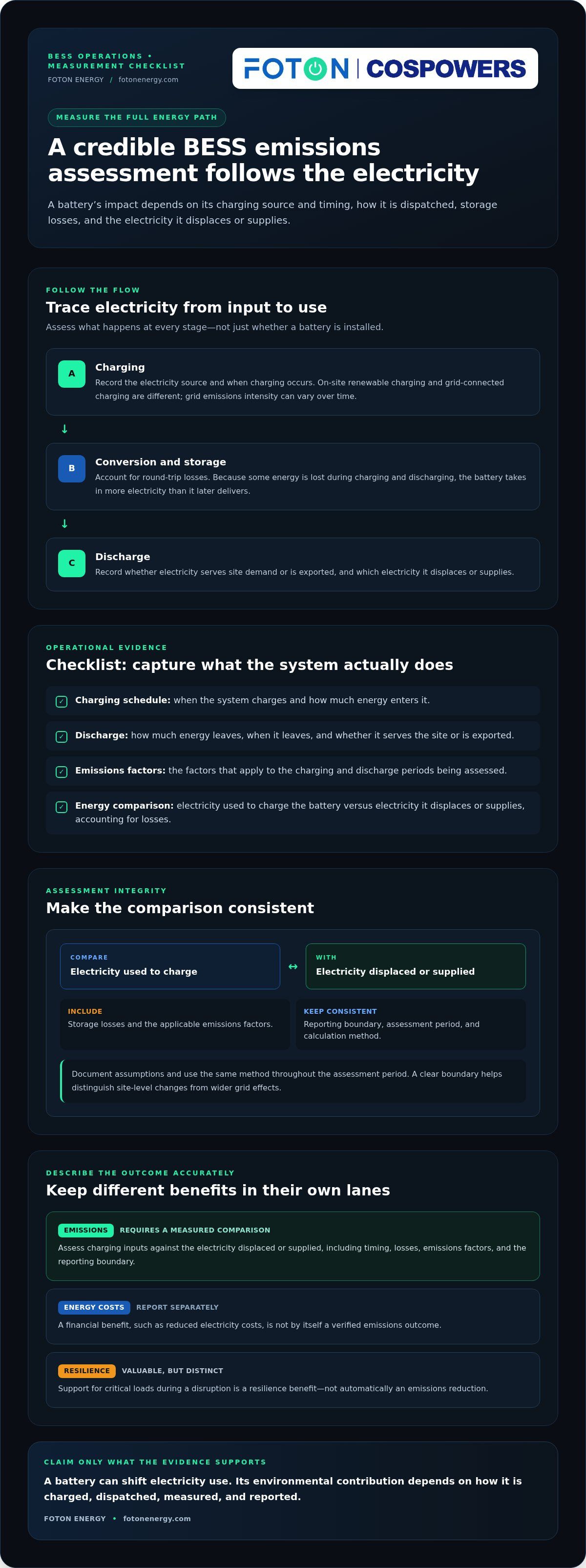
A battery changes when electricity is used, not where that electricity comes from. To assess its environmental contribution, track energy through each stage: charging, conversion and storage, then discharge to a site load or export to the grid. Both the charging source and timing matter, as do round-trip losses. Because some energy is lost during charging and discharging, the battery must take in more electricity than it later delivers.
A battery’s climate contribution depends on its operating pattern, energy inputs and the electricity system it interacts with. A financial benefit, such as reduced electricity costs, should therefore be reported separately from a verified emissions outcome. Resilience benefits, including support for critical loads during a disruption, are also valuable, but they are not automatically emissions reductions.
When can storage support renewable-energy integration?
If on-site renewable generation exceeds immediate demand, a battery may store some of that electricity for later use, helping match generation with a facility’s consumption. The result depends on system configuration and how the stored energy is used. Grid-connected charging is different: the battery may charge from the wider electricity supply, whose emissions intensity can vary over time. Describe charging as renewable only when the energy source and accounting support that claim.
Technology selection is separate from emissions accounting. When assessing storage chemistry, Foton’s guide to sodium-ion battery commercial availability can inform the discussion of technology options. Project objectives and site requirements should remain central to the decision.
Why does dispatch strategy matter to environmental claims?
Charging and discharge schedules determine which electricity flows the battery shifts. For a credible assessment, record when the system charges, how much energy enters and leaves, whether electricity serves site demand or is exported, and which emissions factors apply to those periods. A peak-shifting schedule may reduce costs, but it does not necessarily lower emissions: grid emissions intensity can differ between charging and discharge hours.
Compare the electricity used to charge the battery with the electricity it displaces or supplies, accounting for storage losses and the chosen reporting boundary. Keep the method consistent throughout the assessment period and document assumptions. This helps sustainability teams distinguish measured operational changes from modelled results or broader system effects.
For organisations assessing how operating strategy and site design work together, commercial and industrial energy storage planning can support evaluation of BESS against operational objectives.
How to Measure BESS Contributions Without Overclaiming
Credible measurement starts before the battery operates. Document a baseline for site energy use and relevant emissions, define which facilities and energy flows are included, set an assessment period, and choose a consistent calculation method. Record assumptions, including how electricity emissions factors are selected, and apply them consistently when comparing results. Check the current guidance for any reporting framework your organisation uses.
Public environmental claims should match the measured boundary and the evidence collected within it. Reduced electricity costs, for example, are a financial outcome, not proof of lower emissions. Reporting each result under the right category makes the battery’s contribution clearer and keeps claims within what the data can substantiate.
Which indicators help assess storage performance?
Use operational data to show how the system ran, then assess environmental indicators separately. Depending on the records available, useful measures may include energy charged and discharged, renewable electricity stored and later used, and energy lost during system operation. To assess emissions, document the calculation method and relevant electricity data for charging and discharge periods. Keep uptime, resilience and cost measures distinct from emissions results.
| Metric | Data source | Interpretation | Claim limitation |
|---|---|---|---|
| Energy charged and discharged | Battery or energy-management system records | Shows energy flows and operating patterns | Doesn’t establish emissions impact on its own |
| Renewable energy stored and used | Generation, battery and site energy records | Indicates whether storage shifted renewable supply to a later use | State the boundary and how renewable energy is attributed |
| Operational emissions estimate | Energy records, selected emissions factors and documented method | Estimates emissions associated with the assessed energy flows | Results depend on the factors, assumptions and period used |
| Cost, uptime or resilience | Billing and operational records | Shows financial or service performance | Don’t present these as emissions reductions |
How can companies keep green claims specific and credible?
Describe the asset, operating period, measurement boundary and calculation assumptions alongside any stated result. Avoid unqualified labels such as “carbon-neutral” or “emissions-free” unless the claim is fully substantiated within its stated scope. For improving corporate green credentials with energy storage, bring sustainability, finance, energy operations and communications teams into the review process. Each team can validate relevant data, confirm what the calculation shows and check that public wording does not go beyond the evidence.
A Practical Roadmap for Aligning Energy Storage with Sustainability Goals
A strong project begins with business priorities, not a battery specification. Align the proposed system with existing energy, climate and resilience objectives, then plan how its operation and outcomes will be assessed. This sequence helps teams make informed design decisions and build evidence collection into the project from the outset.
Use five stages to move from ambition to accountable operation:
- Define objectives. Specify what the project is intended to support, such as renewable-energy use, load flexibility, emissions goals or continuity for critical operations. Decide how each objective will be evaluated.
- Assess the site. Review energy demand patterns, existing generation, operational constraints, safety needs and relevant grid requirements. Establish a baseline and assign responsibility for collecting the necessary data.
- Model use cases. Compare potential operating strategies against site conditions and stated objectives. Consider how charging, dispatch and system losses may affect energy flows and emissions. Do not assume one strategy delivers every benefit.
- Measure performance. Capture operational data and assess environmental indicators using the documented baseline, boundaries and calculation method.
- Report findings. Communicate what was measured, over what period, and what the evidence does and does not demonstrate. Keep financial, resilience and environmental outcomes distinct.
What should companies establish before project design?
Bring energy operations, engineering, safety, sustainability, finance and communications teams into planning early. Together, they can document demand patterns, existing generation, site constraints and sustainability objectives before selecting system architecture. Define who owns data collection and how the baseline will be maintained. Engineering work can then assess project feasibility, system design and grid-code considerations against site requirements. This connects technical decisions with operational and reporting needs.
How should teams govern measurement and reporting?
Assign clear ownership for operational data, emissions calculations, internal review and external disclosures. Schedule regular checks against the baseline, and document changes to calculation methods, data sources or reporting boundaries. If a method changes, explain the change and account for it when comparing periods. Otherwise, apparent progress may reflect a different calculation rather than a real operational shift.
For monitoring and optimisation, an intelligent energy management system can help teams observe operating patterns and support evidence-led decisions. Foton Energy’s guide to AI-driven energy management systems provides more context on these capabilities. Improving corporate green credentials with energy storage depends on connecting operational visibility to defined objectives and transparent reporting.
Coordinating technical design, measurement and sustainability priorities calls for project planning. Plan a BESS project with Foton Energy through feasibility assessment, system design and engineering input aligned to site requirements.
How Foton Energy Supports BESS Projects That Advance Corporate Goals
Battery storage can be a valuable part of a corporate energy strategy, but it cannot guarantee sustainability outcomes on its own. Foton Energy is an energy-storage infrastructure and engineering partner, helping organisations evaluate how project design and operation can support site requirements and business objectives. For improving corporate green credentials with energy storage, the distinction matters: credible progress depends on measured performance, not equipment ownership.
Foton Energy draws upon extensive industry experience and partnerships with leading energy storage manufacturers with decades of manufacturing heritage. This capability supports project planning across advanced battery systems and the engineering expertise needed to assess their fit for a site.
What can an integrated BESS solution bring together?
A project can bring together several connected elements, each with a distinct role in deployment planning:
- Battery systems: Commercial and industrial BESS options include LFP and sodium-ion systems.
- Energy management: Intelligent, AI-driven energy management supports monitoring and grid optimisation, helping teams understand system operation.
- Safety and thermal management: Safety and thermal-management architecture are part of planning a system suited to project requirements.
- Engineering consulting: Feasibility assessment, system design and grid-code compliance connect technical decisions with site requirements.
These capabilities inform how a system is planned and managed. They do not, by themselves, establish an emissions reduction. That depends on operating strategy, energy inputs and the measurement method.
What are the next steps for a corporate BESS discussion?
Start with a clear picture of the site, its operating priorities and its sustainability objectives. Bring relevant energy-use information, site constraints and reporting needs into the discussion. These inputs help shape feasibility and engineering work, and clarify which use cases merit further assessment. Involving sustainability, operations and technical stakeholders early can also align project decisions with the evidence the organisation intends to collect.
Foton Energy brings energy storage infrastructure, intelligent energy management and engineering consulting together to support project evaluation and planning. Explore Foton Energy’s energy storage solutions to consider how a BESS project can align with operational and sustainability objectives.
Turn Energy Storage Plans into Measurable Progress
Energy storage can support corporate sustainability objectives, but its environmental value depends on how the system is charged, operated and assessed. Strong plans start with clear goals, a documented baseline and a consistent method for measuring energy flows and emissions. They also distinguish climate outcomes from financial savings and resilience benefits.
That discipline is central to improving corporate green credentials with energy storage. It connects project design to operational priorities, helps gather meaningful evidence and supports accurate communication of results.
Foton Energy brings energy infrastructure and engineering capabilities to this planning process, including AI-driven energy management and consulting for project feasibility and system design. Foton is the exclusive global strategic partner of Cospowers, a Tier-1 manufacturer with more than 30 years of manufacturing heritage. These capabilities can support project evaluation, while measured outcomes remain tied to the system’s actual operation.
Ready to align a storage project with your site requirements and sustainability objectives? Explore Foton Energy’s energy storage solutions and take the next step toward a well-grounded project plan. Clear goals and credible evidence can turn ambition into practical progress.
Frequently Asked Questions
Can battery energy storage improve a company’s green credentials?
Yes. Battery energy storage can support a company’s sustainability strategy when its operation produces measurable outcomes tied to stated goals. For improving corporate green credentials with energy storage, define a baseline and reporting boundary, then track charging sources, energy flows and system losses over a set period. A battery may improve energy flexibility or help use renewable generation, but installation alone is not evidence of environmental improvement. Communicate only what the data supports.
Does installing a BESS automatically reduce corporate emissions?
No. A BESS is an asset, not an automatic emissions-reduction measure. Its contribution depends on when and how it charges and discharges, the electricity sources involved, system losses and the emissions calculation method. Compare measured operation with a documented baseline before making claims. Battery capacity, resilience benefits and cost management may be valuable project outcomes, but they do not, by themselves, demonstrate lower emissions.
How can a company measure the sustainability impact of energy storage?
Establish a baseline and reporting boundary, then collect consistent operational and energy-flow data over a defined period. Depending on available records, indicators can include energy charged and discharged, system losses and renewable-energy utilisation. Apply a stated emissions methodology, record assumptions and use relevant electricity data. Keep environmental indicators separate from financial savings and resilience measures, and verify current reporting-framework guidance before using it in disclosures.
Can energy storage help a company use more renewable electricity?
It may help match renewable generation with demand by storing available energy for later use. For example, a site could store some surplus on-site generation rather than use it immediately. The outcome depends on system configuration, charging source, operating schedule and storage losses. Assess actual energy flows instead of assuming a battery always increases renewable use or reduces emissions, and explain the boundaries and limitations of the calculation.
What should a company measure before deploying a BESS?
Document the site’s energy demand patterns, existing generation, operating constraints and the sustainability objectives the project is intended to support. Establish a baseline before deployment, then assign responsibility for collecting operational data, calculating emissions and preparing reports. This preparation helps teams assess project feasibility, select meaningful indicators and compare results consistently over time. It also clarifies what evidence is needed to evaluate performance against the original objectives.
How can companies avoid greenwashing when discussing battery storage?
Make each claim specific: describe the system, assessment period, reporting boundary and calculation method. Distinguish verified results from project intentions, and report resilience or cost-management benefits separately from environmental outcomes. Avoid broad claims that suggest a battery is inherently clean or guarantees emissions reductions. Before publication, have sustainability, technical and communications teams review the wording against available operational data and documented assumptions.
What role does an energy management system play in BESS sustainability reporting?
An energy management system can support monitoring and optimisation by organising information about battery behaviour and energy flows. That data can help teams understand charging and dispatch patterns, but the system’s outputs are not independent proof of emissions reductions. Reporting still relies on data quality, a defined boundary, a consistent calculation method and appropriate review. Use operational records as inputs to a documented assessment, and state important assumptions clearly.


