

Scope every interface before it becomes a site issue. An EPC checklist for utility-scale BESS projects should assess engineering, performance requirements, system design, construction planning, interconnection, and site conditions as one coordinated scope. It should also clarify how equipment, controls, safety systems, and project acceptance fit together.
Planning a utility-scale BESS project means aligning technical requirements with site conditions and grid connection needs. A clear EPC checklist helps teams identify gaps early and define what the system must deliver, how it will be built, and what evidence will show it is ready to operate.
This guide covers practical checks for electrical, civil, and structural engineering; usable energy, power, efficiency, and operating limits; design integration and safety; construction logistics and scheduling; interconnection requirements; and site constraints. Use it to organize early decisions and give stakeholders a consistent basis for EPC planning.
Key Takeaways
- Map electrical, civil, structural, and site conditions together so the design reflects real project constraints.
- Define usable energy, rated power, efficiency boundaries, auxiliary consumption, and operating limits before selecting system components.
- Coordinate safety systems, controls, equipment interfaces, and acceptance records as parts of one integrated design.
- Build construction sequencing around permitting, interconnection requirements, site logistics, and supply-chain dependencies.
- Align the project’s technical requirements with its grid connection and intended operating role from the earliest planning stages.
Electrical, civil, structural, and site engineering
Use the checklist to coordinate the site layout, electrical interfaces, foundations, and installation sequence. Each decision affects equipment access, safe operation, and the connection between the energy storage system and the project’s grid interface.
- Confirm electrical boundaries and interfaces. Document where the battery, power conversion equipment, transformers, protection systems, and control connections meet. This gives engineering teams a shared basis for reviewing cable routes, equipment clearances, grounding, and the planned discharge path.
- Match foundations to verified ground conditions. Sandy gravel and gravel soils have a moderate bearing capacity of around 3,000 pounds per square foot, according to the reported site-engineering data. Use geotechnical findings to inform foundation design, grading, drainage, and equipment support.
- Coordinate structural design with equipment loads. Map container and electrical equipment positions against foundation plans, lifting access, and installation clearances. This helps the civil and structural packages accommodate the selected equipment without obstructing cable entry, inspection, or replacement activities.
- Set site boundaries, setbacks, and buffers in the layout. Show battery areas, nearby structures, access roads, drainage paths, and emergency access on one coordinated site plan. Clear spatial relationships help the project team assess operations, safety, construction movement, and future maintenance access.
- Screen site selection for natural hazards. Identify exposure to flooding, wildfire, high winds, unstable ground, and other relevant local hazards during early site engineering. Use those findings to shape grading, drainage, equipment placement, protective design, and construction planning.
- Assess safety as an integrated installation. Include protection systems, fire systems, site spacing, and emergency procedures in the assessment, rather than relying on a component list alone. This connects equipment choices with the site’s actual layout and response arrangements.
- Plan site preparation before equipment delivery. Sequence clearing, grading, drainage, foundations, access roads, cable routes, and laydown areas against the installation plan. This helps prevent equipment arriving before the site can support safe unloading and placement.
- Define Canadian field support and local O&M interfaces. Record who coordinates site access, installation support, operating handover, maintenance, and escalation with local teams. For a Canadian project, clear responsibilities help connect delivery activities with ongoing operation and maintenance.
- Map applicable regulation to the project location. According to the Washington State Legislature, Chapter 19.285 RCW is the Energy Independence Act. Record relevant jurisdictional requirements in the project’s design basis so the engineering team can distinguish Washington-specific considerations from other site conditions.
Round-trip efficiency and operating limitations
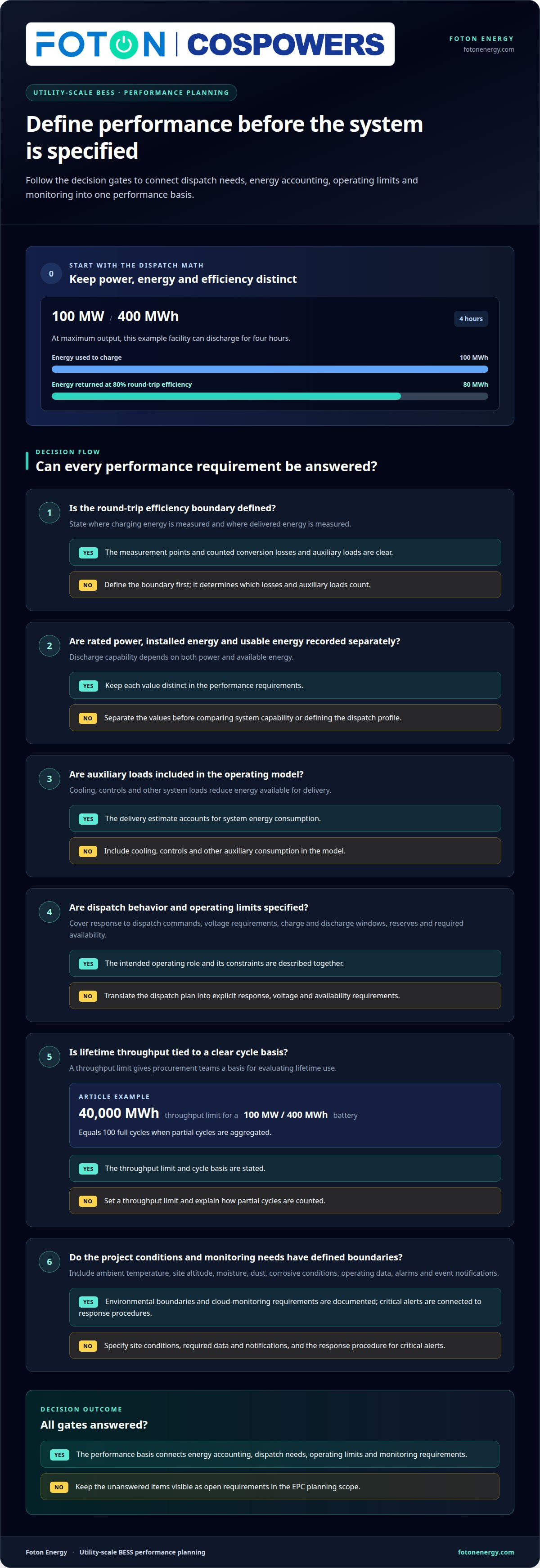
Set performance requirements around the intended dispatch profile, not a single efficiency figure. For example, a 100 MW/400 MWh facility can discharge maximum output for four hours, while an 80% round-trip efficiency means 80 MWh returned for every 100 MWh used to charge it.
- Define the efficiency boundary. State where charging energy is measured and where delivered energy is measured, because the boundary determines which conversion losses and auxiliary loads count.
- Separate rated power from installed and usable energy. Record each value independently, since the system’s discharge capability depends on both power and available energy.
- Include auxiliary consumption in the operating model. Account for energy used by cooling, controls, and other system loads, because it reduces energy available for delivery.
- Specify response behavior and voltage requirements. Describe how the system is expected to respond to dispatch commands and operate across its required voltage range, because controls and grid interfaces depend on those conditions.
- Set a throughput limit and cycle basis. A 40,000 MWh throughput limit for a 100 MW/400 MWh battery equals 100 full cycles when partial cycles are aggregated, giving procurement teams a clear basis for evaluating lifetime use.
- Translate the dispatch plan into operating limits. Identify expected charge and discharge windows, reserve requirements, and periods when the battery must remain available, because competing duties can constrain energy delivery.
- Specify temperature and altitude conditions. Define the project’s expected ambient temperature range and site altitude in procurement documents, because both can affect equipment operating limits and performance assumptions.
- Record environmental operating boundaries. Document exposure to moisture, dust, corrosive conditions, and other relevant site factors, then align equipment enclosures and maintenance plans with those conditions.
- Define cloud monitoring and notification requirements. List the operating data, alarms, and event notifications that need to reach control-room personnel, because timely visibility supports informed operating decisions.
- Connect alerts to response procedures. Assign each critical notification to an operational action, such as reviewing an abnormal temperature or voltage reading, so alerts support clear decisions rather than creating noise.
- Model performance across the intended duty cycle. Compare expected dispatch with efficiency, usable energy, throughput, temperature limits, and auxiliary demand, because a design that meets one operating point may not meet every project requirement.
Bring these criteria together in the performance specification and acceptance tests. A precise basis helps the EPC team assess integration, demonstrate operating capability, and distinguish guaranteed system boundaries from the project’s dispatch assumptions.
Utility-scale BESS design and turnkey EPC services
Standalone BESS projects connect storage directly to the grid. Solar-plus-storage projects must also coordinate battery operation with solar generation and its electrical interfaces. This additional integration affects design responsibilities, control strategies, and commissioning plans, since the battery and solar plant need to operate as a coordinated system.
There is no single EPC cost per kWh or per MW for United States projects. Pricing depends on the project and is provided after a quote request. Key cost factors include storage duration, equipment and construction scope, interconnection work, site conditions, and long-term service terms.
Use these checks to define the EPC scope:
- Set the turnkey boundary. List which design, procurement, construction, integration, testing, and handover activities fall within the EPC scope. A written boundary helps owners distinguish included work from owner-retained responsibilities and identify interfaces early.
- Translate the operating purpose into a design basis. State whether the battery is intended to provide energy shifting, capacity, ancillary services, or a combination where applicable. The duty profile informs system architecture, control requirements, and project acceptance criteria.
- Map each grid-service capability to a system function. Utility-scale storage can support grid frequency, voltage, and overall system reliability. Connect each required capability to the relevant controls, electrical interfaces, and operating procedures so the design supports the project’s intended role.
- Coordinate energy, capacity, and ancillary-service participation. Storage may enable participation in these markets where applicable. Align the dispatch strategy and operating responsibilities with the project’s market role, since one battery can be assigned multiple services.
- Define the long-term service agreement interface. Record which party handles monitoring, maintenance coordination, issue escalation, and operating support over the service term. Owners need clear responsibilities so operational tasks remain aligned with EPC handover documents.
- Make acceptance deliverables part of the contract scope. Include approved drawings, test records, certificates, alarm and point lists, operating and maintenance manuals, warranty terms, and training records. These records give the operating team a documented basis for handover.
- Plan commissioning around the complete infrastructure. Coordinate battery controls, power conversion equipment, protection systems, and grid interfaces in the test sequence. Integrated testing can demonstrate how the assembled system responds to operating commands and project requirements.
For owners, a well-defined turnkey scope connects design intent to delivery, commissioning, and ongoing service. Use the EPC checklist to make interfaces, capabilities, and handover records traceable throughout the project.
Construction logistics, scheduling, and supply-chain constraints
Key risks include site conditions, interconnection requirements, equipment selection, permitting, supply-chain constraints, construction logistics, scheduling, and changing project requirements. Safety, commissioning, and operational risks can also arise when equipment interfaces, responsibilities, or handover activities are not coordinated.
Use these checks to connect procurement, construction, and commissioning:
- Link the schedule to project dependencies. Sequence design approvals, permitting, site readiness, equipment delivery, installation, testing, and commissioning so a delay in one workstream is visible against dependent activities.
- Confirm delivery routes and site handling plans. Coordinate transport access, unloading areas, lifting arrangements, and temporary storage with the site layout, because equipment movement can affect installation sequencing and site safety.
- Track long-lead equipment against required dates. Connect supplier production and delivery milestones to construction needs, so developers can identify schedule exposure before equipment becomes critical to site progress.
- Set a documented EPC scope boundary. Identify which party owns design, procurement, construction, integration, testing, commissioning, and handover tasks, because unclear interfaces can leave essential work without an accountable owner.
- Assign supplier accountability in contract documents. Define deliverables, review periods, quality records, corrective-action processes, and escalation routes for each supplier, giving the EPC team a consistent way to manage performance.
- Coordinate subcontractor work packages. Align civil, electrical, equipment installation, controls, and commissioning activities through an interface schedule, because work in one area may depend on completion or access in another.
- Make schedule changes traceable. Record the cause, affected activities, responsible party, and revised dependencies for each approved change, so project teams can distinguish scope changes from execution delays.
- Review applicable law and tariff exposure. Identify the jurisdictions and import pathways relevant to the project, then assess how changes could affect procurement documents, delivery assumptions, and supplier responsibilities.
- Include supply-chain diligence in procurement. The Uyghur Forced Labor Prevention Act introduced additional diligence requirements for companies importing products that may involve supply chains connected to regions associated with forced labor concerns. Include relevant diligence responsibilities in supplier documentation.
- Qualify suppliers for Canadian project needs. Review technical fit, manufacturing and delivery plans, documentation, communication arrangements, and capacity to support the project location. These criteria help developers assess supplier readiness without assuming one qualification process fits every project.
- Coordinate safety responsibilities across work packages. Assign responsibility for site procedures, equipment interfaces, construction activities, and commissioning controls, so teams understand how their work connects to the project safety plan.
- Plan commissioning inputs before construction ends. Schedule access to equipment, test documentation, controls support, and responsible personnel, because commissioning depends on coordinated technical and site readiness.
- Connect handover records to operating needs. Identify the documents, system information, and open-item tracking required for transition, so construction closeout supports a clear operational start.
These checks make supply-chain and execution dependencies accountable work items. They also help owners and developers maintain continuity from equipment procurement through construction, commissioning, and operational handover.
Interconnection requirements and site conditions
For a United States project, coordinate local requirements with the state, county, fire marshal, and serving utility. Review the permitting, environmental review, fire and emergency planning, site layout, interconnection studies, protection, metering, controls, and commissioning criteria that apply to the specific location.
Interconnection is a technical design interface, not just a point on a site plan. Define the battery energy storage system’s connection point, expected operating modes, control signals, protection interfaces, and information exchanged with the utility. These requirements inform equipment selection and commissioning tests.
- Map the utility interface. Identify the point of connection, metering boundary, protection equipment, communications path, and responsible party for each interface. Keep the project one-line diagram consistent with the interconnection scope.
- Track applicable grid rules. FERC Orders 841 and 2222 are among evolving rules relevant to energy storage, qualifying facilities, and inverter-based resources. Identify which requirements apply to the project’s participation model and grid connection.
- Coordinate controls and operating signals. Document how dispatch instructions, active and reactive power requests, alarms, and status information move between the battery controls, plant controller, and utility interface. Test these exchanges during commissioning.
- Specify remote monitoring needs. Define which operating values, alarms, and event records must be available remotely, who receives them, and how they support operating decisions. Keep the data list aligned with control-room responsibilities.
- Review site and grid constraints together. Compare the proposed equipment arrangement with cable routes, access, drainage, and utility connection requirements. A site change can affect electrical routing, protection design, and construction sequencing.
- Address Canadian grid interfaces by jurisdiction. Identify the applicable provincial or territorial connection process, utility technical requirements, metering arrangements, and operating communications. Align the design documents and commissioning plan with the project’s local grid interface.
- Set a communications basis. Specify protocol, signal ownership, time synchronization, and event records for connected control systems. NIST identifies IEEE 1588 precision timing as important for real-time control in the smart grid.
- Connect renewable generation requirements. For a solar-plus-storage site, map how renewable output, battery charging, discharge, and export limits interact at the connection point. This clarifies how the combined plant will follow grid instructions.
Use an interface register to track each technical requirement, its design owner, evidence, and test stage. For project planning that connects storage design with grid requirements, discuss utility-scale storage planning.
Foton Energy (Foton Pty Ltd): C&I BESS
Foton Energy (Foton Pty Ltd) offers utility-scale storage for project teams turning EPC requirements into storage-system decisions. It is a natural next step once performance needs, site constraints, grid interfaces, and delivery scope are defined and the team is ready to discuss system fit.
Bring the project’s intended operating role, interconnection requirements, and key design assumptions to the discussion. This helps shape the storage solution around the infrastructure it must connect to and the outcomes it is intended to support.
For commercial and industrial projects, Foton Energy also offers C&I BESS. Contact Foton Energy (Foton Pty Ltd) to discuss your project requirements.
Move from planning to a defined project scope
Use an EPC checklist for utility-scale BESS projects to establish a shared basis for decisions, responsibilities, and project priorities. A clear scope helps align technical, commercial, and operational stakeholders before detailed execution planning begins.
Foton Energy (Foton Pty Ltd) offers utility-scale storage, C&I BESS, and residential storage systems for grid-scale, commercial, and residential applications. Discuss your project’s intended role and requirements with Foton Energy to identify a suitable storage solution.
Bring your project objectives and current planning assumptions into the conversation. Contact Foton Energy (Foton Pty Ltd) to discuss your storage project and its next planning steps. A well-aligned scope gives your team a stronger foundation for moving forward with clarity and purpose.
Frequently Asked Questions
What should an EPC checklist cover for a utility-scale BESS project?
An EPC checklist for utility-scale BESS projects should connect the design basis to procurement, construction, grid connection, and operational handover. Include an interface register that identifies each work package, its accountable party, required inputs, and completion evidence. For example, link a control-system deliverable to its integration test and acceptance record. This makes gaps between contracts and technical work visible before they affect execution.
What are the key design and engineering requirements for utility-scale battery energy storage systems?
Key requirements include a coordinated design basis, defined equipment interfaces, control architecture, protection approach, and operating objectives. Engineering should also address how the battery system interacts with the plant controller and grid connection. For example, trace a dispatch command from its origin through the controls to the equipment response, then specify how the test team will record the result. This connects design intent with observable project performance.
What US codes and standards apply to BESS EPC projects, including NFPA 855, UL 9540, and IEEE standards?
Applicable codes and standards depend on the project’s jurisdiction, design, equipment, and approval pathway. Treat NFPA 855, UL 9540, and relevant IEEE standards as items for a project-specific applicability review, not as a universal checklist that applies identically everywhere. Record the edition or requirement used, its project scope, the responsible design discipline, and the evidence needed for review. This creates a traceable basis for design and approvals.
What permitting, environmental, fire-safety, and zoning approvals are required for utility-scale BESS in the United States?
Required approvals depend on the project location and site characteristics. Build an approvals register that identifies the responsible state, county, local planning authority, fire marshal, and environmental review process. Link each approval to its submission materials, review status, conditions, and responsible lead. For example, track land-use review separately from fire-safety planning so site-layout changes can be assessed against both approval workstreams.
What interconnection studies, grid-code requirements, and utility approvals must a BESS EPC contractor complete?
Plan interconnection work around the serving utility’s process and the project’s connection agreement. Track required studies, technical submissions, utility comments, design revisions, and approval milestones in one register. Link each study result to its design consequence, such as a change to protection settings or operating controls. The EPC scope should also identify who prepares each submission and coordinates responses, keeping utility decisions connected to the construction schedule.
How should EPC contracts allocate performance guarantees, availability, degradation, liquidated damages, and warranties?
Contracts should define each performance measure, its measurement boundary, test conditions, exclusions, reporting method, and remedy. Separate equipment warranties from system-level commitments, and state how degradation is assessed over the agreed operating profile. For example, define how test results are handled when auxiliary consumption affects measured output. Align liquidated damages with clearly stated milestones and failure conditions so responsibility and remedy follow the contract, not assumptions.
What site preparation, civil works, drainage, access, and geotechnical checks belong on a BESS EPC checklist?
Record survey information, ground investigation findings, grading assumptions, drainage design, foundation interfaces, and construction access in coordinated documents. Use the geotechnical review to guide how the design addresses soil variability, groundwater, slope, and settlement. For example, confirm whether equipment routes and work areas remain usable under expected site conditions. Keep civil drawings aligned with equipment dimensions and installation sequencing so site preparation supports delivery, placement, cable routing, and future maintenance access.
What commissioning, acceptance testing, and performance tests are required before commercial operation?
Set commissioning and acceptance tests against the contract’s stated functions and operating requirements. Define test prerequisites, responsible parties, pass criteria, data records, and a process for resolving failed or incomplete tests. Test the system in stages, from equipment checks through controls integration and operational demonstrations. For example, record command inputs, system responses, alarms, and unresolved issues in a controlled test record before making the agreed handover decision.


