

Technical due diligence for BESS projects is most useful before financing, an asset transaction, or a major project change, when technical risks can still affect the decision. It tests whether the intended use, system design, battery technology and financial model align, and whether project plans address construction, commissioning and operation. The scope matters: a narrow equipment review can miss risks created by contracts, grid integration or operating strategy.
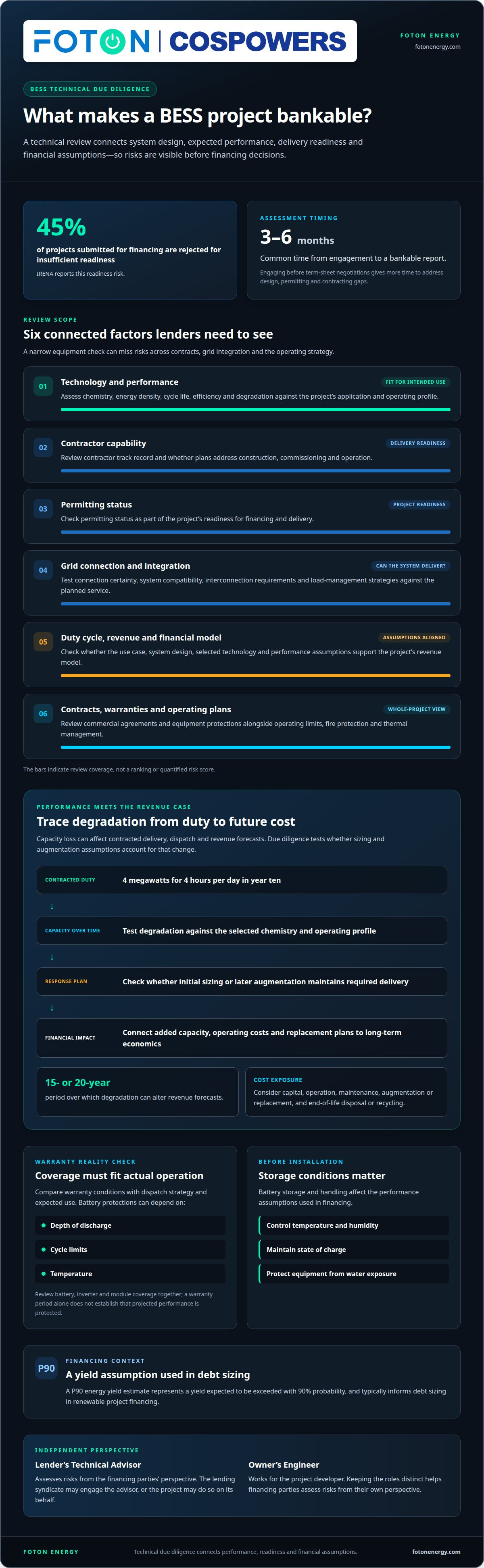
Lenders and investors need a clear view of technology risk, contractor capability, permitting status, and grid connection. Technical due diligence for BESS projects brings these factors together, helping reveal where performance assumptions or project plans need closer attention before financial close.
If you’re weighing a BESS investment, arranging finance, or preparing an asset for sale, this article explains when an independent assessment adds value and what it examines. You’ll learn how degradation can affect long-term revenue, how warranties and certification evidence shape performance risk, and why fire safety and thermal management belong in the review. The aim is a complete picture of project readiness, grounded in how the system is expected to operate.
Key Takeaways
- Commission an independent assessment before financing, an asset transaction, or a major project change, while design and contracting decisions can still be addressed.
- Assess degradation against the project’s duty cycle and revenue model; battery performance assumptions shape long-term capacity and bankability.
- Lenders look beyond equipment selection to technology risk, contractor capability, permitting, grid connection, and readiness for construction and operation.
- Review warranty conditions alongside certifications and operating limits to understand how real-world use affects long-term performance protections.
- Include fire protection, thermal management, grid integration, commercial agreements, and operating plans in a project-wide technical review.
Why is battery degradation a bankability issue?
Battery degradation reduces available energy over time, which can affect whether a BESS meets its contracted duty. In the United States, capital costs depend on system design and site requirements. Operating, replacement, and augmentation costs depend on efficiency, maintenance, use, and performance over the project life.
Chemistry and technology performance
Chemistry and technology performance determine how a battery’s operating characteristics affect capacity loss and efficiency over time. For investors, assessing energy density, cycle life, efficiency, and degradation rates helps establish whether the selected technology suits its intended application.
For example, a system contracted to provide four megawatts for four hours per day in year ten may need additional capacity installed upfront to account for degradation. The assessment should connect that obligation to the chosen chemistry and operating profile, rather than treating battery specifications as separate from project revenue.
Battery storage and handling also affect the performance assumptions used in financing. During storage, temperature and humidity control, a maintained state of charge, and protection from water exposure help preserve equipment before installation.
Warranty terms and protections
A warranty review examines the conditions under which protections for batteries, inverters, and supplied modules apply. A warranty’s value depends on its terms, the equipment it covers, and whether actual operation stays within the stated limits.
Battery protections can depend on depth of discharge, cycle limits, and temperature. The review compares these conditions with the project’s dispatch strategy and expected use. It also considers inverter coverage and module supply terms alongside the battery warranty, making gaps between equipment protections easier to identify.
A warranty period alone does not show that projected performance is protected. The assessment interprets coverage alongside degradation assumptions, operating limits, and the equipment included in the agreement.
Degradation and augmentation planning
Degradation and augmentation planning estimates how capacity loss may affect future delivery, then evaluates how the project will maintain its required performance. This matters because battery degradation can alter revenue forecasts across a 15- or 20-year period.
Technical due diligence connects projected capacity decline with contracted output, dispatch patterns, and financial modelling. If the system must retain a particular delivery capability in year ten, the analysis tests whether its initial sizing accounts for expected degradation or later augmentation.
Augmentation adds capacity to address declining capability, but it also affects project costs and operating plans. The review considers the timing and assumptions behind the added capacity, then assesses their effect on the project’s long-term economics.
Operating and replacement cost exposure
Cost exposure includes the capital needed to build a system, the costs of operating it, and later replacement or augmentation. For US projects, the assessment relates these categories to system configuration, site requirements, efficiency, maintenance, and the operating profile.
Operating costs interact with degradation: less usable energy can affect dispatch and revenue, while augmentation or replacement requires additional capital. Evaluations should therefore test total cost of ownership against the financial model, warranty terms, and end-of-life disposal or recycling strategy.
A useful review makes assumptions visible instead of treating future costs as a single allowance. It links expected maintenance, battery performance, and replacement planning to the operating case used for revenue forecasts.
Independent technical assessment for project financing
An independent engineering assessment helps investors understand whether a BESS project is technically ready for financing. It tests the project’s design, delivery plans, and performance assumptions against the asset’s intended use.
Before financial close, a Lender’s Technical Advisor assesses technology risk, contractor track record, permitting status, and grid connection certainty. The lending syndicate may engage the advisor, or the project may do so on its behalf. This role differs from an Owner’s Engineer, who works for the project developer. Keeping the roles distinct helps financing parties assess risks from their own perspective.
Grid requirements affect whether a project can deliver its planned service and revenue. An assessment examines system compatibility, interconnection requirements, and load-management strategies. It also evaluates whether the BESS use case matches the design, selected technology, and financial model. A P90 energy yield estimate represents a yield expected to be exceeded with 90% probability, and typically informs debt sizing in renewable project financing.
Timing matters. BESS technical due diligence commonly takes three to six months from engagement to a bankable report. Developers are advised to engage technical advisors before term-sheet negotiations, allowing design, permitting, and contracting gaps to be addressed earlier. IRENA reports that 45% of projects submitted for financing are rejected for insufficient readiness, underscoring the value of resolving project gaps before lenders assess the submission.
Australian support programmes provide useful context, but they do not replace commercial technical due diligence. Capacity Investment Scheme Tender 6 sought 2.4 GWh of dispatchable capacity and specified a minimum two-hour duration. It targets distribution-connected projects of up to 5 MW, with flexibility for larger projects, and is intended to finance up to sixteen hybrid solar, battery, and retrofit projects reaching construction in 2027.
Independent evaluations also support asset transactions. A buyer can use technical due diligence to assess design, implementation, operation, risks, and optimisation potential; a seller can use it to make project condition more transparent. For renewable asset acquisitions, an O&M contract expiring within 12 months of closing without agreed renewal terms is a technical red flag. After financial close, a technical advisor may monitor construction, certify drawdown, and review operational performance. Where project design and financing assumptions need to align, a focused engineering assessment for utility-scale storage can help clarify the technical basis.
Certifications, warranties, and long-term performance
Certification evidence and warranty agreements help show how a BESS is qualified and protected. Their value depends on their scope, operating conditions, and covered equipment.
Operational limits and warranty protections
Operational limits are the conditions a battery must meet for its warranty protections to apply. Reviewing them matters because dispatch plans and actual operating records determine whether coverage remains relevant.
Battery protections can depend on depth of discharge, cycle limits, and temperature. An independent review compares these conditions with the project’s dispatch strategy, operating procedures, and performance assumptions. If daily operation exceeds an agreement’s limits, practical protection may differ from what the project expects.
Reviewers map warranty terms across battery modules, inverters, and other covered equipment. They examine the performance covered, exclusions, claims process, and remedies stated in each agreement. This can reveal mismatches, such as module coverage that does not align with the operating assumptions for the complete system.
Certification reviews answer a related but distinct question: whether the technology has appropriate certifications and is proven for its intended use. The assessment compares the evidence with the equipment and configuration being financed. A document covering one component does not establish that every part of the project design has been assessed.
This distinction supports financing evaluations. Investors can see which documents apply to the battery, which apply to other equipment, and how warranty conditions shape operational flexibility. The review clarifies the relationship between qualification evidence and contractual protection.
Thermography and end-of-warranty inspections
Thermography uses temperature patterns to identify areas that warrant closer inspection. Near warranty expiry, it can contribute to an evidence-based assessment of battery storage condition and support maintenance or claims decisions.
An end-of-warranty inspection brings equipment condition, operating records, and agreement terms into one review. The technical assessment compares observed performance with the project’s operating history and identifies issues that may need further investigation before coverage ends.
Thermal images are most useful when interpreted alongside equipment records and inspection findings. A temperature difference is an observation, not a complete diagnosis. The review relates it to operating conditions and the equipment concerned, helping distinguish a pattern that needs investigation from one explained by normal operation.
Technical due diligence can also help when a warranty is expiring or damage has occurred. In these cases, the review clarifies the condition evidence, relevant agreement provisions, and remaining performance risks. This gives owners and financing parties a stronger basis for planning continued operation, repair, or a warranty claim.
For each certification and warranty, the assessment records the equipment and operating conditions covered. This focused comparison helps investors understand how evidence, agreements, and long-term operating plans fit together.
Fire safety and AS/NZS 5139 compliance
Engineers assess BESS site suitability by reviewing ground conditions, drainage, flood and fire exposure, and connection requirements. They relate these findings to the system layout, site access, and safety design before evaluating project risks.
Thermal management and fire protection
Thermal management controls battery operating conditions, while fire protection addresses hazards if a battery event occurs. Reviewing both matters because energy storage systems need coordinated prevention, detection, and response design.
For lithium-ion battery energy storage, technical due diligence examines how the design addresses thermal runaway risk. Engineers review thermal management solutions, fire protection, and suppression systems as parts of the wider system design. They also assess whether the proposed measures align with applicable local and national standards.
These evaluations connect equipment choices with the site plan. For example, engineers consider how battery enclosure placement and separation affect the protection strategy. Installation monitoring also checks AS/NZS 5139 safety and separation requirements, so design intent can be compared with installation conditions.
Site conditions and hazard assessment
Site and hazard assessment considers whether physical conditions can support safe installation and operation. Ground stability, water exposure, and nearby hazards can all affect layout, access, and protection planning.
Engineers review geotechnical information alongside drainage and potential flood exposure. They consider how these conditions relate to equipment foundations, access routes, and the proposed location of battery enclosures. Fire-risk evaluation considers the site layout and how protection measures relate to surrounding areas.
Grid connection and load-management requirements also shape system design. A site review considers whether the proposed layout and interconnection approach work together, rather than assessing the battery location in isolation.
Supplier health and safety records are another part of project risk evaluation. Supplier due diligence can examine health and safety performance, management systems, manufacturing quality control, and the supplier team’s technical competency. These factors help investors understand how safety and quality processes support equipment delivery.
Engineers also consider whether supplier capabilities and manufacturing processes align with project equipment requirements. Battery-cell sourcing and production quality control, for example, inform the assessment of supply-chain reliability. The review can cover a complete energy storage system or individual components, including cells and control systems.
For developers, findings should connect site hazards, equipment design, and installation monitoring. A flood concern, for instance, should be considered alongside protection from water exposure and enclosure placement. A fire-risk finding should prompt a review of thermal management, suppression design, separation, and applicable standards.
This integrated approach gives financing parties a clearer account of how hazards are identified and addressed. It also shows whether the renewable energy project’s safety design, supplier processes, and grid connection assumptions support the proposed installation.
BESS technical due diligence scope
A useful review connects the project’s intended use with its design, agreements, delivery plans, and operating model. Its scope should reflect how each element affects the others.
Technical documents and data review
Document review brings project records together to test technical assumptions and identify gaps. A battery specification alone cannot establish whether the complete project suits its intended use.
The assessment examines planned use cases and revenue streams, equipment selections, system design, and commercial agreements. It also reviews construction, commissioning, and operating plans. Technical drawings and equipment schedules can be considered alongside the financial model, allowing design assumptions and projected performance to be assessed together.
Project records should show how chosen equipment supports the intended service and how commercial agreements account for that service. Reviewers also assess whether the technology is commercially viable, has been deployed successfully, holds appropriate certifications, and is proven for its intended use case. Depending on the review, supplier due diligence can cover a complete system or components such as cells and control systems.
Construction and commissioning evaluation
Construction and commissioning evaluation examines whether delivery plans can implement the proposed design and demonstrate system readiness. Gaps between design intent and installation can affect project performance.
The assessment considers construction plans, commissioning arrangements, and the technical responsibilities assigned to contractors. It checks how project milestones relate to equipment delivery, system integration, and planned operation. For example, commissioning activities should demonstrate that the installed configuration matches the design and selected use case.
Environmental and permitting considerations form part of project readiness, alongside grid connection requirements. Reviewers consider whether interconnection and load-management strategies fit the system design. After financial close, a technical advisor may monitor construction and certify drawdown, linking delivery progress with financing requirements.
Operational, cybersecurity, and vendor risks
Operational, cybersecurity, and vendor reviews consider whether operating arrangements and supplier capabilities support the asset’s intended performance. They matter because system design, commercial terms, and ongoing operations are interdependent.
Reviewers evaluate operating plans against planned use cases and revenue streams, including whether maintenance strategies support the intended system operation. A cybersecurity assessment should consider how control systems are governed, how responsibilities are assigned, and whether vendor access arrangements are addressed in project documentation.
Supplier evaluations can examine supply-chain reliability, battery-cell sourcing, manufacturing quality control, health and safety records, management systems, customer references, installations, and team competency. The assessment can then recommend whether a supplier suits the asset under consideration. For a multi-site portfolio, the scope should also consider whether maintenance and technical approaches remain consistent across locations.
Because these elements interact, a narrow equipment-only review can miss project-level risks. Engage Foton Energy for an engineering assessment to evaluate how design, delivery, and operational assumptions fit together.
Foton Energy (Foton Pty Ltd): C&I BESS
Foton Energy (Foton Pty Ltd) offers C&I BESS for commercial and industrial energy storage. If your assessment has clarified the project’s intended use, operating requirements, and technical priorities, this offering can be a practical next step.
For larger-scale deployments, Utility-Scale Storage may also suit the application. The right system category depends on the project’s use case and design requirements, not on a single performance assumption. A clear technical scope helps connect those requirements with the storage solution under consideration.
To discuss your project’s energy storage requirements, contact Foton Energy (Foton Pty Ltd).
Turn technical findings into your next decision
Use the assessment as a decision framework, not simply a record of observations. Turn findings into clear priorities: which design choices are ready to advance, which assumptions need more evidence, and which risks should shape the project’s next stage. This gives investors and project teams a practical basis for aligning technical decisions with investment objectives.
Technical due diligence for BESS projects can also inform the storage solution that best fits a defined application. Foton Energy (Foton Pty Ltd) offers C&I BESS, Residential Storage Systems, and Utility-Scale Storage. Consider these offerings in light of your project’s intended use and technical requirements.
Bring your project requirements and assessment priorities into the next conversation, and build a clear path forward. Contact Foton Energy (Foton Pty Ltd) to discuss your energy storage plans.
Frequently Asked Questions
When is a Technical Due Diligence (TDD) useful?
A TDD is useful when a technical assessment can inform an investment, financing, or project decision. A buyer, for example, can use it to understand an operating asset’s condition before acquisition, while a developer can identify design gaps before committing to construction. It can also support decisions about repowering, equipment changes, or an asset whose performance has departed from its original assumptions.
Can a TDD be customised?
Yes. The scope can be tailored to the project’s stage, transaction, technology, and intended use. A development-stage review may focus on design maturity, grid connection, and delivery plans, while an operating-asset assessment may examine performance records, maintenance, and equipment condition. For a portfolio, the work can compare site-specific risks using consistent evaluation criteria across the assets.
What is the difference between a Lender’s Technical Advisor and an Owner’s Engineer?
A Lender’s Technical Advisor assesses technical matters for financing parties, while an Owner’s Engineer works for the project developer. Their perspectives and responsibilities differ, even when both review project engineering. For example, the lender’s advisor may assess whether project risks are adequately understood for financing, while the Owner’s Engineer supports the developer’s technical decisions and delivery. Clear appointment terms help define each role.
When should a developer engage a technical advisor?
A developer should engage a technical advisor early, ideally before term-sheet negotiations. Early input can identify design, permitting, and contracting gaps while project decisions remain open. The advisor can also assess whether the proposed use case, equipment choices, and delivery approach fit together before financing discussions rely on those assumptions. For an acquisition or operational review, engagement should align with the decision deadline and access to project records.
What does technical due diligence for a battery energy storage system (BESS) project include?
The assessment covers the project’s intended use, system design, equipment, commercial arrangements, delivery plans, and operating strategy. It considers whether those elements are consistent, rather than treating battery selection as a standalone issue. Depending on the project stage, it may also examine supplier capability, site and grid integration, safety design, performance assumptions, and records relevant to construction or ongoing operation.
How are battery capacity, usable energy, efficiency, degradation, and augmentation assumptions validated?
Reviewers compare equipment information and project modelling with the planned operating profile and contracted duty. They examine how usable energy and efficiency assumptions translate into expected delivery, then assess whether degradation projections reflect intended cycling and operating conditions. Augmentation assumptions are tested against future performance requirements and the financial model. This helps expose inconsistencies, such as a forecast that depends on capacity the design cannot deliver.
How should BESS battery, inverter, and energy management system performance and warranties be evaluated?
Evaluate equipment performance as an integrated system, then map each warranty to the component and operating conditions it covers. For the battery, examine capacity and degradation assumptions; for the inverter, consider its role in the planned operating profile. For the energy management system, assess whether its documented functions support the intended dispatch strategy. Compare these findings with warranty limits, exclusions, and agreement terms to identify potential gaps.
How should grid interconnection studies, transmission constraints, and deliverability be assessed for a BESS project?
Assess grid studies against the project’s proposed connection, operating mode, and intended services. Review interconnection requirements and system compatibility, then consider whether transmission constraints could affect the ability to deliver planned output. Load-management strategies should also align with the design and financial model. By connecting study assumptions with project plans, the assessment can identify whether a technical constraint could change expected operation or revenue.


