

A battery’s strongest revenue case can still be its weakest financing case. De-risking BESS investments for financiers means balancing revenue certainty with operational control, battery degradation and the project’s ability to service debt.
Revenue certainty matters, but it is only one part of a bankable investment case. Financiers also need to understand how cycling affects battery performance, how flexibility agreements allocate dispatch rights and market exposure, and whether merchant revenue assumptions hold up under debt underwriting.
This article explains how guarantees, battery cycling, flexibility agreements, merchant revenue and capital structure interact to shape BESS investment risk. It outlines what each tool can protect against, what risks remain, and how financing choices can align project returns with lender requirements.
Key Takeaways
- Match guarantees to the risks they actually cover, while preserving a clear view of who controls battery operations.
- Assess cycling against expected performance over the asset’s operating life, not just commissioning results.
- Separate contracted revenue from merchant exposure to understand how each affects debt service and lender confidence.
- Design the capital stack around project cash flows, tax-credit treatment and how losses are allocated.
- Connect technical, commercial and regulatory diligence so financing assumptions reflect the risks that can materially affect project value.
Performance insurance and output guarantees
Performance protections can make a battery’s expected output and revenue easier to assess, but they do not remove every investment risk. A technical guarantee covers defined performance measures, such as available capacity or energy delivery. Insurance responds only to losses covered by its policy. Financiers should distinguish these protections before treating either as support for debt repayment. Contracts need clear measurement methods, testing conditions, claim procedures and remedies. For example, a capacity commitment is useful only if the parties agree on how to measure capacity and what happens when results fall short.
Performance insurance can transfer some technology and degradation risks to A-rated specialty carriers. Its value depends on policy wording, exclusions, limits and the evidence required for a claim. Align insured performance measures with the project’s operating assumptions rather than relying on a broad label such as “battery cover.” If a warranty and an insurance policy address the same failure, understand how their responsibilities fit together. This helps prevent a gap between the manufacturer’s obligations and the insurer’s coverage.
Insurance-backed revenue floors address a different exposure: variable market income. A floor sets a minimum revenue level across defined merchant scenarios, supporting more predictable cash flow for debt service. Above that threshold, the owner and offtaker may share additional revenue under agreed terms. The agreement should specify the reference revenue, settlement period, payment conditions and treatment of operational constraints. A financial floor can protect revenue while leaving dispatch control with the owner or optimizer. That distinction matters when financiers want income support without transferring operational decisions.
An insurer-backed floor relies on the insurer’s contractual promise to pay when the agreed revenue test is met. Underwriting therefore considers both the project’s revenue calculation and the insurer’s ability to meet its obligations. Political risk insurance serves a different purpose: it may protect against specified political events affecting a project, particularly where cross-border investment is involved. It does not automatically insure against weak market prices, battery underperformance or every government action. Review covered events and exclusions alongside the revenue agreement to avoid assuming that the same risk is covered twice.
Tax treatment also belongs in the financing review. The U.S. Section 48E investment tax credit may be monetized directly or transferred, and BESS performance issues can affect tax credits as well as asset value, expected returns and insurance. According to the Internal Revenue Service, the credit can increase by 10 percentage points for facilities located in an energy community. Model tax-credit proceeds separately from insured revenue, then test how a delayed or reduced payment would affect the project’s financing plan. This keeps credit assumptions distinct from guarantees, policy proceeds and operating cash flow.
Battery degradation and cycling risk
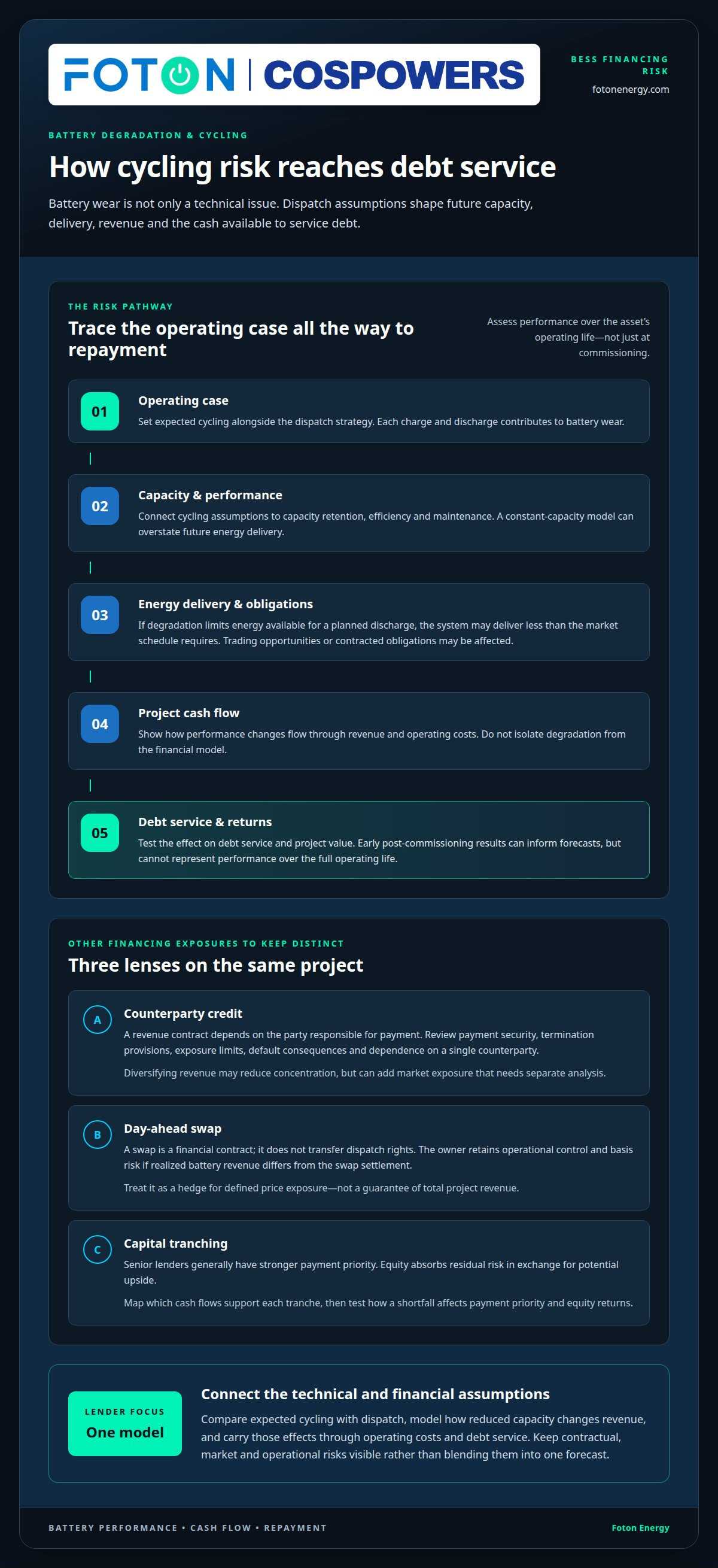
Battery performance can change long after commissioning, affecting asset value, expected returns and insurance. Cycling intensity matters because every charge and discharge contributes to wear. A model that assumes usable capacity stays constant throughout operations can overstate future energy delivery. Lenders need projections that connect dispatch assumptions with capacity retention, efficiency and maintenance. They should also distinguish a warranty’s defined performance commitments from actual operating outcomes. Post-commissioning data can help refine forecasts, but early results alone cannot represent performance over the asset’s full operating life.
Start with the operating case. Compare expected cycling with the dispatch strategy, then trace how reduced capacity could affect revenue. For example, if degradation limits the energy available for a planned discharge, the system may deliver less than the market schedule requires. That can reduce trading opportunities or affect contracted obligations. The financial model should show how performance changes flow through revenue, operating costs and debt service, rather than treating degradation as a technical issue alone.
Counterparty credit risk adds another layer. A revenue contract is only as dependable as the party responsible for payment. If an offtaker faces financial stress, even a well-designed agreement may not deliver cash on schedule. Lenders can examine payment security, termination provisions, exposure limits and the consequences of default. They should also identify whether the project depends heavily on one counterparty. A diversified revenue plan may reduce concentration, but it can introduce more market exposure that requires separate analysis.
A day-ahead swap is a financial contract; it does not transfer BESS dispatch rights. The owner retains operational control but also retains basis risk if actual battery revenues diverge from the swap settlement. For example, a swap may settle against a market reference that differs from the project’s realized prices or operating profile. Model that gap under different dispatch outcomes. Treat the swap as a hedge for defined price exposure, not as a complete guarantee of total project revenue.
Tranching separates financing by risk and return. Senior lenders generally expect stronger payment priority, while equity absorbs residual risk in exchange for potential upside. A project can also allocate exposure across contracted and merchant revenue streams, but each depends on the same battery’s operating performance. Map the cash flows that support each tranche, then test how a shortfall would affect payment priority and equity returns. This makes the path of potential losses visible instead of hiding it inside a blended forecast.
For a coherent financing view, connect three schedules: projected cycling, capacity change and cash flow. Then test how a performance shortfall could combine with counterparty default or swap basis movements. Scenarios that isolate each risk may miss how they interact. This analysis gives lenders a clearer basis for setting debt assumptions and helps equity investors understand which uncertainties remain after contractual protections.
Merchant revenue exposure and debt underwriting
Merchant income comes from selling stored electricity and services into changing markets. Prices, spreads and dispatch opportunities move with market conditions, so lenders may struggle to underwrite energy-arbitrage and ancillary-service revenues across a 10-year debt term. A practical approach to de-risking BESS investments for financiers separates contracted cash flows from merchant assumptions. This shows which income supports scheduled debt payments and which depends on future market conditions. It also clarifies how weaker revenue could affect coverage, reserves and repayment capacity.
A tolling agreement exchanges some market exposure for contracted stability. The offtaker receives dispatch rights over contracted battery capacity and assumes the associated market risk. That figure illustrates a specific agreement structure, not a universal market rate. For underwriting, focus on how payment is calculated, when it is made and what operational obligations apply to the battery.
Partial tolling can balance contracted income with retained upside. The project contracts some capacity to an offtaker and reserves the rest for merchant optimization. For example, a project could allocate one block of capacity to tolling and another to market dispatch. The contracted block can support a more predictable revenue base; the retained block remains exposed to market outcomes. Model both streams separately, including how capacity allocation affects dispatch opportunities and total project cash flow.
Debt analysis should test whether merchant proceeds can support repayment under less favorable conditions. Build scenarios around changes in energy spreads, ancillary-service availability, operating constraints and the share of capacity committed under a toll. Then assess how those conditions affect net revenue after operating costs. A lender can distinguish a project that depends on optimistic merchant income from one with contracted cash flows covering a defined portion of debt service. The remaining exposure can inform debt sizing and repayment assumptions.
Market structure can also change as storage technologies and policies evolve. In Great Britain, a larger long-duration storage rollout could reduce merchant battery build by around 11% through the early 2030s. This potential shift matters because more storage can influence market competition and merchant revenue opportunities. It does not determine an individual asset’s income, but it informs assumptions about future competition and market depth.
For de-risking BESS investments for financiers, review capacity allocation alongside the revenue model. A toll may reduce exposure, but it also limits the capacity available for independent optimization. Compare contracted cash flow with the retained merchant case, then stress each separately and together. This gives financiers a clearer view of how the structure performs if market income falls, contracted capacity remains committed or expected opportunities shift over time.
BESS capital stack design
Project costs, installed prices and financing costs vary with duration and location. Longer-duration designs, site scope, grid connection requirements, local construction conditions and perceived revenue risk all shape the capital required and its cost.
A BESS capital stack allocates funding and losses across different structures. Common components include senior debt, mezzanine financing, tax equity and sponsor equity. Senior debt typically has repayment priority, while equity absorbs residual risk and may benefit from remaining returns. The right balance depends on project cash flows, contracts, tax treatment and the risks each investor is prepared to hold. Map each funding source to its repayment terms, security and position in a downside scenario.
Tax credits can influence how much sponsor equity a project needs at financial close. Monetizing or transferring the U.S. Section 48E investment tax credit can reduce required project equity by 20-30% of project capital expenditure. Model the credit separately from operating revenue, then assess how its timing and treatment affect funding needs. Section 168 is associated with accelerated depreciation for reclassified BESS components and supporting infrastructure. These tax mechanisms can alter the funding mix, but they do not replace project cash flow or debt capacity.
Capital structures can also allocate losses through layers. In Climate Investor Two, Tier 1 public donors provide a first-loss buffer and do not expect their capital to be recouped. Tier 2 includes commercial investors and development finance institutions providing equity, with Tier 1 bearing losses up to a certain point. This example shows how a subordinated layer can absorb defined early losses before other capital is affected. Its relevance depends on the project’s funding mandate and the terms governing each layer.
Duration and location influence the financing case in different ways. A longer-duration system may require a different equipment and construction scope than a shorter-duration asset, while location shapes interconnection work and the market opportunities that support repayment. These factors affect project requirements and the risk assessment behind financing terms. Compare projects using consistent assumptions for capacity, duration, site works and revenue structure, rather than treating a cost figure from another location as directly transferable.
For financing analysis, build a sources-and-uses schedule and connect it to a downside cash-flow case. Show how senior debt, mezzanine capital, tax equity and sponsor contributions fund project costs, then trace the order in which cash supports payments and losses. Test whether projected operating cash flow supports scheduled debt service without relying on tax-credit proceeds that have not been earned. This makes funding gaps visible and helps investors understand how capital exposure changes when revenue or project delivery underperforms.
What diligence steps should lenders and investors take before financing a BESS project?
Effective diligence connects technical, commercial, financial and regulatory evidence in one financing case. Start with a risk register that names each exposure, its owner, its mitigation and its effect on cash flow. For example, link a capacity shortfall to the revenue assumptions it could change. Then trace that change through operating costs, debt service and equity returns. This reveals gaps across workstreams instead of leaving each specialist to assess risks in isolation.
Technical diligence should test whether the battery’s expected performance supports its operating model. Review capacity assumptions, dispatch patterns, degradation projections, maintenance plans and performance obligations together. Compare the model with commissioning evidence and operating data when available. Evaluate system performance after go-live, not only at handover, because issues may emerge during operations. A mismatch between assumed cycling and the operating strategy can change capacity retention and forecast energy delivery.
Commercial diligence should map each revenue source to its contract or market assumption. Identify who controls dispatch, who pays and what happens if a counterparty fails to perform. For merchant income, test underlying price and service assumptions against downside cases. For a toll or floor agreement, trace settlement terms and operational obligations into the cash-flow model. Confirm that contracted and merchant revenue are not counted twice for the same battery capacity or operating period.
Regulatory diligence should examine the policy and legal framework where the asset will operate. Risks to low-carbon infrastructure investment can arise from insufficient or contradictory enabling policies, weak legal frameworks, limited enforcement capacity or frequent regulatory changes. Record which permissions, market rules and contractual rights support the project’s assumptions. Then assess how a change in a relevant rule could affect market access, revenue eligibility or project obligations. This connects jurisdictional exposure to specific financing dependencies.
Financial diligence should reconcile the technical model, contracts and funding plan. Compare projected revenue with operating costs, debt repayment and required reserves under a downside case. Separate tax-credit proceeds from operating cash flow and show their timing distinctly. Check that each capital source has a defined role, payment priority and loss exposure. If the model assumes a particular operating pattern, trace that assumption back to dispatch rights and battery capabilities. Resolve inconsistencies before they affect debt sizing.
Bring these workstreams together in a decision record: list material findings, their financial effects and the mitigation assigned to each. This gives lenders and investors a traceable basis for financing decisions, rather than a collection of disconnected reports. Discuss BESS project diligence priorities as you align technical design with financing requirements.
Foton Energy (Foton Pty Ltd): C&I BESS
Foton Energy (Foton Pty Ltd) offers C&I BESS for commercial and industrial energy storage projects. It can be a natural next step when financiers and project stakeholders are translating performance, revenue and financing assumptions into a practical system scope. Matching the storage solution to the project’s operating requirements helps connect technical choices with the investment case.
Foton Energy also offers Utility-Scale Storage, Residential Storage Systems and Data Centre & Telco Backup. These offerings serve different applications, so the relevant option depends on the project’s use case and scale. For a C&I project, focus on how the planned storage system fits the site’s requirements and commercial objectives.
Contact Foton Energy (Foton Pty Ltd) to discuss your C&I BESS project.
Move from financing assumptions to project alignment
The next step is to turn a financing thesis into project decisions that remain coherent through development and operation. A disciplined approach to de-risking BESS investments for financiers starts by aligning the asset’s intended role, operating model and funding structure. That alignment gives stakeholders a shared basis for assessing trade-offs as the project moves forward.
Foton Energy (Foton Pty Ltd) offers C&I BESS, Residential Storage Systems and Utility-Scale Storage. These options suit different project contexts, from commercial and industrial requirements to residential and grid-scale applications. Connecting the intended use case with the right storage scope can frame a practical discussion about the project’s next development steps.
Bring your project objectives and financing priorities into that conversation. Contact Foton Energy (Foton Pty Ltd) to discuss how your storage project can move toward a more aligned investment case. A clear next step can help turn analysis into confident progress.
Frequently Asked Questions
What are the main risks for financiers investing in battery energy storage systems (BESS)?
The main risks include technical underperformance, changing market revenues, counterparty default and regulatory uncertainty. These exposures can interact: a battery operating below its assumed capability may earn less, while a contract counterparty could also fail to pay. Financiers can make these connections visible by mapping each risk to its effect on cash flow, debt repayment and asset value. Project diligence should also examine permitting, grid access and the assumptions behind the operating strategy.
What BESS revenue streams and offtake structures are most bankable in the United States?
Bankability depends on how clearly revenue can be forecast, contracted and matched to payment obligations. Energy arbitrage, ancillary services and contracted offtake can each contribute, but their reliability depends on market rules, dispatch rights and counterparty strength. For example, a contract may provide clearer payment terms than fully merchant operation while limiting the owner’s ability to capture market upside. Assess each income source separately before combining them in a project forecast.
What debt, equity, and project-finance terms are typical for U.S. BESS projects?
There is no single set of debt, equity or project-finance terms that applies to every U.S. BESS project. Financing structures reflect contracted revenues, merchant exposure, technology, development stage, tax-credit treatment and risk allocation. A capital plan may combine senior debt, mezzanine financing, tax equity and sponsor equity. Compare proposed terms by repayment priority, security, covenants and downside protections, rather than relying on a generic market template.
How do battery warranties, degradation guarantees, and augmentation plans affect BESS financing?
These provisions shape how lenders assess the battery’s expected capability over its operating life. A warranty defines covered performance obligations and remedies; a degradation guarantee sets a performance threshold under specified conditions. An augmentation plan explains how the project will address capacity changes over time. For example, the financing model should reflect when additional equipment or replacement capacity may be needed and how that affects cash flow, operations and contracted commitments.
How can BESS financiers assess merchant revenue and price volatility risk?
Financiers can assess merchant exposure by separating revenue streams and testing how market-price changes affect each one. Examine assumptions for energy arbitrage, ancillary services, dispatch availability and operating constraints. Then model combinations of weaker spreads and fewer market opportunities, rather than changing one input at a time. Compare the results with contracted income and scheduled debt payments. This reveals which assumptions drive repayment capacity and where the project remains sensitive to price movements.
What insurance, performance guarantees, and liquidated damages can reduce BESS investment risk?
Insurance, guarantees and liquidated damages address different exposures, so their scope should be clearly distinguished. Performance guarantees set contractual outcomes, while liquidated damages provide an agreed remedy when specified obligations are missed. Insurance responds to covered events under policy terms. Review exclusions, claim evidence, payment limits and links to equipment warranties. Align these protections with the project’s technical specifications and contracts so that a performance shortfall has a defined remedy and responsible party.


